Cash Budget
Short-term cash-flow forecast used to plan liquidity, borrowing needs, covenant headroom, and operating funding gaps.
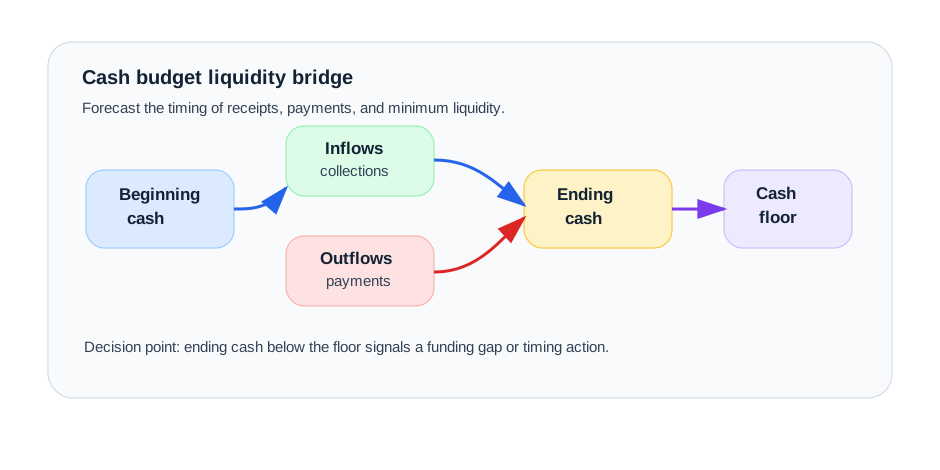
A cash budget is a short-term forecast of cash inflows, cash outflows, and ending cash balance. It helps a company test whether it can meet payroll, supplier payments, debt service, taxes, capital spending, and minimum liquidity requirements.
Unlike an income statement budget, a cash budget focuses on when money actually enters and leaves the bank account. That timing difference is why a profitable company can still face a liquidity problem.
Basic Formula
The core formula is:
A practical cash budget also compares ending cash with a minimum cash floor:
If the result is negative, the company needs a funding action, expense delay, working-capital improvement, or revised operating plan.
What A Cash Budget Includes
Cash budgets usually cover weekly, monthly, or quarterly periods. The shorter the liquidity runway, the more frequently the budget should be refreshed.
| Budget Line | Typical Inputs | Why It Matters |
|---|---|---|
| Beginning cash | Bank balances and treasury reports. | Sets the liquidity starting point. |
| Customer receipts | Collections forecast, sales terms, overdue receivables. | Converts revenue expectations into cash timing. |
| Operating payments | Payroll, rent, suppliers, utilities, taxes, and insurance. | Shows the cash cost of keeping operations running. |
| Capital spending | Approved capex, deposits, milestone payments. | Identifies investment cash needs. |
| Financing flows | Debt draws, repayments, interest, equity proceeds, dividends. | Shows whether external funding is needed or available. |
| Minimum cash floor | Treasury policy, lender covenants, or management buffer. | Defines the point where a funding gap becomes urgent. |
The cash budget should reconcile to the operating budget, capital expenditure plan, debt schedule, and working-capital forecast.
Worked Example
Suppose a business starts the month with $5,000 of cash. It expects $12,000 of receipts and $9,000 of payments.
If management requires a minimum cash balance of $6,000, the budget shows a $2,000 surplus:
The business can operate without immediate borrowing under this base case. A downside case with slower collections or higher supplier payments may produce a different result.
Cash Budget vs. Operating Budget
Operating Budget and cash budget are connected but not interchangeable.
| Question | Operating Budget | Cash Budget |
|---|---|---|
| What does it forecast? | Revenue, expenses, and operating profit. | Cash receipts, payments, and ending liquidity. |
| Accounting basis | Usually accrual accounting. | Cash timing. |
| Main risk shown | Margin, cost control, and operating performance. | Liquidity gaps, borrowing needs, and payment timing. |
| Key users | FP&A, operations, management, board. | Treasury, CFO, lenders, board, restructuring advisors. |
The operating budget may show profit while the cash budget shows a temporary cash shortfall because customers pay late, inventory builds, or capex is front-loaded.
Public Source Checks
Useful public sources can support company-context and benchmark inputs:
- SEC EDGAR Company Search: Filings for liquidity discussion, debt maturities, capital expenditures, working-capital trends, and management discussion.
- SEC Financial Statement Data Sets: Structured XBRL-derived statement data for cash, receivables, payables, capex, debt, and operating cash-flow context.
- Federal Reserve H.15 Selected Interest Rates: Market-rate context for short-term borrowing cost assumptions.
Public filings can support benchmark context, but the cash budget itself should tie to bank balances, customer collections, supplier schedules, payroll calendars, tax dates, debt terms, and the current forecast.
Scenario Question
A company expects strong quarterly profit, but the cash budget shows ending cash below the lender’s minimum liquidity covenant for two weeks because a large customer pays after payroll and inventory purchases.
Answer: The cash budget is identifying a timing problem, not necessarily a profitability problem. Management may need to accelerate collections, draw on a revolver, delay discretionary payments, adjust inventory purchases, or negotiate timing before the covenant issue occurs.
Quiz
When Cash Budgets Mislead
A cash budget can mislead when:
- customer collection timing is too optimistic
- supplier, payroll, tax, or debt-service dates are missing
- minimum cash requirements are ignored
- capex deposits and milestone payments are excluded
- borrowing availability is assumed without checking covenants
- seasonality is averaged away
- one monthly total hides weekly cash shortages
- the cash budget is not reconciled to the operating budget and debt schedule
Liquidity analysis should focus on the lowest cash point, not just the period-end balance.
Review Checklist
Before relying on a cash budget, document:
- forecast period and update frequency
- beginning cash source and bank reconciliation date
- customer collection assumptions and overdue receivables
- payroll, supplier, tax, rent, insurance, and debt-service dates
- capex and one-time transaction payments
- minimum cash floor or covenant requirement
- borrowing availability and draw conditions
- downside case for delayed receipts or higher outflows
- reconciliation to operating budget, working capital forecast, and debt schedule
Related Terms
- Operating Budget: The accrual-based revenue and expense plan that cash budgeting converts into liquidity timing.
- Cash Inflows and Outflows: Cash receipts and payments expected during the budget period.
- Liquidity Management: The broader treasury process behind cash budgets.
- Runway: The period a company can keep operating before cash is exhausted.
- Capital Expenditure Budget: The capex plan that often drives major cash outflows.
- Cash Conversion Cycle: A working-capital timing measure that helps explain cash-budget pressure.