Runway
Liquidity measure estimating how long a company can operate before current cash is exhausted at its net burn rate.
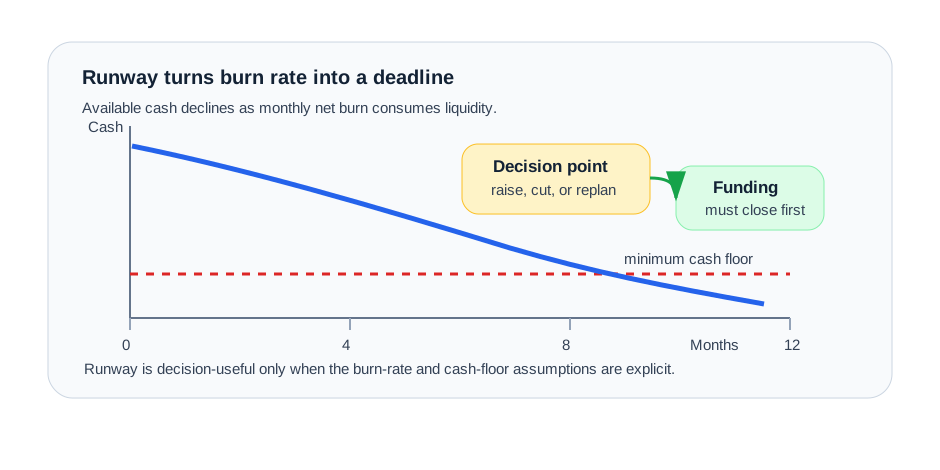
Runway is the amount of time a company can keep operating before it runs out of available cash at its current or forecast Burn Rate. It is most common in startup finance, turnaround planning, liquidity management, venture funding, and board reporting.
Runway is a liquidity metric, not a valuation metric by itself. A company with longer runway has more time to raise capital, cut costs, improve collections, grow revenue, or change strategy before cash becomes the binding constraint.
Basic Formula
The simple formula is:
Net burn is:
If monthly inflows are greater than outflows, the company may be cash-flow positive and ordinary runway may not be the right framing. Analysts should still test minimum cash requirements, working-capital timing, debt service, and one-time payments.
Gross Burn vs. Net Burn
Runway depends heavily on which burn-rate definition is used.
| Measure | Formula | Best Use |
|---|---|---|
| Gross burn | Monthly cash operating outflows. | Shows the cash cost of running the business before receipts. |
| Net burn | Monthly cash outflows minus monthly cash inflows. | Shows how quickly cash is being consumed after operating receipts. |
| Adjusted burn | Net burn adjusted for one-time items or planned changes. | Useful for board forecasts, but assumptions must be visible. |
Gross burn is useful for cost control. Net burn is usually more useful for liquidity runway.
Worked Example
Suppose a company has $500,000 of available cash and net burn of $50,000 per month.
If the company expects to raise capital in six months, the base case appears workable. If burn rises to $75,000 per month, runway falls:
That shorter runway may force earlier fundraising, cost cuts, customer-collection work, or a smaller capital plan.
What Changes Runway
Runway can move quickly when the cash forecast changes.
| Driver | Effect On Runway | Analyst Check |
|---|---|---|
| Customer collections slow | Shortens runway. | Test receivables aging and collection timing. |
| Hiring accelerates | Shortens runway. | Confirm start dates, salaries, benefits, and contractors. |
| Revenue growth converts to cash | Extends runway. | Distinguish bookings, revenue, and cash receipts. |
| Supplier terms improve | Extends runway temporarily. | Check whether payables stretch is sustainable. |
| One-time capex or legal costs appear | Shortens runway. | Include deposits, retainers, taxes, and milestone payments. |
| New debt or equity funding closes | Extends runway. | Use closed financing, not hoped-for financing, in the base case. |
The most useful runway analysis is usually a sensitivity table, not a single point estimate.
Public Source Checks
Useful public sources can support liquidity context for public companies and market-rate assumptions:
- SEC EDGAR Company Search: Filings for liquidity discussion, going-concern language, debt maturities, cash balances, risk factors, and management discussion.
- SEC Financial Statement Data Sets: Structured XBRL-derived statement data for cash, operating cash flow, debt, current liabilities, and equity issuance context.
- Federal Reserve H.15 Selected Interest Rates: Market-rate context when short-term borrowing cost or refinancing assumptions affect runway.
Public sources help with external context. A real runway calculation still needs the company’s current cash balance, bank reconciliation, forecast cash receipts, payment calendar, debt terms, payroll plan, and board-approved forecast.
Scenario Question
A startup reports 12 months of runway using planned cost cuts that have not been approved. Without those cuts, cash lasts only 7 months. Management wants to start fundraising in six months.
Answer: The decision should be based on the defensible case, not the optimistic label. The board should show both scenarios, confirm which savings are committed, and decide whether fundraising or expense action must begin earlier.
Quiz
When Runway Misleads
Runway can mislead when:
- gross burn and net burn are mixed without explanation
- expected financing is treated as if it has already closed
- one-time cash outflows are excluded
- cash receipts are forecast from revenue instead of collection timing
- restricted cash is included as available cash
- monthly averages hide near-term weekly cash gaps
- cost cuts are assumed before they are approved or executed
- debt covenants or minimum cash requirements are ignored
The right question is not only “how many months?” It is “what action must happen before the cash constraint becomes binding?”
Review Checklist
Before relying on runway, document:
- cash balance source and date
- whether cash is unrestricted and available
- gross burn, net burn, and adjusted burn definitions
- forecast cash receipts and collection timing
- payroll, supplier, tax, debt-service, capex, and one-time payments
- minimum cash floor or covenant requirement
- approved versus unapproved cost cuts
- closed financing versus planned financing
- base, downside, and stress-case runway
- decision date for fundraising, cost action, or liquidity contingency plan
Related Terms
- Burn Rate: The rate at which cash is consumed.
- Cash Budget: The forecast that usually supports runway analysis.
- Liquidity Management: The broader treasury discipline behind runway planning.
- Liquidity: The ability to access cash or convert assets to cash.
- Operating Budget: The operating plan that drives many burn-rate assumptions.
- Cash Conversion Cycle: A working-capital timing measure that can explain runway pressure.
- Variable Expense: Activity-driven costs that may change when a company tries to extend runway.