All-Equity Net Present Value
All-equity NPV values a project's unlevered operating cash flows as if financed without debt, separating asset economics from financing effects.
All-equity net present value, also called unlevered NPV, estimates a project’s value as if it were financed entirely with equity and had no project-level debt. It discounts unlevered after-tax operating cash flows at a required return for the project’s business risk without the additional financial risk created by borrowing.
The method separates two questions: whether the operating asset creates value on a stand-alone basis, and whether financing adds benefits or costs. It is often the first component of an adjusted present value (APV) analysis.
Terminology is not standardized. A source using “all-equity NPV” may apply a different cash-flow or rate convention, so verify whether its calculation is genuinely unlevered before comparing results.
Key Takeaways
- All-equity NPV excludes interest, principal payments, and debt tax shields from project cash flow.
- The discount rate is the unlevered cost of capital, sometimes called the all-equity cost of capital, not the sponsor’s current levered cost of equity.
- A positive result means the estimated operating benefits exceed the investment and required unlevered return under the assumptions.
- Financing can still change total value through tax effects, subsidies, issuance costs, guarantees, distress risk, or restrictions.
- Cash-flow and discount-rate definitions must describe the same project risk, currency, tax basis, and claimant level.
All-Equity NPV Formula
For a finite project:
Where:
- \(I_0\) is the initial project investment;
- \(FCFF_t\) is unlevered free cash flow in period \(t\);
- \(r_U\) is the unlevered required return for the project’s operating risk; and
- \(TV_n\) is terminal, residual, or disposal value at the end of the explicit period, if applicable.
For a project with no continuing or disposal value, omit the terminal-value term. Later capital outlays should be included in their actual periods rather than forced into \(I_0\).
Building Unlevered Project Cash Flow
A common free cash flow to the firm form is:
Project analysis should use incremental cash flow: amounts that change if the project is accepted. Depending on the facts, include:
- purchase, construction, installation, testing, and startup cash outlays;
- incremental revenue and operating costs;
- working-capital investment and later recovery;
- taxes on project operating income and disposals;
- maintenance and replacement expenditure;
- opportunity costs of assets already owned;
- side effects on existing products or operations; and
- residual value, shutdown cost, or remediation obligations.
Exclude debt proceeds, interest, principal repayment, and the interest tax shield from the unlevered operating cash flow. Those financing effects are analyzed separately. [Sunk costs] already incurred and unaffected by the decision are also excluded, although their accounting treatment may remain visible in reported results.
Choosing the Unlevered Discount Rate
The all-equity rate should reflect the project’s operating risk without leverage. Analysts may estimate it from:
- returns required for comparable unlevered assets;
- peer-company betas adjusted to remove financial leverage and then matched to project risk;
- a project-specific opportunity cost of capital; or
- a corporate unlevered rate adjusted for material differences in country, currency, product, maturity, or cyclicality.
The unlevered cost of capital is not necessarily the company’s current cost of equity. Equity in a leveraged company bears both operating and financing risk, so using that levered equity rate to discount debt-free project cash flow can understate value.
A lower all-equity rate is not justified merely because the project will use no debt. The project still carries operating uncertainty. Likewise, a risky project should not inherit a low company-wide rate simply because a diversified sponsor can fund it.
Worked Example
Assume a project requires $5.0 million today and is expected to produce the following unlevered cash flows:
| Year | Operating FCFF | Terminal or recovery cash | Total cash flow |
|---|---|---|---|
| 0 | ($5.0 million) | ||
| 1 | $1.7 million | $1.7 million | |
| 2 | $2.0 million | $2.0 million | |
| 3 | $2.3 million | $0.4 million | $2.7 million |
At an estimated unlevered required return of 10%, the present value of future cash flows is:
All-equity NPV is therefore:
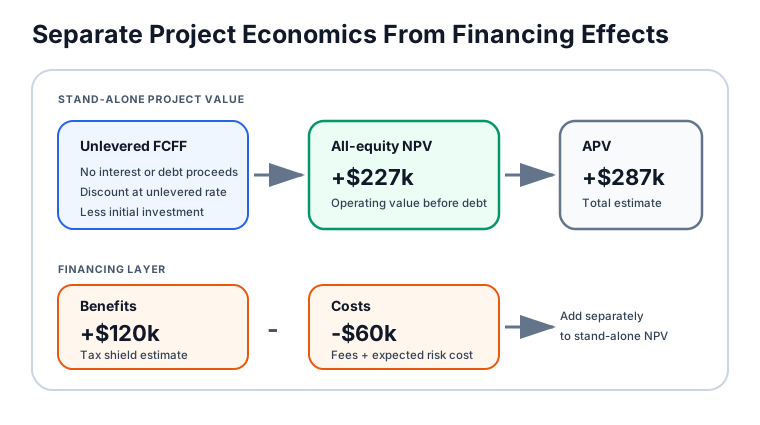
The project has an estimated positive stand-alone NPV of about $227,000. This result does not yet include debt tax benefits, financing fees, subsidized borrowing, guarantees, or expected distress costs.
From All-Equity NPV to Adjusted Present Value
A simplified APV bridge is:
Possible financing benefits include interest tax shields or below-market subsidized funding. Possible costs include issuance fees, expected distress costs, restrictive financing terms, hedging costs, and transaction expenses. Each item needs its own cash-flow and risk analysis.
Suppose the example project has $120,000 of estimated present-value tax benefits from planned debt, $35,000 of financing fees, and $25,000 of expected financing-related costs:
The example illustrates the structure, not a universal tax-shield formula. Tax deductibility, loss carryforwards, changing debt balances, default probability, and jurisdiction can materially alter the financing value.
All-Equity NPV vs. WACC and Equity NPV
| Approach | Cash flow | Discount rate | Financing treatment |
|---|---|---|---|
| All-equity NPV | Unlevered project FCFF | Unlevered cost of capital | Financing effects excluded initially |
| WACC NPV | FCFF before debt service | WACC consistent with expected leverage | Tax and financing mix reflected mainly in WACC |
| Equity NPV | Cash flow after debt service | Levered cost of equity | Debt proceeds, interest, principal, and equity investment reflected in equity cash flow |
| APV | Unlevered project value plus separate financing effects | Rate matched to each component | Benefits and costs valued explicitly |
These approaches should produce consistent values when cash flows, taxes, leverage, and discount rates are modeled consistently. Differences often reveal mismatched assumptions rather than a superior formula.
All-equity NPV can be especially useful when leverage changes substantially over the project’s life, financing is subsidized, or financing side effects are material enough to model separately. A conventional WACC approach may be simpler when leverage is stable and the required assumptions are supportable.
Why Financing Still Matters
A positive all-equity NPV does not make financing irrelevant. Financing can affect:
- total value through taxes and transaction costs;
- liquidity and the ability to complete the project;
- default probability and expected distress cost;
- cash available to different claimants;
- covenants, collateral, and operating flexibility;
- currency or refinancing exposure; and
- ownership dilution and control.
Financing also affects whether a project is feasible for a constrained company. A valuable stand-alone asset can still be rejected or delayed when the organization lacks cash, borrowing capacity, implementation resources, or permission under existing agreements.
Sensitivity and Decision Review
All-equity NPV is an estimate, not a fact. Test at least the assumptions that can materially change cash flow or the unlevered rate:
- sales volume, price, and ramp timing;
- operating margin and input costs;
- construction cost and completion date;
- working-capital requirement;
- maintenance and replacement spending;
- useful life and terminal value;
- tax assumptions;
- project risk and discount rate; and
- abandonment, delay, or expansion options.
Use sensitivity analysis to isolate important inputs and scenario analysis to preserve relationships among volume, price, cost, timing, and financing conditions.
Common Mistakes
- Discounting unlevered FCFF at the sponsor’s levered cost of equity.
- Including interest expense in project cash flow while also using a financing-adjusted discount rate.
- Counting debt proceeds as an operating project benefit.
- Omitting working capital, maintenance CapEx, shutdown cost, or terminal recovery.
- Using accounting profit instead of incremental cash flow.
- Applying the current company’s risk to a project with different operating or country exposure.
- Adding a tax shield that may not be usable because taxable income is insufficient.
- Assuming a positive all-equity NPV guarantees funding or execution.
- Comparing all-equity and WACC NPVs without reconciling leverage and tax assumptions.
- Treating a positive base case as sufficient without sensitivity or scenario analysis.
Authority and Further Reading
- Aswath Damodaran: Introduction to Valuation distinguishes firm cash flow, equity cash flow, cost of capital, cost of equity, and the adjusted present value approach.
- Aswath Damodaran: The Adjusted Present Value Approach explains valuing an unlevered firm first and then adding financing benefits and costs separately.
Related Terms
- Net Present Value: Present value of project benefits less present value of project costs.
- Present Value: Measurement-date equivalent of future cash flows.
- Unlevered Cost of Capital: Required return used for debt-free operating cash flow.
- Free Cash Flow to the Firm: Cash flow available to debt and equity providers before financing distributions.
- Incremental Cash Flow: Cash flow that changes because a project is accepted.
FAQs
Is all-equity NPV the same as equity value?
Why not use the company's current cost of equity?
Does positive all-equity NPV mean debt will improve the project?
This page provides general financial education, not personalized investment, financing, tax, or legal advice.