Free Cash Flow
Cash a business generates after operating needs and capital investment, widely used in valuation and capital allocation.
Free cash flow (FCF) is a nonstandard cash-flow measure that commonly equals operating cash flow minus capital expenditures. It helps show how much cash remains after a defined level of investment, but the formula varies and the result may still be needed for debt service, acquisitions, leases, or other commitments.
For that reason, an FCF number is useful only when its calculation and reconciliation are clear. It should not be assumed to equal cash available for dividends, buybacks, or other discretionary uses.
Key Takeaways
- The common shortcut is operating cash flow minus capital expenditures.
- FCF is not a uniformly defined accounting subtotal, so issuer calculations can differ.
- Total capex, maintenance capex, capitalized software, and acquired assets may be treated differently.
- Positive FCF does not prove that all debt, lease, pension, or acquisition obligations are funded.
- One period can be distorted by working-capital timing, delayed investment, or asset sales.
- FCFF and FCFE are valuation-specific measures and should not be used interchangeably with a general issuer-defined FCF metric.
Common Formula
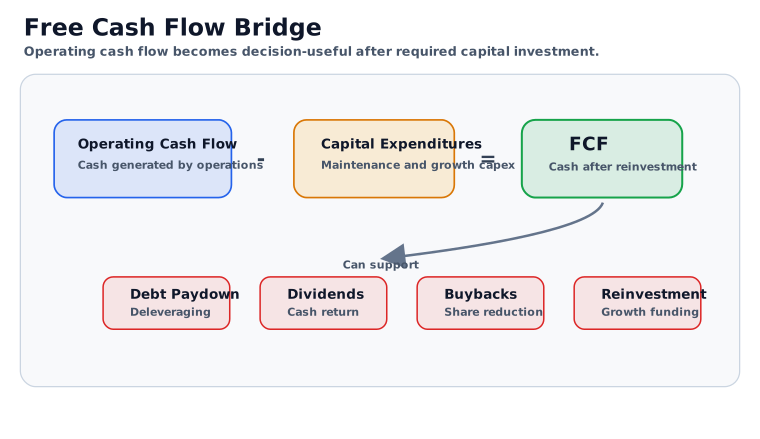
This formula is a starting point, not a universal rule. A company may subtract purchases of property, plant, and equipment only, while an analyst may also subtract capitalized software or other recurring investment. The calculation should state whether capex is shown as a positive outflow or a negative cash-flow statement amount.
Worked Example: Two Reasonable FCF Definitions
Assume a company reports:
- $12.4 million of cash flow from operating activities
- $4.1 million of purchases of property, plant, and equipment
- $0.8 million of capitalized software spending
- $1.2 million of mandatory debt principal due during the year
If the company’s stated definition subtracts only property, plant, and equipment purchases:
An analyst who treats recurring capitalized software as investment could calculate:
Neither number deducts the $1.2 million principal payment. Cash after that mandatory payment would be lower, but it should be labeled separately rather than silently changing the FCF formula. The example shows why the definition and intended use matter as much as the headline number.
Free Cash Flow, FCFF, and FCFE
| Measure | Financing perspective | Common use | Important boundary |
|---|---|---|---|
| General FCF | Depends on stated formula | Liquidity review and cash conversion | May include interest in operating cash flow and omit principal |
| FCFF | Before discretionary debt and equity payments | Enterprise-value DCF | Must be discounted at a firm-level required return |
| FCFE | After net debt financing | Equity-value DCF | Sensitive to borrowing and repayment assumptions |
A valuation model must match the cash-flow claim with the discount rate and value being estimated. A general issuer-defined FCF measure cannot be inserted into an enterprise or equity DCF without checking its financing treatment.
FCF vs. Earnings and EBITDA
| Measure | Main basis | Major cash-flow items not directly shown |
|---|---|---|
| Net income | Accrual profit after recognized expenses and taxes | Timing of receivables, inventory, payables, and capital investment |
| EBITDA | Earnings before interest, taxes, depreciation, and amortization | Taxes, working capital, capital spending, interest, and principal |
| General FCF | Cash measure after defined capex | Items omitted by the stated formula, often including debt principal and acquisitions |
A profitable business can have negative FCF when it builds inventory, extends customer credit, or invests heavily. Conversely, FCF can be temporarily high when working capital releases cash or management delays necessary spending.
How to Reconcile FCF
- Start with the exact operating cash flow reported in the cash-flow statement.
- Identify every capital-spending line included in the issuer’s reconciliation.
- Compare property and equipment purchases with capitalized software, content, development, or contract costs.
- Separate recurring investment from acquisitions and financial-asset purchases.
- Review working-capital movements and determine whether they are sustainable.
- Identify cash interest, taxes, leases, pensions, restructuring, and legal payments already included in operating cash flow.
- List principal, acquisitions, dividends, buybacks, and other uses not deducted from FCF.
- Apply one definition consistently across periods and explain any change.
Maintenance vs. Growth Capex
Analysts sometimes subtract estimated maintenance capex rather than total capex. That can help assess steady-state cash generation, but maintenance capex is rarely a separately audited line and can be difficult to estimate.
Classifying spending as “growth” does not make it optional. A company may need growth investment to preserve competitive position, satisfy contracts, or replace a declining product. Compare management’s classification with asset age, depreciation, capacity, unit growth, and historical replacement cycles.
Cash-Flow Quality Checks
- Receivables: Is operating cash flow supported by collections or by slower revenue growth?
- Inventory: Is cash released through durable efficiency or temporary destocking?
- Payables: Is the company extending payment terms beyond a sustainable level?
- Capex: Is spending below depreciation because assets are efficient or because replacement is deferred?
- Capitalization: Are operating costs being moved into capitalized assets?
- Asset sales: Are proceeds included in a custom cash measure even though they are not recurring operations?
- Stock compensation: Does cash generation coexist with material dilution?
- Factoring: Have receivable sales accelerated cash without improving underlying economics?
Valuation and Credit Use
FCF trends can inform valuation, debt capacity, and capital allocation, but the measure must be adapted to the question. Enterprise valuation generally uses FCFF, equity valuation may use FCFE, and credit analysis focuses on cash available for contractual debt service.
Forecasts should connect growth with required working capital and capital spending. A model that raises revenue without funding the related reinvestment can overstate future cash flow and terminal value.
Risks and Common Mistakes
- Comparing companies without reconciling different FCF definitions.
- Calling FCF discretionary cash while ignoring mandatory principal or other commitments.
- Subtracting only maintenance capex without a supportable estimate.
- Treating a working-capital release as recurring operating performance.
- Excluding normal cash costs because management labels them unusual.
- Ignoring capitalized software, content, or development spending.
- Using FCF per share as though it were a standardized accounting measure.
- Matching a levered cash flow with WACC or an unlevered cash flow with the cost of equity.
Free cash flow is a supplemental analytical measure, not a substitute for the complete financial statements. This article is educational and is not accounting, credit, tax, valuation, or investment advice.
Authoritative Sources
- SEC: Non-GAAP Financial Measures, including Free Cash Flow
- SEC: Financial Statement Data Sets
- SEC: EDGAR Application Programming Interfaces
- OpenStax: Statement of Cash Flows and Financing Activities
Related Terms
- Operating Cash Flow is the common reported starting point for general FCF.
- Capital Expenditure is the investment outflow commonly deducted.
- Free Cash Flow to the Firm is an unlevered valuation cash flow.
- Free Cash Flow to Equity is a levered equity valuation cash flow.
- Discounted Cash Flow converts forecast cash flows into a present-value estimate.
- Terminal Value captures value beyond an explicit forecast under stated assumptions.