Taking Delivery
Taking delivery settles a physically delivered futures position through payment and receipt of the commodity or an exchange-approved delivery instrument.
Taking delivery means fulfilling the long side of a physically delivered futures contract by paying the required invoice and accepting the commodity, currency, security, or exchange-approved delivery instrument specified by the contract. In many commodity markets, the long first receives title through a warehouse receipt, shipping certificate, or warrant rather than arranging an immediate truck, railcar, pipeline movement, or warehouse withdrawal.
Delivery rules are product-specific. The exchange rulebook determines the eligible grade, location, timing, delivery instrument, invoice calculation, assignment process, and operational deadlines.
Key Takeaways
- Only contracts designated for physical delivery can require delivery of the underlying asset or a delivery instrument.
- A long position remaining open into the applicable delivery period may be assigned to take delivery.
- The long must generally fund the full invoice value, not merely maintain futures margin.
- Delivery often transfers title or control before the buyer physically moves the commodity.
- First-notice day, last-trade day, position day, and delivery day differ by product.
- Brokers and clearing firms may impose earlier close-out or funding deadlines than the exchange.
- Cash-settled futures end through a final cash payment and do not create a physical-delivery obligation.
- A long generally cannot assume which eligible grade, location, or security the short will deliver when the contract permits choices.
- Futures margin should not be subtracted from the delivery invoice unless the clearing and broker records explicitly show how funds are applied or released.
Spot Delivery Month
The spot delivery month, also called the spot month or current delivery month, is the contract month that matures and becomes deliverable during the present month. The nearby or front month is the nearest traded contract month. These labels often point to the same contract once delivery is current, but they are not universally interchangeable.
For a physically delivered contract, the spot month is when delivery procedures become current. For a cash-settled contract, the expiring month approaches final trading and the contract’s final settlement calculation. Exchanges list product-specific contract months, and the most actively traded contract can shift to a deferred month before the nearby contract expires.
| Issue | Why the spot month matters |
|---|---|
| Convergence | Futures should approach the relevant cash or final settlement value as expiration nears. |
| Notice and assignment | A physically delivered position may enter the notice and assignment process before its last trading day. |
| Liquidity | Volume and open interest often migrate to a later month as participants roll exposure. |
| Position controls | Spot-month position limits, accountability levels, or broker restrictions may differ from deferred months. |
| Funding | A long assigned to take delivery may need the full invoice amount, not only futures margin. |
| Final settlement | A cash-settled contract can become sensitive to the benchmark methodology and observation window. |
Do not use “expiration,” “last trading day,” “first notice day,” and “delivery day” interchangeably. The order and timing vary by contract. A trader that does not intend to participate in delivery should know the broker’s close-out deadline, which may be earlier than the exchange deadline.
Spot-Month Example
Assume a commercial firm uses a nearby wheat futures contract only as a financial hedge and plans to sell its grain to a local elevator. As the contract enters its spot month, the firm may close or roll the futures before notice exposure begins. Leaving the position open without checking the current rulebook could turn a price hedge into an invoice, assignment, storage, or logistics obligation.
For a cash-settled equity-index future, there is no warehouse or commodity transfer. The spot month still matters because liquidity, final trading, margin, and the official settlement calculation can affect the position.
Physical Delivery vs. Cash Settlement
| Feature | Physical delivery | Cash settlement |
|---|---|---|
| Final obligation | Transfer commodity, currency, security, or delivery instrument | Pay or receive final cash difference |
| Long position | Takes delivery and pays invoice | Receives or pays final variation amount |
| Short position | Makes delivery under contract rules | Receives or pays final variation amount |
| Operational needs | Delivery account, funding, approved facilities or counterparties | Accurate final-settlement reference and cash capacity |
| Main risk | Assignment, funding, storage, quality, location, and load-out | Benchmark, final-price, and cash-settlement risk |
All futures are marked to market under their clearing rules, but final settlement can still be physical or financial.
Common Delivery Process
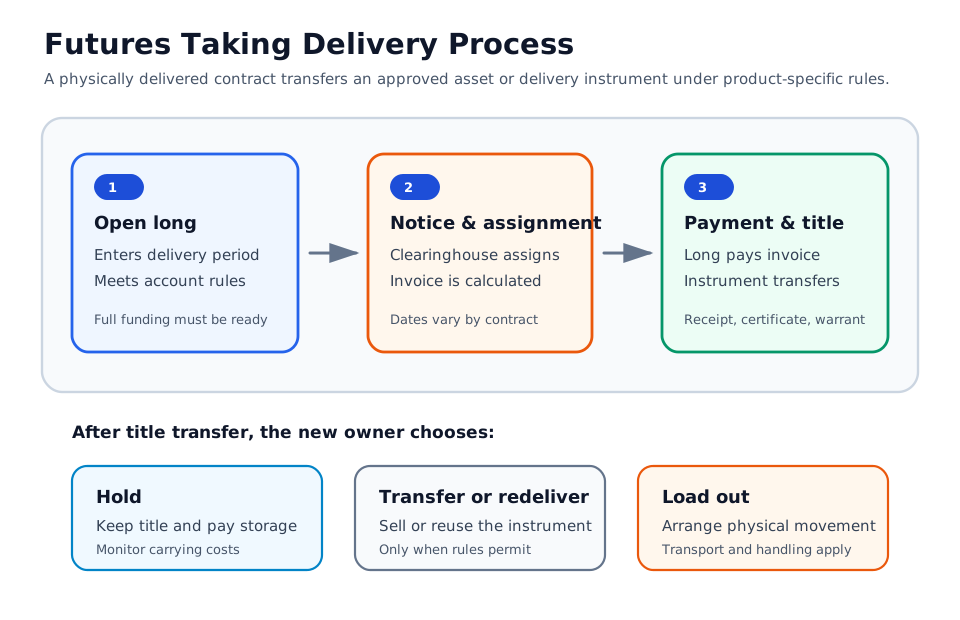
The exact sequence varies, but a physically delivered commodity contract often follows this pattern:
- Position or intention: The short that intends to deliver notifies its clearing firm or clearinghouse under the product rules.
- Notice and assignment: The clearinghouse assigns a delivery notice to an eligible long position.
- Invoice: The clearinghouse or clearing members calculate the amount owed using the contract’s settlement price and required adjustments.
- Payment and title transfer: Funds move from the long side, while the delivery instrument or asset title moves from the short side.
- Post-delivery action: The new owner can hold, sell, redeliver, transfer, or request physical load-out if the rules and facility permit.
The process is managed through futures commission merchants, clearing members, the clearinghouse, and approved delivery facilities. A customer normally cannot complete exchange delivery by dealing directly with an unknown counterparty.
Long and Short Responsibilities
| Party | Core obligation | Evidence to verify |
|---|---|---|
| Long taking delivery | Provide funds and accept assigned delivery | Delivery notice, invoice, account instructions, receipt or warrant |
| Short making delivery | Tender eligible asset or delivery instrument | Grade, location, registration, title, and notice documents |
| Clearing member | Submit notices, funds, positions, and instructions | Clearing records and customer delivery account |
| Clearinghouse | Match or assign parties and process settlement | Exchange delivery reports and rulebook |
| Approved facility | Hold or make available eligible commodity | Warehouse receipt, shipping certificate, warrant, or registry record |
The clearinghouse controls the contractual settlement process; it does not necessarily operate the warehouse, pipeline, vault, or transport system.
Delivery Instruments
| Instrument | What it generally represents | Typical next step |
|---|---|---|
| Warehouse receipt | Title to identified eligible commodity already held in approved storage | Hold and pay storage, sell the receipt, redeliver, or request load-out |
| Shipping certificate | Facility commitment to provide eligible commodity under specified rules | Retain, transfer, redeliver, or call for shipment |
| Warrant | Title or control record commonly used for exchange-approved metal | Hold in depository, transfer, redeliver, or withdraw |
| Electronic registry entry | Ownership or entitlement recorded in an approved system | Transfer or retire according to registry and contract rules |
The delivery instrument is not the same as the delivery notice. The notice communicates the intent and assignment; the instrument transfers the specified title or entitlement.
How Delivery Differs Across Markets
The phrase “physical delivery” covers several operational models:
| Market type | What the long may receive | Important control |
|---|---|---|
| Stored agricultural commodity | Warehouse receipt or shipping certificate | Grade, location, storage, load-out, and facility rules |
| Exchange-approved metal | Warrant or depository entitlement | Brand, form, weight tolerance, storage, and withdrawal |
| Government bond future | Eligible security selected under delivery and conversion-factor rules | Deliverable basket, invoice, accrued interest, and cheapest-to-deliver economics |
| Deliverable currency future | Specified currency against payment in the quote currency | Bank instructions, value date, cutoffs, funding, and settlement system |
| Energy contract | Pipeline, terminal, transfer, or other product-specific obligation | Delivery location, scheduling, capacity, quality, and nomination rules |
Not every contract in one market follows the same method. Some energy, metal, agricultural, rate, or currency products are cash settled. The exact product code and contract month must be checked before any delivery assumption is made.
For Bond Futures, conversion factors and the short’s choice among eligible securities affect the invoice and the asset received. For stored commodities, a title instrument can transfer while the goods remain at the approved facility.
Hypothetical Invoice Example
Assume a simplified physically delivered contract has:
| Input | Amount |
|---|---|
| Contract quantity | 1,000 units |
| Delivery invoice price | $50.00 per unit |
| Contracts assigned | 1 |
Ignoring grade, location, conversion-factor, accrued-interest, tax, and fee adjustments:
1Invoice amount = 1 contract x 1,000 units x $50.00
2               = $50,000
The long may have posted only a fraction of that amount as futures margin before delivery. Taking delivery can therefore create a much larger immediate funding requirement.
If storage costs $0.04 per unit each month, the new owner would incur another hypothetical $40 monthly while the commodity remains stored. Load-out, insurance, transport, inspection, and handling could add further costs.
Funding Timeline Example
Assume the long had maintained $6,000 of futures margin before assignment. The delivery invoice is still $50,000 under the simplified example. The trader should not assume that only $44,000 of additional funding is required.
Margin and invoice payment serve different purposes. Depending on the clearing and broker process:
- variation gains and losses may already have been settled;
- futures margin may remain restricted until the position is completed;
- invoice funds may be due before margin is released;
- the broker may require an additional liquidity buffer; and
- fees, storage, or other charges may be collected separately.
The account could therefore need access to the full $50,000 invoice plus costs even while $6,000 remains associated with the futures position. Only the actual clearing and broker statement establishes how funds are applied.
Delivery-Cost Reconciliation
Using the same hypothetical contract, assume the long incurs:
| Item | Amount |
|---|---|
| Delivery invoice | $50,000 |
| Clearing and delivery fees | $120 |
| First month of storage | $40 |
| Inspection and handling | $180 |
| Estimated transport | $900 |
| Total initial cash requirement | $51,240 |
The effective cost is $51.24 per unit before tax and financing:
1$51,240 / 1,000 units = $51.24 per unit
Comparing only the $50.00 invoice price with a local cash quote would omit $1.24 per unit in this simplified example. Actual costs can differ materially by asset, facility, route, timing, account, and contract.
Delivery Options and Invoice Adjustments
Some futures contracts grant the short choices over eligible grade, location, timing, or asset. These delivery options can affect the futures price and the long’s actual receipt.
Depending on the product, an invoice may include:
- quality premium or discount;
- location differential;
- conversion factor;
- accrued interest;
- final settlement or delivery price;
- storage or handling charges; and
- taxes, fees, or other contract adjustments.
Do not calculate the invoice from contract size and screen price alone unless the rulebook confirms that method.
Assignment and Choice Risk for the Long
When a contract permits delivery over a period, a long position can become eligible for assignment under the applicable process. The long should not assume it can choose:
- the exact day a delivery notice arrives;
- which eligible short is matched;
- which eligible grade, location, or security is tendered; or
- when an approved facility can complete a requested load-out.
The contract’s delivery options generally belong to the party identified by the rules, often the short. Their value can influence futures pricing and basis before delivery.
Assignment is not necessarily the same as the last trading day. A position can face notice exposure while the contract still trades. This is why first-notice, position, last-trade, and delivery dates must be mapped separately.
Daily Settlement vs. Delivery Invoice
Futures gains and losses are generally settled during the life of the contract. The delivery invoice completes the exchange of the specified asset or delivery instrument; it is not a second payment of all earlier futures P&L.
| Cash flow | Purpose |
|---|---|
| Daily variation settlement | Transfers futures gains and losses as settlement prices change |
| Initial or maintenance margin | Supports contract performance under clearing and broker requirements |
| Delivery invoice | Pays for the asset or delivery instrument under the contract formula |
| Post-delivery charges | Covers storage, handling, financing, insurance, transfer, or load-out |
The final account reconciliation should show each component separately. Combining margin, variation settlement, invoice value, and storage into one unexplained number makes delivery errors difficult to detect.
Why Delivery Supports Convergence
Physical delivery links the futures contract to the cash market. If futures and comparable cash prices diverge enough near expiration, eligible participants may have an incentive to buy in one market and sell or deliver in the other.
This connection supports convergence, but it does not require every cash quote to equal every futures price. Grade, location, timing, delivery options, financing, storage, transaction costs, and operational constraints can sustain a basis difference.
Taking Delivery vs. Moving the Commodity
Taking delivery can mean acquiring a transferable instrument while the commodity remains in an approved facility. Physical load-out is a later logistics decision.
| Post-delivery choice | Main consequence |
|---|---|
| Hold the delivery instrument | Retain title and pay applicable storage or carrying charges |
| Sell or transfer the instrument | Transfer ownership through the approved market or registry |
| Redeliver against a futures short | Use the eligible instrument to satisfy a later delivery, if permitted |
| Request load-out | Arrange inspection, scheduling, transport, insurance, and facility charges |
The practical asset received may therefore be an exchange-recognized title document rather than loose goods at the buyer’s premises.
Decision Before the Delivery Window
An open position approaching expiration generally requires one of four documented decisions:
| Decision | What happens | Main risk to control |
|---|---|---|
| Offset | Enter an opposite trade in the same contract month | Liquidity, execution price, and broker cutoff |
| Roll | Offset the near contract and open a later month | Calendar spread, new basis, sizing, and later deadline |
| Cash settle | Hold a cash-settled contract to final settlement | Benchmark method, final value, and cash capacity |
| Make or take delivery | Complete the physical-delivery process | Assignment, invoice funding, title, custody, storage, and logistics |
The correct choice depends on the commercial purpose and operational capability, not only the expected market direction. A trader seeking continued price exposure may roll, while a commercial buyer may intentionally take delivery. Neither action should occur by default because a calendar reminder was missed.
Evidence to Retain
A complete delivery file can include:
- exchange contract specifications and the applicable rulebook version;
- broker and clearing-firm deadline notices;
- daily positions, settlement prices, and margin records;
- delivery intent, assignment notice, and invoice;
- warehouse receipt, shipping certificate, warrant, security record, or payment instruction;
- proof of funds and title transfer;
- grade, weight, location, inspection, and facility records;
- storage, insurance, handling, transfer, and transport invoices; and
- the final accounting, tax, and position reconciliation.
The documents should agree on product, month, quantity, account, dates, price, and legal owner. A delivery instrument in a different name or location is not a minor formatting difference.
Risks and Common Mistakes
- Holding a long contract past the broker’s deadline without delivery capability.
- Confusing last-trade day with first-notice day.
- Assuming futures margin is enough to fund the full delivery invoice.
- Treating a delivery notice as though it is the warehouse receipt or warrant.
- Assuming all physically delivered products use the same three-day sequence.
- Ignoring grade, location, delivery options, and invoice adjustments.
- Forgetting storage, insurance, load-out, inspection, and transport costs.
- Expecting immediate physical possession when title remains in an approved facility.
- Assuming a broker will support delivery for every customer or product.
- Applying commodity-delivery mechanics to a cash-settled contract.
- Assuming the current CTD bond, grade, or location is the only eligible delivery choice.
- Subtracting futures margin from the invoice without checking actual account treatment.
- Failing to distinguish daily variation settlement from final invoice payment.
- Comparing a futures invoice with a local cash price before adding carrying and transport costs.
- Holding title without arranging insurance, custody, storage payment, or load-out authority.
Delivery Readiness Checklist
- Confirm whether the contract is physically delivered or cash settled.
- Read the current contract specifications and delivery-rule chapter.
- Record first-position, first-notice, last-trade, last-notice, and delivery dates.
- Obtain the broker and clearing firm’s earlier customer deadlines.
- Confirm the account is eligible and operationally configured for delivery.
- Estimate invoice funding, margin release, storage, fees, insurance, and transport.
- Verify grade, location, quantity, delivery instrument, and assignment method.
- Decide whether to hold, sell, redeliver, transfer, or load out the asset.
- Document tax, accounting, regulatory, and commercial implications with qualified advisers.
- Reconcile variation settlement, margin release, invoice funding, title, and post-delivery costs.
Authoritative Sources
- The CFTC Futures Glossary distinguishes delivery, delivery notice, delivery instrument, delivery options, spot month, warehouse receipts, and shipping certificates.
- CME Group’s grain delivery lesson explains assignment, invoice payment, and receipt of a shipping certificate or warehouse receipt.
- CME Group’s warehouse receipt and shipping certificate FAQ explains the title-versus-facility-commitment distinction.
- CME Group’s cash settlement versus physical delivery explainer distinguishes final cash payment from physical settlement.
- CME Group’s Treasury delivery lesson illustrates why financial futures can also involve physical delivery of an eligible security.
This page is for financial education only. It does not instruct a reader to make or take delivery, hold a futures position into expiration, or arrange physical commodity logistics. Delivery can require substantial funding and specialized operational arrangements; verify current exchange, clearing-firm, broker, tax, legal, and accounting requirements.
Knowledge Check
FAQs
Does taking delivery mean the commodity arrives immediately?
Can every futures customer take delivery?
Is the futures margin enough to pay for delivery?
Is the spot delivery month always the next calendar month?
Can futures margin be applied directly to the delivery invoice?
Can the long choose the exact commodity or security delivered?
Related Terms
- Futures Contract: The standardized exchange-traded contract that establishes settlement obligations.
- Spot Price: The comparable cash-market price for customary prompt delivery.
- Roll Forward in Derivatives: Replacing a near contract with a deferred contract before delivery.
- Futures Basis: The cash-futures spread that tends toward convergence near delivery.
- Exchange for Physical (EFP): A privately negotiated futures transaction paired with a bona fide related cash-market position.
- Bond Futures: Deliverable contracts in which an eligible security, conversion factor, and invoice calculation can matter.
- Cost of Carry: Financing, storage, insurance, and ownership economics that affect cash-versus-futures pricing.
- Margin: Collateral supporting the futures position rather than payment of the full delivery invoice.