Protective Put
Protective Put is a financial instrument concept used in contract analysis, payoff profiles, pricing, or risk transfer.
A protective put is a strategy in which an investor:
- owns the underlying asset
- buys a put option on that same asset
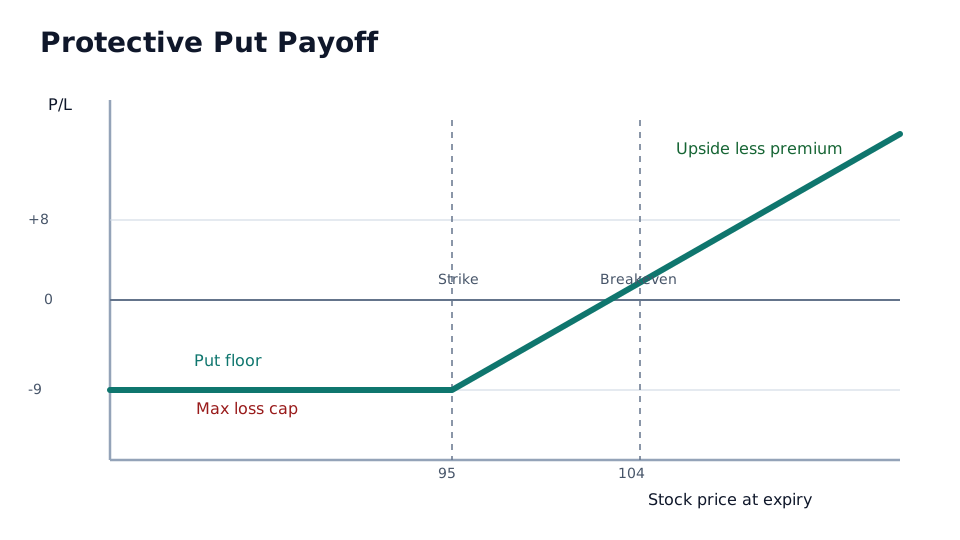
The put acts like downside insurance. It does not remove all risk, but it creates a floor under the position once the strike price is reached.
Why Investors Use Protective Puts
Investors use protective puts when they want to:
- stay invested in the asset
- keep upside if the asset rises
- limit damage if the asset falls sharply
This is why the strategy is often compared to buying insurance on a house or a car: the investor pays a premium to reduce catastrophe risk.
How the Strategy Works
Suppose an investor owns a stock at $100 and buys a put with:
- strike price =
$95 - premium paid =
$4
At expiration:
- if the stock is above
$95, the put may expire worthless - if the stock falls below
$95, the put gains value and limits further downside
The investor still participates in upside, but the premium paid reduces net return.
Payoff Shape
The payoff shape shows the core tradeoff clearly: the stock keeps most of its upside, but the put creates a floor that limits how far losses can extend below the strike after accounting for premium.
At expiration, the protective put’s profit can be summarized as:
where:
- \(S_T\) is the stock price at expiration
- \(K\) is the put strike price
- \(S_0\) is the stock purchase price
What Protection Costs
The major tradeoff is straightforward:
- the put limits downside
- the premium drags on return if the decline never happens
Using the example above, the investor has downside protection below $95, but the maximum loss is not zero. It includes the gap from $100 down to $95 plus the $4 premium paid.
That means the strategy reduces risk, but it is not free.
When a Protective Put Makes Sense
Protective puts can make sense when an investor:
- wants to hold a stock through a risky event
- has a concentrated position they do not want to sell yet
- wants emotional and financial protection during uncertain markets
They are often especially attractive when the investor cares more about avoiding a large drawdown than about maximizing upside.
Practical Use
Traders, risk teams, and market analysts use Protective Put to understand pricing, liquidity, order flow, contract payoff, hedging, and market structure.
Practical Example
In a trading or derivatives review, Protective Put should be checked against the instrument terms, quote source, position size, margin, hedge, and exit liquidity.
Decision Check
Ask whether Protective Put changes execution quality, payoff shape, volatility exposure, funding cost, liquidity risk, or hedge effectiveness.
Watch For
Market terms are highly context-sensitive. The same label can behave differently across venues, cash markets, futures, options, OTC contracts, clearing models, settlement rules, margin regimes, and stressed market conditions.
Interpretation Note
Interpret Protective Put by mapping it to price formation, contract rights, trading constraints, risk transfer, and settlement mechanics.
Finance Context
In finance, Protective Put matters when it affects valuation, execution, exposure measurement, margin, liquidity, or the reliability of a hedge.
Common Confusion
Do not confuse Protective Put with a standalone trading recommendation. It is a market concept that still depends on price, timing, liquidity, and risk limits.
Where It Shows Up
You will see Protective Put in trade tickets, exchange rules, broker notes, risk reports, option chains, fixed-income screens, and market commentary.
Analyst Takeaway
Treat Protective Put as important when it changes how a position is priced, traded, hedged, funded, or settled.
Decision Impact
For Protective Put, the decision impact is whether the contract changes payoff, hedge behavior, margin, collateral, valuation, settlement, or close-out exposure. If no trigger, input, or counterparty right changes, Protective Put should not be treated as a separate risk driver.
Analysis Boundary
The analysis boundary for Protective Put is crossed when payoff, optionality, valuation input, margin, collateral, settlement, hedge behavior, and close-out rights do not change. Then it is contract vocabulary rather than a separate risk exposure.
Decision Trace
Trace Protective Put from instrument clause to payoff, coupon, maturity, collateral, settlement, valuation input, and close-out right. Protective Put matters when it changes cash flows, price sensitivity, counterparty exposure, margin, liquidity, or the holder rights embedded in the contract.
Use Boundary
The use boundary for Protective Put is reached when payoff, coupon, maturity, collateral, margin, settlement, exercise rights, close-out rights, and valuation inputs are unchanged. In that case, explain the contract language but do not treat it as a new exposure.
Decision Marker
The decision marker for Protective Put is the moment contract economics change: payoff, coupon, maturity, collateral, exercise, conversion, settlement, margin, close-out rights, or valuation input. If those economics are unchanged, do not treat it as a new exposure.
Risk Check
The risk check for Protective Put is whether contract language hides a different payoff or rights profile. Test settlement terms, optionality, collateral, margin, maturity, close-out rights, valuation inputs, and counterparty exposure before treating the instrument as comparable.
Decision Evidence
Decision evidence for Protective Put should show the contract clause, payoff effect, valuation input, collateral treatment, settlement rule, and holder or counterparty right. Protective Put can change analysis only when those terms alter cash flow, exposure, or price sensitivity.
Related Terms
- Put Option: The contract that creates the protection.
- Strike Price: The level at which the put begins to provide meaningful downside support.
- Hedging: The broader risk-reduction purpose of the strategy.
- Covered Call: A contrasting strategy that sells upside rather than buying protection.
- Covered Option: Related finance concept that helps place Protective Put in context.
Review Evidence
Review evidence for Protective Put should make the financial-instrument evidence traceable, not just definitional. For Protective Put, tie the evidence to the contract, security master record, payoff terms, pricing source, and settlement instructions and explain why that evidence is reliable enough for the finance decision.
Before relying on Protective Put, document the decision context: the trade date, valuation date, maturity, reset date, and settlement cycle. Keep the Protective Put evidence trail visible: independent price verification, counterparty record, collateral status, and accounting classification. In Derivatives work, Protective Put matters when it changes cash flows, fair value, risk exposure, hedge treatment, or balance-sheet presentation.
- Source: cite the record, filing, contract, model input, system log, or policy that supports Protective Put.
- Timing: record when Protective Put is measured: date, period, jurisdiction, market condition, or processing window that could change the financial conclusion.
- Boundary: distinguish Protective Put from nearby concepts that require different evidence or support a different finance decision.
- Decision use: identify the approval, valuation input, allocation step, control, disclosure, or risk decision affected if the evidence for Protective Put were different.
The practical risk for Protective Put is that instrument terms are unreliable unless the legal terms, payoff profile, valuation source, and settlement facts are aligned. If those facts are unavailable, keep Protective Put in the explanatory layer instead of treating it as decision-grade evidence.
Materiality Check
Protective Put is material when it can change a finance conclusion, not just when Protective Put appears in a document. For Protective Put, test whether the evidence affects cash-flow timing, payoff shape, settlement risk, fair value, hedge designation, counterparty exposure, or balance-sheet treatment. If those decision points are unchanged, keep Protective Put explanatory and avoid overweighting it in the final decision.
A practical materiality check is to name the decision that would change if Protective Put is wrong, stale, missing, or tied to the wrong period. Protective Put warrants deeper review only when pricing, risk measurement, accounting classification, or trade suitability would change.