Registered Security
A registered security records ownership by holder name, but the phrase must be distinguished from an offering registered under securities law.
A registered security commonly means a security whose ownership is recorded by holder name on the issuer’s or transfer agent’s books, rather than a bearer instrument owned through possession of a certificate. The phrase can also be used for a security offered under an effective regulatory registration statement. Those meanings involve different records and should not be confused.
Ownership registration answers who is recorded as holder. Securities-law registration answers how an offer or sale complies with disclosure and registration requirements.
Key Takeaways
- Ownership registration links a security position to a named registered holder.
- Registered securities can be certificated or entirely book-entry.
- Street-name holdings are registered in an intermediary’s or nominee’s name, while the customer is beneficial owner.
- Direct registration places the investor’s own name on the issuer-level record for an eligible security.
- An offering registered with the SEC is a separate legal concept from recording ownership.
- An exempt or restricted security can still be recorded in a named holder’s account.
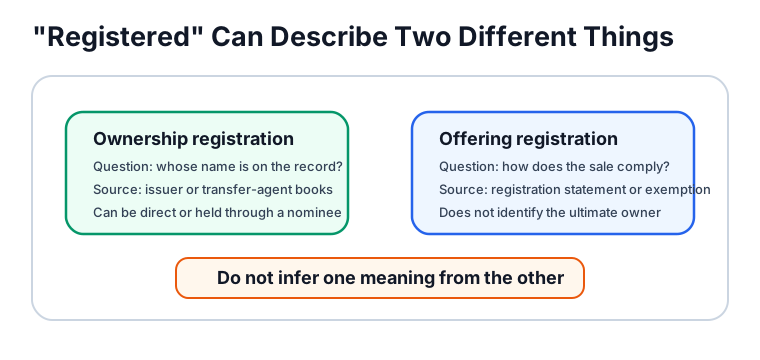
Two Meanings of Registered
| Meaning | Core question | Main record |
|---|---|---|
| Ownership registration | Whose name is recorded as holder? | Issuer or transfer-agent security-holder records |
| Offering registration | Was the offer or sale registered under securities law? | Registration statement and regulatory filings |
The same security can involve both meanings, one meaning, or neither in casual usage. A publicly offered share may be registered under the Securities Act and held in street name under a depository nominee. A privately offered share may be exempt from offering registration but still be recorded in a named holder’s account on the company’s share register.
Ownership-Registered Securities
For ownership purposes, the issuer or its agent maintains records showing:
- registered holder name
- security class or issue
- share count or principal amount
- certificate or book-entry position
- issuance and transfer history
- restrictions, legends, or stop-transfer notations
Payments and communications can be processed using those records. For a registered bond, the issuer or paying agent can direct interest and principal through the registered ownership chain. For registered shares, the records support dividends, proxy communications, transfers, and corporate actions.
Registration does not mean a paper certificate exists. Modern registered securities are often uncertificated and held in electronic book-entry form.
Direct Registration, Street Name, and Certificates
| Holding method | Registered name on issuer books | Evidence commonly received by investor |
|---|---|---|
| Direct registration | Investor | Transfer-agent account statement |
| Street name | Broker, bank, depository nominee, or another intermediary | Brokerage or custody statement |
| Personal certificate, where available | Investor | Physical certificate plus issuer record |
All three can involve a registered security. The difference is the identity of the registered holder and how the position is evidenced.
In street name, the beneficial owner normally relies on the broker’s customer records. The issuer-level record may show only an aggregate nominee position. In direct registration, the transfer agent maintains the investor’s named book-entry position.
Worked Example: Exempt Offering, Registered Owner
A private company sells 20,000 shares to an investor in an offering that relies on an exemption from Securities Act registration.
The company or transfer agent records the investor’s name and 20,000-share position in the share register. The shares are therefore registered by ownership form, even though the offering was not registered with the SEC.
The shares may also be restricted for resale. Recording the investor’s name does not make them freely tradable, and the offering exemption does not remove antifraud or applicable state-law requirements.
Now assume the company later completes a registered public offering. Those publicly offered shares may be held in street name. At the issuer level, a depository nominee may be the registered holder, while brokerage customers are beneficial owners.
The example shows why “registered security” cannot be interpreted safely without context.
Registered vs. Bearer Securities
| Feature | Registered form | Bearer form |
|---|---|---|
| Ownership evidence | Named records maintained by issuer or agent | Traditionally tied to possession of the instrument |
| Transfers | Recorded through an authorized process | Traditionally effected by delivery, subject to law and market rules |
| Payments | Directed through holder records | Traditionally made to the bearer or coupon presenter |
| Loss or theft | Records can support account control and replacement procedures | Possession-based claims create greater loss and theft concerns |
| Modern use | Common in electronic markets | Restricted, discontinued, or uncommon in many jurisdictions |
Bearer instruments remain subject to instrument terms and applicable law. They should not be assumed to be anonymous, lawful, transferable, or available in a particular jurisdiction.
Registered Does Not Mean Unrestricted
A named ownership record does not establish that a security can be sold freely. Transferability may be limited by:
- securities-law resale restrictions
- restrictive legends
- lockup agreements
- shareholder agreements
- liens, pledges, or court orders
- issuer stop-transfer instructions
- market eligibility and settlement rules
- sanctions or account controls
Before accepting or transferring a security, verify both the ownership record and the legal ability to transfer.
Offering Registration Is a Separate Process
In the United States, offers and sales of securities generally must be registered or qualify for an exemption. A registration statement provides prescribed issuer, offering, risk, management, and financial information and must become effective before the registered sale proceeds.
An exempt offering is not unregulated. Antifraud provisions still apply, and federal and state notice, eligibility, disclosure, resale, and other requirements may apply.
Ownership registration cannot substitute for offering compliance. Likewise, an effective offering registration statement does not prove that every later transfer is valid, that the security is unrestricted, or that the investment is suitable.
Why Ownership Registration Matters
Named security-holder records support:
- payment of dividends, interest, and principal
- shareholder voting and proxy communications
- tender offers, rights offerings, exchanges, and reorganizations
- transfer processing and replacement of lost certificates
- record-date determinations
- restriction and stop-transfer controls
- estate, trust, gift, and entity-name changes
- reconciliation of issued and outstanding securities
These functions depend on accurate records and secure processing. A data error can result in delayed payments, rejected transfers, duplicate records, or disputes over ownership.
How to Evaluate a Registered Position
Confirm:
- Issuer and security: legal issuer name, class, CUSIP or other identifier, and governing terms.
- Registered holder: exact name and account registration on issuer-level records.
- Beneficial owner: whether another party has the economic interest or control.
- Holding method: direct registration, street name, certificate, trust, custody, or another arrangement.
- Restrictions: legends, lockups, liens, stop-transfer orders, or resale limitations.
- Agent: current transfer agent, registrar, custodian, broker, or depository.
- Offering status: registered offering, exempt offering, and any applicable resale pathway.
- Evidence: current statements, confirmations, certificates, legal documents, and regulatory filings.
Common Mistakes and Risks
Equating named ownership with SEC registration. They are different concepts governed by different records.
Assuming registered means freely tradable. Restrictions can apply even when the holder’s name is recorded accurately.
Assuming street-name investors are unrecorded. Their beneficial positions are recorded by intermediaries even when the issuer sees only a nominee.
Treating registration as an investment endorsement. Regulatory filing or ownership recording does not establish value, quality, safety, or suitability.
Relying on a certificate alone. The issuer’s current records, transfer status, and restrictions must also be verified.
Using U.S. terminology globally. Registration, bearer form, book entry, and transfer law vary across jurisdictions.
Official Source Checks
- Investor.gov: Holding Your Securities explains direct registration, street name, and physical certificates.
- SEC: Transfer Agents explains ownership records, transfers, certificates, and distributions.
- SEC: Exempt Offerings distinguishes registered offerings from common exemptions.
- SEC: Frequently Asked Questions About Exempt Offerings explains that antifraud and other requirements continue to apply and discusses restricted securities.
Related Terms
- Registered Holder: The person or nominee listed on the issuer’s ownership records.
- Share Register: The issuer-level record of registered share ownership and transfers.
- Direct Registration System (DRS): Electronic book-entry registration directly in an investor’s name.
- Street Name: Registration under an intermediary or nominee for a beneficial owner.
- Bearer Bond: A debt instrument traditionally associated with possession-based ownership.
- Restricted Securities: Securities subject to resale limitations.
- Registration Statement: A regulatory filing for a registered securities offering.
- Securities Act of 1933: The principal U.S. federal statute governing securities offers and sales.
FAQs
Is a registered security always registered with the SEC?
Can a registered security be held in street name?
Does a registered security require a paper certificate?
Does registered mean the security is safe or approved?
This article is educational and does not provide securities-law, tax, compliance, or investment advice. Verify the issuer records, governing documents, restrictions, and applicable law for a specific security.