VIX Futures
VIX futures are cash-settled contracts on the expected VIX level at a specified expiration, with distinct term-structure, basis, and roll risks.
VIX futures are standardized, cash-settled futures contracts that reflect the market’s estimate of the Cboe Volatility Index at a specified future expiration. They trade on Cboe Futures Exchange under the VX product symbol and provide exposure to expected equity-market volatility, not ownership of the current or “spot” VIX reading.
A VIX futures price can differ substantially from the current VIX Index because each futures contract refers to a later settlement date. Buying VIX futures is therefore not the same as buying today’s VIX, and a rise in spot VIX does not guarantee an equal rise in every futures expiration.
Key Takeaways
- Each VIX futures contract represents a specific expiration, not a perpetual position in the current VIX Index.
- Standard
VXfutures use a$1,000multiplier per VIX point under current Cboe specifications. - Profit or loss depends on the futures price change, contract quantity, and multiplier.
- Final settlement uses a Special Opening Quotation of the VIX Index, not necessarily the prior close or an intraday spot VIX quote.
- VIX futures do not follow the simple financing-and-storage cost-of-carry model used for a storable asset.
- Curve shape, convergence, roll, timing, leverage, and hedge mismatch can dominate the outcome.
- A volatility hedge can lose money even if equities decline, particularly when the move, timing, or selected expiration differs from what the market had priced.
- Dollar sensitivity is measured per VIX futures point and contract; futures margin is not the maximum possible loss.
- A long VIX futures position can reduce some portfolio losses without fully offsetting them and can create repeated losses during calm markets.
VIX Index vs. VIX Futures
The Volatility Index (VIX) is a calculated measure of 30-day expected S&P 500 volatility derived from SPX option prices. It is an index value, not a security or inventory that can be purchased and stored.
VIX futures instead trade the market’s estimate of the VIX settlement value for particular future dates. A June contract and a September contract can have different prices because they refer to different horizons, option sets, events, and risk conditions.
| Measure | What it represents | Can it be held directly? |
|---|---|---|
| Spot VIX Index | Current 30-day expected volatility measure | No; it is a calculated index |
| Near VIX future | Expected VIX settlement at a nearby expiration | Yes, as a listed futures position |
| Deferred VIX future | Expected VIX settlement at a later expiration | Yes, as a separate listed contract |
Contract Mechanics
Current standard VIX futures specifications identify:
| Contract term | Standard VX treatment |
|---|---|
| Venue | Cboe Futures Exchange |
| Underlying framework | Cboe Volatility Index methodology |
| Contract multiplier | $1,000 per VIX point |
| Settlement | Cash settlement |
| Final value | Special Opening Quotation of the VIX Index |
| Expirations | Monthly and listed weekly expirations |
Specifications, calendars, tick rules, trading hours, and margin requirements can change. The exchange rulebook, product specification, clearing record, and broker account terms control over a general explanation.
Profit and Loss Example
For n standard contracts with multiplier M, the long position’s simplified profit or loss between entry price F_0 and exit or settlement price F_1 is:
Assume a participant buys 2 VIX futures at 18.50 and later closes them at 20.25. Using the $1,000 multiplier:
The long position gains $3,500 before commissions and fees. If the contracts instead fall to 16.75, the same position loses $3,500.
The cash posted as margin can be much smaller than the contract’s economic sensitivity. Margin is collateral and can change; it is not the maximum loss.
Dollar Sensitivity and Position Size
For the standard contract’s $1,000 multiplier, a one-point futures move changes one contract’s value by $1,000 before costs. A 0.10-point move changes it by $100.
| Contracts | P&L from a 1-point rise for a long | P&L from a 5-point rise for a long |
|---|---|---|
| 1 | +$1,000 | +$5,000 |
| 4 | +$4,000 | +$20,000 |
| 10 | +$10,000 | +$50,000 |
The short side has the opposite result. This money sensitivity is more useful than treating the quoted VIX level as a conventional investment notional. VIX futures do not represent ownership of a stock portfolio or a deposit equal to the index level multiplied by the contract multiplier.
Position size should be tied to a documented scenario, loss budget, term structure, liquidity, and hedge objective. Dividing a stock portfolio’s value by a VIX futures quote does not produce a defensible hedge ratio because the portfolio and futures measure different risks.
Worked Example: Margin Liquidity
Assume a participant owns four standard futures at 20.00. If the futures fall to 17.00, the loss is:
That loss is settled through the futures margin process. It can require cash even if the position is intended as a long-term portfolio hedge. A later volatility spike does not help a position that was liquidated after earlier losses.
VIX Futures Term Structure
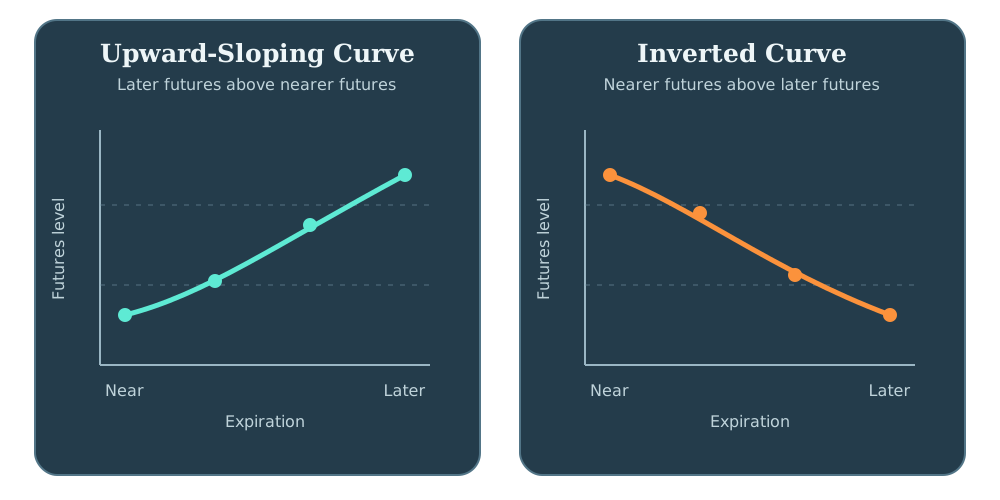
The VIX futures term structure is the sequence of prices across listed expirations. An upward-sloping curve has later contracts above nearer contracts. An inverted curve has nearer contracts above later contracts. These shapes describe current prices; they do not guarantee the path of future spot VIX.
Upward-Sloping Curve
When later VIX futures trade above nearer futures, the curve is often described as contango. A long position that repeatedly moves from a cheaper expiring contract into a more expensive deferred contract can face an adverse roll difference, although the realized return also depends on price changes before each roll.
Inverted Curve
During periods of acute near-term uncertainty, nearer VIX futures can trade above deferred contracts. This is commonly described as backwardation or an inverted curve. The inversion does not guarantee that a long position will profit; the selected contract can fall as the event passes or expected volatility changes.
Use Contango and Backwardation for the general futures-curve concepts.
Worked Example: Rolling a Long Position
Assume a long strategy closes a near VIX future at 24 and opens a later contract at 27. The three-point calendar spread is not an immediate $3,000 loss. The old contract realizes its own entry-to-exit P&L, and the new position begins at 27.
If the later future subsequently declines from 27 to 23, one standard long contract loses:
The decline illustrates an adverse convergence or roll mechanism. If the later contract instead rises to 32, the new position gains $5,000. The starting contango identifies the initial curve relationship, not the future path.
A fund can roll over several days and can hold more than one expiration. Its result then depends on each day’s contract weights, prices, execution, fees, and rebalancing rule.
Curve Shape Is a Snapshot
An upward or inverted curve can change through:
- a move concentrated in the near contract;
- a parallel shift across expirations;
- a change concentrated in deferred contracts;
- a flattening or steepening between selected months; or
- a temporary event premium entering and leaving one expiration.
These paths can produce different P&L even when the curve starts and ends with similar labels. A position in a deferred future is not a position in the entire VIX curve, and a spread between two months is not equivalent to an outright long VIX position.
Scheduled events also interact with contract dates. A future settling before an event and one settling after it can respond differently. Event awareness does not make the outcome predictable because the starting prices can already reflect substantial expected volatility.
Why Spot VIX and Futures Can Diverge
VIX is not a storable asset. A participant cannot buy spot VIX, finance it, hold it in inventory, and deliver it against a futures contract. Consequently, the familiar cash-and-carry relationship for physical commodities or financial assets is not a valid standalone VIX futures pricing formula.
VIX futures prices reflect several interacting factors:
- expected volatility near the contract’s settlement horizon;
- the market price of volatility risk;
- time remaining to expiration;
- scheduled and unscheduled event risk;
- supply and demand for volatility exposure;
- the tendency of volatility to change rapidly and sometimes revert after spikes; and
- liquidity and positioning in each contract month.
As expiration approaches, the expiring future becomes increasingly tied to its settlement framework. Before then, spot VIX and the futures contract can move by different amounts or even in different directions over short intervals.
Final Settlement and the SOQ
VIX futures settle in cash to a Special Opening Quotation, commonly referenced by the settlement symbol VRO. Cboe calculates this value on expiration morning using the applicable SPX option opening prices under its settlement methodology.
The final settlement value can differ from:
- the prior day’s VIX close;
- the VIX level displayed shortly before or after the calculation;
- the expiring futures price before trading terminates; and
- a trader’s estimate based on option midquotes.
This difference is not necessarily an error. The SOQ is a defined settlement calculation using opening trade information, while the continuously published VIX Index uses its own real-time inputs and timing.
Worked Example: Settlement to the SOQ
Assume one standard VIX future was purchased at 18.50 and held to a final SOQ of 21.10. The total contract gain from entry to final settlement is:
Suppose the last observed futures trade before termination was 20.80 and the prior day’s VIX Index close was 20.40. Neither number replaces the contract-defined 21.10 SOQ in the final calculation.
Because futures are marked to market, much of the $2,600 may already have moved through daily settlement before expiration. The final cash flow completes the remaining difference; it does not pay the full entry-to-SOQ gain a second time.
The example is hypothetical. The actual settlement date, final trading time, eligible SPX option inputs, and SOQ calculation come from current Cboe rules.
Using VIX Futures as a Hedge
A participant may buy VIX futures because equity-market stress is often associated with higher expected volatility. The position can offset some losses in a stock portfolio when the selected futures contract rises enough, but it is not a direct or complete equity hedge.
Hedge effectiveness depends on:
- the equity portfolio’s size, beta, concentration, and options exposure;
- which VIX expiration is selected;
- the timing and size of the market decline;
- the starting VIX futures price and curve shape;
- how spot and forward volatility react;
- the hedge quantity, rebalance rule, and exit timing; and
- roll costs, margin cash flows, spreads, and fees.
A slow equity decline can produce a different volatility response from a sudden shock. A deferred VIX future may react less than spot VIX because the contract refers to volatility at a later date. If elevated volatility was already priced, the futures response may also disappoint.
Worked Example: Partial Equity Hedge
Assume an investor has a $2,000,000 equity portfolio and buys four standard VIX futures at 20. During a market shock:
- the equity portfolio loses
8%, or$160,000; - the held VIX future rises from
20to32; and - the four futures gain
4 x $1,000 x 12 = $48,000.
The simplified combined result is a $112,000 loss before costs:
1-$160,000 + $48,000 = -$112,000
The VIX futures reduce the loss but do not eliminate it. The result does not imply a stable hedge ratio between dollars of equities and VIX contracts.
If the equity portfolio instead gains while the future falls from 20 to 17, the hedge loses $12,000. Repeated losses during calm or rising equity markets can make a continuously maintained long-volatility hedge expensive even if it helps during one later shock.
Building a Hedge Scenario
Rather than rely on one historical correlation, define several joint outcomes:
| Scenario | Equity portfolio | Held VIX future | Question |
|---|---|---|---|
| Sudden selloff | Large immediate loss | Potential sharp rise | Is contract quantity sufficient, and can gains be realized? |
| Slow decline | Gradual loss | May rise modestly or remain contained | Does carry erode the hedge before protection appears? |
| Volatility already elevated | Equity loss | Future may rise less than expected | How much stress was priced at entry? |
| Equity rebound | Gain | Future can fall quickly | Is the hedge loss within budget? |
| Event passes | Mixed equity result | Event premium can collapse | Does the exit rule respond to the selected expiration? |
The scenario should identify the specific futures expiration, not just a spot VIX assumption. It should also include roll dates, bid-ask spreads, margin cash flows, and the possibility that equity and volatility relationships differ from history.
VIX Futures vs. Other Volatility Exposure
| Exposure | Economic focus | Main implementation issue |
|---|---|---|
| VIX futures | Linear exposure to a specific VIX futures expiration | Term structure, convergence, roll, leverage, and SOQ settlement |
| VIX index options | Nonlinear option exposure under the applicable VIX option rules | Premium, strike, expiry, volatility sensitivity, and settlement |
| Options on VIX futures | Option whose underlying is a VIX futures contract | Futures-option specifications and delivery into or settlement against futures |
| Futures-linked exchange-traded product | Fund or note following a stated VIX futures strategy | Fees, roll methodology, compounding, issuer or fund structure, and tracking |
| S&P 500 put option | Downside option on an equity index | Premium, strike, expiration, implied volatility, and payoff threshold |
Products with “VIX” in their name are not interchangeable. A futures-linked exchange-traded product may hold and roll a portfolio of VIX futures rather than track spot VIX. Its return can therefore diverge materially from a same-period change in the index.
Evaluating a VIX Futures-Linked Product
Read the governing document and index methodology for:
| Feature | Why it matters |
|---|---|
| Legal structure | A fund, partnership, or unsecured note can create different ownership, tax, and issuer risks |
| Futures months held | Near and deferred contracts respond differently to spot VIX and events |
| Roll schedule | Daily, multi-day, or rule-based rolls create different curve exposure |
| Target exposure | Long, short, inverse, leveraged, or volatility-targeted exposure changes payoff and risk |
| Rebalancing frequency | Daily targets can create path-dependent multi-day results |
| Collateral and cash | Interest and collateral treatment affect return |
| Fees and transaction costs | Gross index performance can exceed the investor’s net result |
| Termination or acceleration | Product documents may permit closure or other actions under specified conditions |
For a product targeting a multiple or inverse multiple of daily VIX futures index performance, the stated target generally should not be projected by multiplying a multi-day benchmark return. Compounding, rebalancing, and volatility can create a materially different result over longer periods.
The product may also have equity-market trading risk. Its share price, indicative value, creation/redemption process, and bid-ask spread are separate from the prices of its underlying futures positions.
Risks and Limitations
- Leverage risk: Losses are based on futures price changes and the multiplier, not limited to margin deposited.
- Basis risk: The selected VIX future may not move with spot VIX or the portfolio being hedged.
- Timing risk: Volatility may rise before or after the held contract is most responsive.
- Curve and roll risk: Replacing an expiring future changes the contract and may create an adverse price difference.
- Mean-reversion risk: A volatility spike can reverse quickly, producing losses for a late long position.
- Settlement risk: The SOQ can differ from nearby VIX and futures observations.
- Liquidity risk: Volume and spreads vary by expiration and market condition.
- Gap risk: VIX futures can move sharply as information arrives outside regular equity-market hours.
- Operational risk: Wrong expiration, quantity, order type, or settlement date can undermine the intended trade.
- Hedge-model risk: Historical equity-volatility relationships may fail during the period being hedged.
Common Mistakes
- Treating a VIX future as if it were today’s VIX Index.
- Pricing VIX futures with only spot VIX and a risk-free interest rate.
- Assuming any stock-market decline guarantees a profitable long VIX futures position.
- Ignoring the expiration-specific curve and selecting a contract by ticker alone.
- Confusing VIX index options, options on VIX futures, and VIX futures-linked products.
- Comparing a futures-linked fund’s return directly with the spot VIX percentage change.
- Holding through expiration without understanding the SOQ process.
- Sizing an equity hedge by dividing portfolio value by the VIX futures quote.
- Treating the standard contract multiplier as if it were an investable notional amount.
- Assuming a leveraged or inverse daily objective applies unchanged over multiple days.
- Ignoring repeated hedge losses and rolls during extended calm periods.
Verification Checklist
Before relying on a VIX futures position or quote, verify:
- product symbol, exact expiration, and whether it is a weekly or monthly contract;
- multiplier, tick value, margin, and broker house requirements;
- current spot VIX, full futures curve, volume, open interest, and bid-ask spread;
- final trading time, settlement date, and SOQ methodology;
- hedge objective, portfolio exposure, scenario size, and selected horizon;
- expected roll date and the spread to the replacement contract;
- stressed cash requirements and account-liquidation terms;
- commissions, exchange fees, tax, accounting, and regulatory treatment;
- for a fund or note, legal structure, target exposure, rebalance frequency, fees, and termination terms; and
- combined portfolio outcomes across sudden, gradual, elevated-volatility, and rebound scenarios.
Authoritative Sources
- Cboe VIX futures overview explains expiration-specific exposure, weekly contracts, and SOQ settlement.
- Cboe VIX futures specifications provides the current multiplier, trading rules, expirations, and settlement terms.
- Cboe VIX term-structure page distinguishes forward-volatility information across maturities.
- CFTC futures glossary defines margin, margin calls, and mark-to-market.
VIX futures are leveraged, complex derivatives and are not guaranteed portfolio protection. This page is for financial education and does not recommend a volatility trade, hedge, broker, product, or account strategy. Legal, tax, accounting, regulatory, and suitability questions require participant-specific review.
Knowledge Check
FAQs
Do VIX futures track the current VIX Index exactly?
Can an investor buy the spot VIX Index?
Why can a VIX futures-linked fund fall while spot VIX rises?
Do VIX futures guarantee protection in a stock-market decline?
What does one VIX futures point represent?
$1,000 per contract. Verify the current Cboe specification because product terms can change and other volatility contracts can use different multipliers.Is a three-point VIX futures roll spread an immediate $3,000 loss?
Related Terms
- Volatility Index (VIX): The current 30-day expected-volatility benchmark underlying the settlement framework.
- Implied Volatility: The volatility input inferred from option prices.
- Contango and Backwardation: Upward- and downward-sloping futures curves.
- Futures Chain: Contract prices and activity across listed expirations.
- Initial Margin: Collateral required to open or carry a leveraged position.
- Roll Yield: Return effect associated with maintaining futures exposure across expirations.
- Tail Risk: Exposure to severe outcomes that a volatility hedge may seek to reduce but cannot eliminate.
- Variance Swap: OTC volatility derivative with payoff mechanics different from VIX futures.
- Correlation: Historical co-movement measure that does not guarantee future hedge behavior.