Face Value
Face value, also called par value or nominal value in many debt contexts, is the stated principal used for coupon and repayment terms.
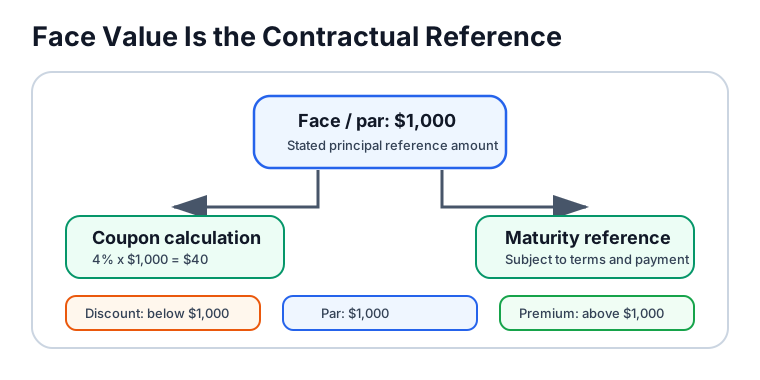
Face value, also called par value and sometimes nominal value, is the stated principal amount of a bond or other financial instrument. For a conventional bond, face value is normally the amount used to calculate coupon payments and the principal the issuer promises to repay at maturity. It is not necessarily the price an investor pays or the amount the security could be sold for today.
Face value is a contractual reference amount. Repayment still depends on the instrument’s terms and the issuer’s ability to pay. Inflation-linked securities, amortizing debt, restructurings, and defaults can also make the actual cash flows differ from the simplest par-value example.
Key Takeaways
- Face value and par value usually mean the same thing for a bond.
- Nominal value can mean face value for an instrument, but in economic data it can instead mean an amount not adjusted for inflation.
- A bond’s coupon rate is generally applied to face value, not its changing market price.
- A bond can trade below par at a discount, at par, or above par at a premium.
- Face value is not market value, issue price, book value, or intrinsic value.
- The meaning of par value for shares is different from its role in bonds and may be mainly legal or accounting in nature.
How Face Value Works for Bonds
A bond’s documentation states a principal or par amount. That amount commonly serves two purposes:
- It is the base used to calculate contractual coupon payments.
- It is the principal amount due at maturity if the issuer performs according to the contract.
For a fixed-rate bond:
Payment frequency matters. If a bond pays coupons semiannually, the annual coupon is divided into two scheduled payments. Accrued interest may also affect the settlement amount when a bond trades between coupon dates.
Worked Example: Face Value and Market Price
Assume a conventional corporate bond has:
- face value of
$1,000 - annual coupon rate of 4%
- annual coupon payments
- market price quoted at 96.50% of par
The annual coupon is:
The market price is:
The bond therefore trades at a $35 discount to face value:
The $40 coupon is still based on the $1,000 face value. Buying the bond for $965 does not change its contractual coupon. If the issuer makes every payment and no special terms apply, the holder also receives the stated principal at maturity. The investment return, however, depends on the purchase price, timing, coupons, reinvestment assumptions, taxes, transaction costs, and credit outcome.
Why Market Price Differs from Face Value
After issuance, investors price a bond using current required yields and expected cash flows. The relationship between a bond’s coupon rate and prevailing required yield helps explain whether it trades below or above par.
| Market condition, all else equal | Typical price relationship |
|---|---|
| Required yield exceeds the coupon rate | Bond tends to trade below face value |
| Required yield equals the coupon rate | Bond tends to trade near face value |
| Required yield is below the coupon rate | Bond tends to trade above face value |
This is a directional relationship, not a complete valuation model. Credit quality, liquidity, time to maturity, embedded options, tax treatment, accrued interest, and market conditions can also affect price.
Face Value Across Financial Instruments
Conventional bonds
Face value is usually the contractual principal amount used for coupons and maturity repayment. A quoted bond price of 102 generally means 102% of par, subject to the market’s quotation and settlement conventions.
Treasury bills
Treasury bills do not make periodic coupon payments. They are commonly issued at face value or below face value, and the difference between the purchase price and maturity amount represents interest under the applicable convention.
Inflation-linked and amortizing securities
The simple fixed-par explanation may not apply without adjustment. For example, Treasury Inflation-Protected Securities have principal that changes with inflation and deflation under their terms. Amortizing instruments repay principal over time rather than only at final maturity.
Preferred shares
A preferred share may have a stated par or liquidation value used to calculate a fixed dividend or define a liquidation preference. The governing documents control. Market price can still be above or below that reference amount.
Common shares
Common-share par value is often a small legal or accounting amount and usually has little connection to the share’s market price. Corporate law and issuer terms vary by jurisdiction, so bond-style maturity repayment should not be assumed.
Currency
The face value printed on a currency note is its denomination. It does not measure purchasing power, which can change with inflation and exchange rates.
Face Value, Par Value, Nominal Value, and Denomination
These labels overlap, but context controls their meaning.
| Label | Common meaning | Important boundary |
|---|---|---|
| Face value | Stated principal or amount shown by the instrument | Does not establish market price or collectibility |
| Par value | Face or principal amount for debt; nominal legal amount for some shares | Stock par value does not imply bond-style repayment |
| Nominal value | Face or par amount in some instrument and corporate-law contexts | In economics, nominal can mean not adjusted for inflation |
| Denomination | Stated monetary or principal unit | Minimum order, quote basis, and settlement amount can differ |
For example, a bond may have $10,000 principal, trade at 98.50 per $100 of par, and settle for a different cash amount after accrued interest. The principal amount, quote basis, price, and settlement amount should be reconciled separately.
For shares, use Par Value Stock for the corporate-law and contributed-capital analysis. For inflation-adjustment terminology, use Nominal vs. Real Values.
Face Value vs. Related Value Measures
| Measure | What it represents | Does it change with market trading? |
|---|---|---|
| Face or par value | Stated contractual or legal reference amount | Usually not, although instrument terms can adjust principal |
| Issue price | Price paid when the security is first sold | Set for the issuance |
| Market value | Current transaction price or market-supported estimate | Yes |
| Book value | Accounting carrying amount or net asset measure | Changes through accounting entries |
| Redemption amount | Amount contractually payable when redeemed | May equal face value, but terms can differ |
The label alone is not enough. Read the prospectus, indenture, offering memorandum, or other governing document to determine what amount is actually owed and when.
Why Face Value Matters
Face value helps investors and analysts:
- calculate fixed coupon payments
- interpret price quotations expressed as a percentage of par
- distinguish principal repayment from market price
- compare bonds trading at discounts or premiums
- reconcile debt balances, maturities, and contractual cash flows
- understand preferred-share dividend and liquidation terms
It does not establish investment quality. Two bonds with the same face value can have very different prices, yields, seniority, liquidity, covenants, and default risk.
Common Mistakes
Treating face value as current value. A $1,000 face-value bond may trade well above or below $1,000.
Applying the coupon rate to market price. The contractual coupon is ordinarily calculated from face value, while current yield uses market price.
Assuming every bond repays par. Default, restructuring, calls, conversions, indexation, amortization, and other terms can change the timing or amount received.
Using par value identically for bonds and shares. Share par value often serves a different legal or accounting purpose.
Ignoring quotation conventions. A quoted price may be stated per $100 of par, may exclude accrued interest, or may use instrument-specific conventions.
Official Source Checks
- Investor.gov: What Are Corporate Bonds? explains face value, price, coupon rate, maturity, and yield to maturity.
- Investor.gov: Bonds explains that principal, face value, and par value are commonly used for the amount due at maturity.
- TreasuryDirect: Understanding Pricing and Interest Rates shows how Treasury bills, notes, bonds, TIPS, and floating-rate notes can be priced at, below, or above par.
These sources describe U.S. instruments and conventions. Issuer documents and local rules control a specific security.
Related Terms
- Market Value: The current market price or market-supported value of an asset or security.
- Bond Prices at Par, Premium, or Discount: Explains why a bond’s market price differs from par.
- Bond Coupon: The contractual interest payment commonly calculated from face value.
- Yield to Maturity: A return measure that incorporates price, coupons, maturity value, and timing assumptions.
- Issue Price: The price investors pay when a security is initially issued.
- Denomination: Stated unit or face amount, distinct from minimum order, quote basis, and settlement cash.
- Par Value Stock: Nominal amount assigned per share for applicable corporate-law and capital-account purposes.
- Nominal vs. Real Values: Distinguishes current-dollar amounts from inflation-adjusted measures.
- Discount: The amount by which a price falls below a stated reference amount such as par value.
FAQs
Is face value the same as par value?
Is nominal value the same as face value?
Is face value the amount paid for a bond?
Does a bond's coupon change when its market price changes?
Will an investor always receive face value at maturity?
This article is educational and does not provide investment, accounting, legal, or tax advice. Review the governing documents and current market information for a specific security.