Roll Forward in Derivatives
Rolling forward closes or offsets a derivative position and establishes a later expiration, changing its price, risks, and settlement timeline.
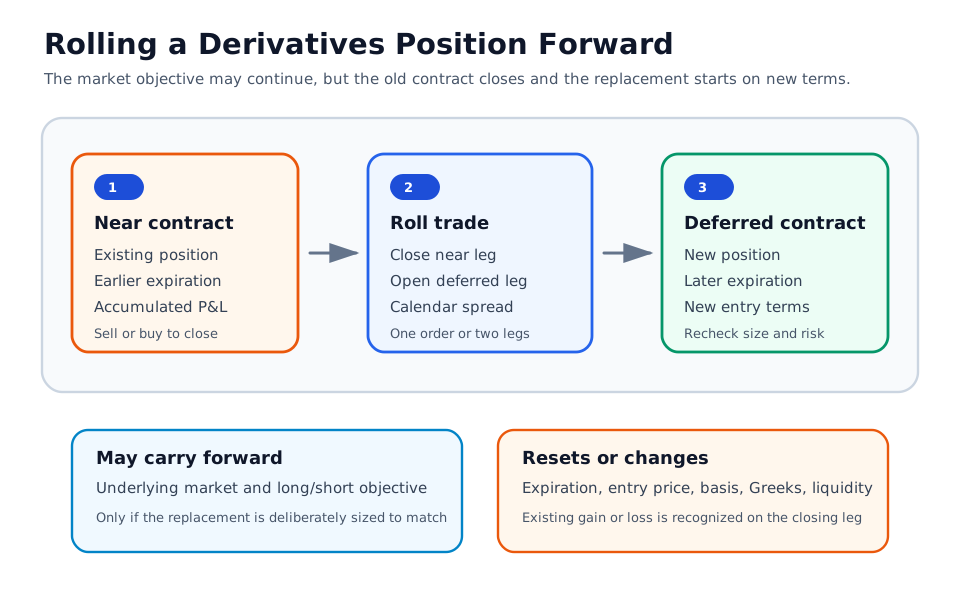
To roll forward a derivatives position is to close or offset a contract with an earlier expiration and establish a new position with a later expiration. The new contract may preserve the intended market direction, but it does not preserve the original entry price, gain or loss, liquidity, margin, or risk sensitivities.
A roll is normally two economic transactions. Closing the existing position ends the near exposure and fixes its trading result under the instrument’s settlement rules; opening the deferred position creates a new exposure at current market terms.
Key Takeaways
- A roll extends exposure; it does not extend the legal life of the original exchange-traded contract.
- A roll does not erase or defer the near contract’s gain or loss; closing that leg ends the exposure.
- A futures roll may be executed through a listed calendar spread to reduce legging risk.
- An options roll changes time to expiration and usually changes delta, gamma, vega, theta, and assignment exposure.
- The deferred contract can have a different price, multiplier, liquidity profile, margin requirement, or settlement process.
- Rolling avoids expiration or delivery only if completed before the applicable deadlines and in accordance with broker and exchange procedures.
How a Roll Works
- Identify the position that is approaching expiration, delivery, exercise, or another operational deadline.
- Close or offset that position in the near contract.
- Open a position in a later contract, using the quantity and terms needed for the intended exposure.
- Recheck notional, sensitivities, margin, liquidity, settlement, and hedge effectiveness.
| What may be carried forward | What resets or changes |
|---|---|
| Intended long or short market direction | Contract expiration and settlement date |
| Underlying market or hedge objective | Entry price and tax lot |
| Approximate notional target | Basis, calendar spread, and carry |
| Strategy mandate | Margin and collateral requirements |
| Risk limit, if reapproved | Liquidity and price sensitivities |
The two contracts are separate instruments. Treating the replacement as a continuation can hide realized profit and loss or a material change in risk.
Futures Roll Example
Assume a trader is long 10 Month 1 futures at an original entry price of $66. Near the roll date:
| Contract | Current price | Action |
|---|---|---|
| Month 1 futures | $70 | Sell 10 to close |
| Month 2 futures | $72 | Buy 10 to open |
Ignoring the multiplier, fees, and prior variation-margin cash flows, the Month 1 leg has accumulated a $4 gain per unit from $66 to $70. Closing it recognizes that result. The Month 2 position then starts at $72.
The deferred-minus-near calendar spread is $2. That spread affects the new exposure and later Roll Yield, but buying the $72 contract after selling the $70 contract is not itself an immediate $2 futures loss.
Calendar-Spread Execution
For a long nearby futures position, the economic roll is:
- sell the nearby contract to offset the existing long; and
- buy the deferred contract to establish the new long.
Many futures venues list this combination as a calendar-spread order. A spread order can reduce the market risk of executing the legs separately, but it does not eliminate spread slippage, partial execution, exchange limits, or liquidity risk. Spread naming and sign conventions vary, so verify which leg is bought and which is sold before submitting the order.
Options Roll Example
Assume an investor owns one 50-strike call that is nearing expiration:
| Leg | Premium | Action |
|---|---|---|
Near 50-strike call | $2.20 | Sell to close |
Later 50-strike call | $4.10 | Buy to open |
The roll requires a net debit of $1.90 per option unit before fees. That debit is not the gain or loss on the original call; the original result depends on its purchase price. The later option has more time to expiration and may have materially different implied volatility and Greeks.
An options roll can also change strike:
- roll out: move to a later expiration;
- roll up: move to a higher strike;
- roll down: move to a lower strike; or
- combine expiration and strike changes in one multi-leg order.
These labels describe trade structure, not suitability or expected profit.
Futures, Options, and OTC Rolls
| Instrument | Near-position action | Replacement-position issue |
|---|---|---|
| Futures | Offset the expiring contract | Select month, quantity, spread, delivery rules, and margin |
| Listed options | Close the current option | Select expiration, strike, style, premium, and Greeks |
| Forward or swap | Terminate, offset, amend, or enter a new trade | Review counterparty consent, valuation, collateral, and documentation |
An over-the-counter “roll” may be a termination plus a new transaction, an amendment, or a novation. The legal and accounting result depends on the actual documentation; it should not be inferred from desk shorthand.
Why Positions Are Rolled
- Maintain market exposure beyond the current expiration.
- Avoid physical delivery, cash settlement, exercise, or assignment when those outcomes are not intended.
- Extend a commercial hedge to match a revised purchase, sale, funding, or production date.
- Move toward a more liquid contract month.
- Adjust option maturity, strike, or risk sensitivities.
- Follow a fund or index methodology that specifies contract-selection and roll dates.
A roll should not be automatic. Closing the position entirely may be more appropriate when the underlying exposure, risk limit, or investment objective no longer exists.
How Risk Changes
| Risk dimension | Futures roll | Options roll |
|---|---|---|
| Price sensitivity | Contract price and basis change | Delta usually changes |
| Convexity | Usually limited for linear futures | Gamma can change materially |
| Volatility exposure | Indirect through market price | Vega and implied volatility change |
| Time decay | Expiration and convergence reset | Theta and remaining time reset |
| Liquidity | Deferred month may be thinner | Later series may have wider spreads |
| Funding and collateral | Margin requirement may change | Premium and margin can change |
| Settlement | New delivery or cash-settlement date | New exercise and assignment window |
Matching contract count does not necessarily match economic exposure. A risk-controlled roll may require notional, duration, DV01, delta, vega, or hedge-ratio adjustments.
Risks and Common Mistakes
- Claiming that rolling avoids realizing the existing gain or loss.
- Assuming the later contract is economically identical except for expiration.
- Letting the near contract enter a delivery, exercise, or assignment window unintentionally.
- Executing two legs separately without controlling legging risk.
- Misreading the calendar-spread quote or buy/sell convention.
- Keeping the same contract quantity when the appropriate hedge ratio has changed.
- Ignoring bid-ask spreads, commissions, market impact, and multi-day index-roll effects.
- Overlooking different margin, collateral, liquidity, and settlement rules.
- Treating a roll as a tax-free continuation without jurisdiction- and account-specific analysis.
- Assuming an options roll preserves delta, volatility exposure, or probability of exercise.
Roll Checklist
- Confirm the contract symbol, multiplier, expiration, first-notice date, last-trade date, and settlement method.
- State the target exposure after the roll: contract count, notional, DV01, delta, vega, or hedge ratio.
- Compare near and deferred liquidity, open interest, bid-ask spread, and active price limits.
- Verify the spread quote and which leg the order buys or sells.
- Estimate realized gain or loss on the closing leg separately from the new entry price.
- Recalculate margin, collateral, premium, and available liquidity.
- For options, review strike, exercise style, implied volatility, Greeks, and assignment risk.
- For OTC trades, review confirmations, valuation, counterparty approval, and legal or accounting treatment.
Authoritative References
The CFTC Futures Glossary defines a roll-over as lifting a near futures position and re-establishing it in a deferred month. CME Group’s futures roll-liquidity explainer describes offsetting a nearby contract and establishing a like deferred position, often through a calendar spread. Its Treasury futures roll guide explains how calendar spreads combine both futures legs and why separate execution creates legging risk.
This page is for financial education only. It does not recommend rolling, closing, exercising, or maintaining a derivative. Futures and short-option positions can produce losses beyond initial margin or premium; tax, legal, accounting, and suitability conclusions require the relevant facts and professional advice.
FAQs
Does rolling a derivative avoid realizing a gain or loss?
Does a futures roll have to use a calendar-spread order?
Does rolling an option preserve the same risk exposure?
Related Terms
- Roll Yield: Return attribution associated with maintaining futures exposure across expirations.
- Contango and Backwardation: Futures-curve shapes that influence roll economics.
- Futures Contract: A standardized exchange-traded agreement with a specified maturity and settlement process.
- Option Contract: A contract granting the holder specified exercise rights before or at expiration.
- Taking Delivery: Completion of a physically settled futures contract through the delivery process.