Market Integrity
Market integrity means markets operate under reliable disclosure, fair-access, trading, surveillance, infrastructure, and enforcement arrangements.
Market integrity is the degree to which a financial market operates under reliable rules for disclosure, access, trading, price formation, custody, clearing, surveillance, and enforcement. A market with integrity limits deception and unfair advantage, treats comparable orders consistently, publishes required information, and can reconstruct activity when problems occur.
Integrity does not mean every security trades at its “true value,” every investor has identical information, or losses are prevented. It means the market’s rules and evidence support fair, orderly, and transparent participation.
Key Takeaways
- Market integrity combines issuer disclosure, trading conduct, venue rules, intermediary duties, operational resilience, and credible enforcement.
- Fair access does not require every participant to use identical technology or strategy; it requires applicable access and conduct rules to be applied consistently.
- Market transparency includes pre-trade and post-trade information, but transparency requirements vary by instrument and venue.
- Liquidity and efficiency can support integrity but are not substitutes for it.
- Surveillance alerts identify patterns for review; they do not prove manipulation or insider trading.
- Market integrity depends on traceable orders, trades, communications, identities, beneficial ownership, and system events.
- Regulation reduces misconduct and disorder risk but cannot guarantee price accuracy, liquidity, or investor profit.
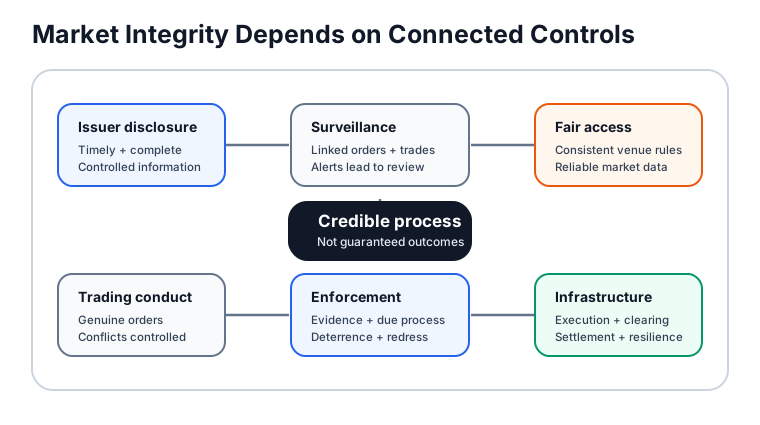
Core Elements of Market Integrity
| Element | What it supports | Evidence |
|---|---|---|
| Issuer disclosure | Timely access to material company information | Filings, announcements, corrections, and controls |
| Fair market access | Consistent admission, connectivity, and order-handling rules | Venue rules, agreements, permissions, and logs |
| Trading conduct | Protection against fraud, manipulation, misuse of information, and abusive practices | Orders, trades, communications, and account relationships |
| Price transparency | Visibility into bids, offers, trades, volume, and reference data as required | Market data and publication timestamps |
| Intermediary controls | Best execution, conflicts, suitability or conduct, capital, and supervision where applicable | Policies, routing records, reviews, and disclosures |
| Market infrastructure | Reliable execution, clearing, settlement, custody, and continuity | System logs, reconciliations, margin, default, and incident records |
| Surveillance | Detection and escalation of anomalous or prohibited patterns | Alerts, cases, cross-market data, and dispositions |
| Enforcement and redress | Deterrence, accountability, review, and remedies | Decisions, sanctions, appeals, and compensation mechanisms |
Weakness in one layer can undermine the others. Accurate issuer disclosure is less useful if selected traders receive it early. Fair order rules are less useful if systems fail during stress or records cannot reconstruct what happened.
Market Integrity vs. Related Concepts
Market efficiency
Market Efficiency concerns how information is reflected in prices. Integrity concerns the rules and conduct through which information and orders enter the market. Prices can be volatile or wrong in hindsight without proving an integrity failure.
Liquidity
Liquidity describes the ability to trade without excessive delay or price impact. A liquid market can still contain manipulation, conflicts, or misleading disclosure. A less liquid market is not automatically unfair.
Financial stability
Stability concerns whether disruption threatens critical financial services or the wider system. Integrity failures can damage confidence and amplify stress, but an isolated misconduct case is not necessarily systemic.
Investor protection
Investor protection overlaps with integrity through disclosure, intermediary conduct, custody, enforcement, and redress. It does not eliminate investment risk or guarantee compensation.
How Information Supports Price Formation
Market prices combine public information, investor expectations, risk tolerance, liquidity, and order flow. Integrity controls focus on how that process occurs:
- issuers release required information through recognized channels;
- confidential information is controlled before publication;
- market participants submit genuine orders under venue rules;
- venues match or execute orders consistently;
- trade information is reported and published as required;
- clearing and settlement complete the transfer of cash and instruments; and
- regulators and venues retain enough data to investigate anomalies.
A fast price response is not proof of a fair process. Reviewers may need to determine whether information leaked, orders were bona fide, accounts were coordinated, or systems treated participants consistently.
Worked Example: Earnings Information and Trading
Assume a listed company expects profit to fall materially below public guidance. Before a broad announcement, an executive gives the update to two favored analysts without a confidentiality agreement. Accounts connected to one recipient sell shares before the public release.
An integrity review separates the evidence:
- Disclosure: Was the information material and nonpublic, and did selective disclosure rules apply?
- Access: Did some market participants receive an informational advantage unavailable to others?
- Trading: Who placed the orders, when, through which accounts, and with what knowledge?
- Communications: What was said, by whom, and under what duty or agreement?
- Price formation: How did orders and price change before and after public release?
- Controls: Did the issuer escalate the information, restrict insiders, and follow its disclosure process?
- Legal conclusion: Which regulator, statute, exchange rule, and evidentiary standard govern each person?
The unusual sales and price movement justify review but do not alone prove a violation. The case requires identities, duties, intent or knowledge where relevant, communications, timing, and applicable law.
Threats to Market Integrity
False or misleading disclosure
Omitting material context, fabricating results, or making unsupported claims can impair investor decisions and price formation.
Selective disclosure and misuse of information
Giving material nonpublic information to favored recipients or trading while subject to a relevant duty can create unfair informational advantages and legal exposure.
Manipulative trading
Wash trades, matched orders, marking the close, layering, spoofing, pump-and-dump activity, and other strategies can create false signals about supply, demand, volume, or price. Legal definitions and intent requirements vary.
Conflicts and unfair order handling
Routing incentives, principal trading, allocation practices, payment arrangements, or misuse of customer orders can harm customers or price formation when not properly controlled and disclosed.
Operational and infrastructure failures
Outages, erroneous data, weak access controls, settlement failures, cyber incidents, or inadequate business continuity can disrupt orderly trading even without misconduct.
Fragmented surveillance
Activity split across venues, products, accounts, entities, and jurisdictions can hide coordinated behavior unless data and authorities can be linked.
Surveillance and Investigation Workflow
Surveillance systems can monitor:
- unusual price, volume, volatility, or order-to-trade ratios;
- rapid order entry, cancellation, layering, or cross-venue patterns;
- employee, proprietary, customer, and related-account trading;
- activity around earnings, offerings, takeovers, index changes, and news;
- concentration, beneficial ownership, or common control; and
- failures, corrections, and latency across trading infrastructure.
An alert should lead to evidence gathering, not automatic accusation. A defensible case records the rule, pattern, accounts, market conditions, communications, explanation, reviewer, and disposition.
Indicators and Their Limits
| Indicator | What it can show | What it cannot prove alone |
|---|---|---|
| Bid-ask spread | Trading-cost and liquidity conditions | Fairness or absence of manipulation |
| Market depth | Available displayed size | Hidden liquidity or executable size under stress |
| Price impact | Response to order flow | Whether the move is abusive or information-driven |
| Volatility | Magnitude of price changes | Misconduct, overvaluation, or disorder by itself |
| Failed trades | Settlement or operational problems | Cause, responsibility, or investor harm |
| Surveillance alerts | Patterns meeting configured tests | Legal violation or intent |
| Disclosure timing | Sequence of public information | Who knew, traded, or breached a duty |
Benford’s Law, z-scores, and anomaly models can support selected reviews, but no generic formula measures market integrity as a whole.
Roles and Responsibilities
- Issuers maintain disclosure controls and communicate required information.
- Trading venues set access and trading rules, operate systems, publish data, and conduct surveillance within their remit.
- Broker-dealers and intermediaries supervise personnel, handle orders, manage conflicts, and keep records.
- Clearing houses, depositories, and custodians support completion, asset protection, margin, and default management.
- Auditors and gatekeepers provide specified assurance, diligence, or professional review.
- Regulators and self-regulatory organizations make rules, examine conduct, investigate, and enforce.
- Investors remain responsible for evaluating price, risk, product terms, and counterparty exposure.
No participant’s role is a guarantee that another participant is honest or solvent.
How to Evaluate Market Integrity
- Define the instrument, venue, participants, and jurisdiction.
- Identify the disclosure, access, trading, and settlement rules.
- Measure data quality, latency, availability, and auditability.
- Review conflicts, order handling, surveillance, and escalation controls.
- Test whether records link beneficial owners, accounts, orders, trades, and communications.
- Examine incident, complaint, enforcement, correction, and outage history.
- Distinguish market-quality metrics from legal compliance evidence.
- Assess cross-venue and cross-border cooperation where activity is fragmented.
Common Mistakes
Equating integrity with a stable or rising market. Fair markets can decline sharply when information changes.
Saying integrity produces true value. Prices remain estimates formed under uncertainty.
Treating every anomaly as manipulation. Legitimate news, hedging, liquidity demand, and model behavior can produce unusual patterns.
Focusing only on ethics. Integrity requires operational systems, records, supervision, and enforceable rules.
Assuming disclosure alone creates equal information. Timing, access, comprehension, data quality, and selective disclosure also matter.
Promising investor protection eliminates loss. Market, credit, liquidity, and operational risks remain.
Official Sources
- SEC: Mission describes the U.S. objective of protecting investors and maintaining fair, orderly, and efficient markets.
- IOSCO: Objectives and Principles of Securities Regulation sets international principles for investor protection and fair, efficient, transparent markets.
- FCA: Market Abuse Regulation explains UK market-abuse, inside-information, disclosure, and surveillance responsibilities.
- SEC: Regulation FD adopting release provides a concrete disclosure mechanism supporting fair access to issuer information.
Related Terms
- Market Manipulation: Conduct intended to create false or misleading market signals under applicable law.
- Insider Trading: Trading or tipping involving material nonpublic information under specified duties and legal standards.
- Material Information: Information a reasonable investor would likely consider important.
- Regulatory Oversight: Monitoring, examination, and enforcement by authorized bodies.
- Market Efficiency: The degree to which prices reflect available information.
- Profit Warning: Public communication that expected performance is materially weaker than prior guidance or expectations.
FAQs
Does market integrity mean prices are always correct?
Does high liquidity prove a market has integrity?
How do regulators detect market abuse?
Can regulation eliminate market misconduct?
This article provides general market-structure and securities-regulation education, not legal, compliance, trading, or investment advice. Apply the current rules for the relevant instrument, venue, participant, and jurisdiction.