Company Guidance on Earnings
Earnings guidance is management's outlook for future revenue, profit, EPS, margins, cash flow, or operating measures and the assumptions behind them.
Company guidance on earnings, usually called earnings guidance, is management’s public outlook for future financial or operating performance. It can cover revenue, operating profit, earnings per share, margins, cash flow, capital expenditure, unit volume, or another measure for a quarter, year, or longer period.
Guidance is an estimate based on assumptions, not a promise or audited result. Its usefulness depends on the measure, range, accounting basis, time horizon, assumptions, update policy, and management’s record of explaining revisions.
Key Takeaways
- Guidance can be numerical, directional, scenario-based, or limited to operating drivers.
- A range communicates uncertainty but does not prove that every outcome inside the range is equally likely.
- Analyst consensus is separate from management guidance.
- GAAP and non-GAAP guidance should not be combined without definitions and, where required, reconciliation.
- A company can raise one metric while lowering another, such as revenue growth with weaker margins.
- Guidance revisions can affect disclosure, Regulation FD, exchange, antifraud, and insider-trading controls.
- Investors should rebuild the implied income statement and cash-flow effects rather than focus only on headline EPS.
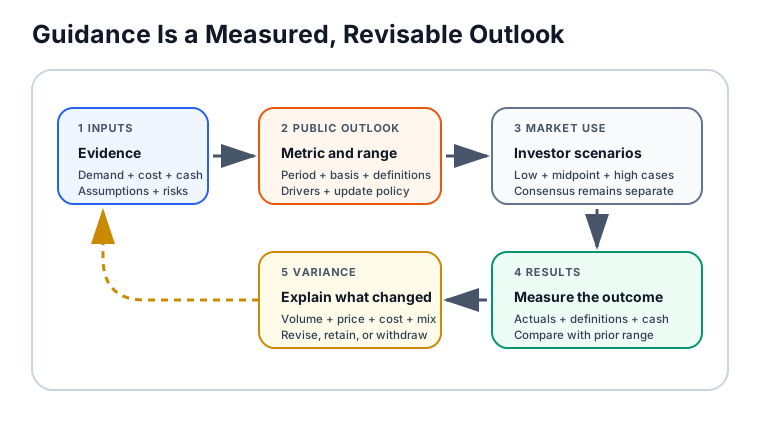
Common Forms of Guidance
| Guidance form | Example | What to verify |
|---|---|---|
| Point estimate | Revenue of USD 1.0 billion | Precision and sensitivity around the estimate |
| Range | EPS of USD 2.40 to USD 2.70 | Midpoint, width, and probability assumptions |
| Growth rate | Revenue growth of 6% to 8% | Currency, acquisitions, disposals, and comparison period |
| Margin | Operating margin of 14% to 15% | GAAP or adjusted basis and cost assumptions |
| Directional | Profit expected to improve in the second half | Baseline, magnitude, and timing |
| Operating driver | Shipments of 90,000 to 95,000 units | Price, mix, utilization, and conversion to earnings |
| Scenario | Base, upside, and downside outcomes | Scenario probabilities and trigger conditions |
| Withdrawal | Prior guidance no longer reliable | Reason, current evidence, and next update |
Some companies guide every quarter; others provide annual targets, long-term objectives, or no formal earnings range. The absence of guidance is not the absence of disclosure obligations.
Guidance vs. Forecast, Target, and Consensus
Guidance is management’s public outlook. A forecast may be an internal model, lender case, budget, analyst estimate, or public projection. A target can be an aspiration rather than management’s current best estimate. Consensus aggregates external analyst estimates.
These distinctions matter. If consensus is USD 3.00 EPS but management’s public range is USD 2.70 to USD 2.90, saying the company “missed guidance” when it reports USD 2.85 is incorrect even though it missed consensus.
Long-term targets deserve particular care. A company may aim for 20% margin in three years while expecting 14% next year. Treating the target as next-year guidance can materially distort valuation.
What Good Guidance Defines
Decision-useful guidance identifies:
- reporting period and effective date;
- currency and foreign-exchange assumptions;
- GAAP, IFRS, statutory, or non-GAAP basis;
- acquisitions, disposals, and discontinued operations;
- organic versus reported growth;
- price, volume, mix, and commodity assumptions;
- expected tax rate, interest cost, and diluted share count;
- capital expenditure, working capital, or cash conversion where relevant;
- known restructuring or one-time items; and
- principal uncertainties that can move results outside the range.
An adjusted metric should not be more precise than the assumptions supporting it.
Worked Example: Revenue and Margin Revision
Assume a company initially guides to revenue of USD 950 million to USD 990 million and operating margin of 14% to 15%. It later lowers revenue to USD 900 million to USD 930 million and margin to 12.5% to 13.5%.
Using range midpoints:
| Calculation | Initial guidance | Revised guidance |
|---|---|---|
| Revenue midpoint | USD 970.0 million | USD 915.0 million |
| Margin midpoint | 14.5% | 13.0% |
| Implied operating profit | USD 140.7 million | USD 119.0 million |
| Implied operating-profit change | -15.4% |
Revenue falls about 5.7% at the midpoint, but implied operating profit falls about 15.4% because the margin also declines. An investor who updates only the revenue line will understate the earnings effect.
The next questions are:
- Is the margin change caused by lower volume, price, input cost, mix, or temporary disruption?
- Is the operating-profit measure GAAP or adjusted?
- Does lower profit reduce operating cash flow or covenant headroom?
- Are tax, interest, share-count, or restructuring assumptions changing too?
- What evidence supports the revised range, and when will it be updated again?
How Guidance Reaches the Market
Companies can communicate guidance through earnings releases, SEC filings, regulatory announcements, investor presentations, public conference calls, and other recognized channels. The process should provide broad access and control selective disclosure.
For a covered U.S. issuer, Regulation FD can apply when material nonpublic guidance is disclosed to specified analysts, investors, or security holders. A private correction to an analyst’s estimate can be problematic even when management does not provide a complete new range.
A public earnings release concerning completed-period results commonly appears as an exhibit to Form 8-K under Item 2.02. Forward-looking guidance can also be communicated through a Regulation FD or voluntary current-report item, depending on the content and circumstances. The relevant filing instructions control.
Forward-Looking and Non-GAAP Measures
Guidance is usually a Forward-Looking Statement. U.S. statutory safe-harbor provisions can protect some forward-looking statements under specified conditions, but the protection is not automatic and does not permit knowingly false statements or erase other requirements.
If guidance uses adjusted EBITDA, adjusted EPS, free cash flow, constant currency, or another non-GAAP measure, Regulation G and Item 10(e) of Regulation S-K can require presentation, explanation, and reconciliation. For some forward-looking non-GAAP measures, a quantitative reconciliation exception can apply when the unavailable information and its probable significance are disclosed as required.
“Adjusted” is not a uniform accounting basis. Compare exclusions across periods and issuers.
How Analysts Should Use Guidance
Rebuild, do not paste
Translate revenue, margin, tax, interest, and share-count guidance into a coherent model. Do not mix the low end of one range with the midpoint of another without stating the scenario.
Separate external assumptions
Management may not guide foreign exchange, commodity prices, rates, or macroeconomic demand. Make those analyst assumptions visible rather than attributing them to the company.
Test range sensitivity
Estimate outcomes at the low, midpoint, and high cases. Test which variables make results leave the published range.
Compare guidance with cash
EPS can improve while cash flow weakens because of working capital, capital expenditure, restructuring payments, or financing costs.
Track revisions consistently
Record the original guidance, every revision date, actual outcome, and the explanation. Avoid hindsight by preserving what was publicly known at each date.
Why Companies Provide or Avoid Guidance
Potential benefits include reducing information gaps, helping investors model the business, communicating operating drivers, and setting a baseline for accountability.
Potential costs include encouraging short-term focus, creating false precision, increasing litigation or disclosure risk, revealing competitive information, and forcing repeated revisions in volatile conditions.
The choice not to publish periodic targets does not permit a company to selectively disclose material nonpublic information or leave an earlier public statement materially misleading.
Common Mistakes
Treating guidance as a guarantee. Actual results can fall outside the range for disclosed or unexpected reasons.
Equating guidance with consensus. Management and analysts produce different forecasts.
Comparing GAAP with adjusted guidance. Definitions and reconciliation matter.
Looking only at EPS. Revenue, margin, cash, leverage, and share count can tell a different story.
Assuming a narrow range is more reliable. Precision can exceed the quality of the underlying forecast.
Ignoring range width changes. A wider range can signal greater uncertainty even when the midpoint is unchanged.
Using boilerplate as proof of safe-harbor protection. Applicable conditions and statement quality must be assessed.
Official Sources
- SEC: Regulation FD adopting release discusses selective earnings guidance and broad public disclosure.
- SEC: Non-GAAP Financial Measures interpretations addresses presentation, reconciliation, prominence, and forward-looking measures.
- SEC: Conditions for Use of Non-GAAP Financial Measures explains Regulation G and Item 10(e).
- SEC: Official Form 8-K and instructions provides Item 2.02, Item 7.01, and other current-report requirements.
Related Terms
- Profit Warning: An announcement that expected performance is materially weaker than prior guidance or expectations.
- Forward-Looking Statements: Statements about expected future performance, plans, risks, or assumptions.
- Material Information: Information a reasonable investor would likely consider important.
- Earnings Per Share: Profit allocated per weighted-average share under the applicable calculation.
- Capital Expenditure: Long-term asset spending that can affect cash guidance differently from earnings.
- Form 8-K: The U.S. current report used for specified events and voluntary information.
FAQs
Are companies required to provide earnings guidance?
Is analyst consensus the same as company guidance?
Why do companies provide guidance ranges?
Can management revise guidance privately with analysts?
This article provides general financial-reporting and securities education, not accounting, legal, disclosure, or investment advice. Guidance should be assessed using current rules and issuer-specific evidence.