Watch List
A financial watch list identifies people, entities, transactions, or securities for screening or monitoring; its source determines the legal response.
A watch list is a set of names, entities, accounts, countries, vessels, transactions, or securities selected for screening or closer monitoring. In finance, the term can refer to an official sanctions or law-enforcement list, an internal AML monitoring list, or a confidential securities-compliance list used to review trading where a firm may possess material nonpublic information.
The label has no single legal effect. A match might require blocking, rejection, reporting, enhanced review, trading surveillance, or no action after a false positive is resolved. The list’s owner, authority, purpose, and matching evidence determine the response.
Key Takeaways
- A watch list is a control input, not proof that a person committed misconduct.
- Official sanctions lists, FinCEN information requests, politically exposed person data, adverse-media feeds, and securities watch lists serve different purposes.
- Name similarity creates an alert; identity requires comparison with reliable identifiers.
- Screening should account for aliases, transliteration, ownership, transaction parties, and list updates.
- A politically exposed person is not automatically prohibited or criminal; the status can inform risk-based due diligence.
- In securities compliance, a watch list usually triggers close surveillance, while a restricted list more often limits or prohibits trading or recommendations.
- Confidential list data needs controlled access, retention, and escalation procedures.
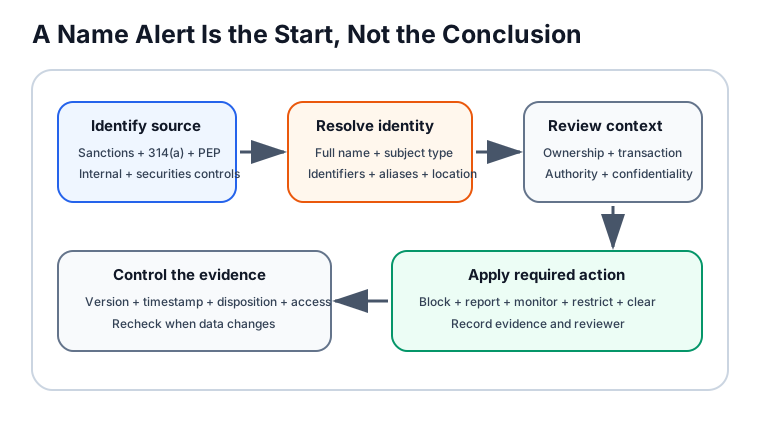
Major Types of Financial Watch Lists
| List type | Typical content | Possible response |
|---|---|---|
| Sanctions list | Designated or restricted people, entities, vessels, or addresses | Apply the program’s block, reject, restriction, license, or reporting rule |
| Law-enforcement request | Subjects sought for specified account or transaction searches | Search and respond through the authorized confidential process |
| Internal AML list | Customers, counterparties, accounts, devices, or patterns selected for monitoring | Enhanced review, transaction monitoring, or case escalation |
| PEP or public-office data | Current or former public officials and related persons under a provider’s methodology | Risk assessment and proportionate due diligence, not automatic rejection |
| Adverse-media data | Reports associating a person or entity with allegations or events | Verify source quality, identity, relevance, status, and recency |
| Securities watch list | Issuers or securities subject to confidential trading surveillance | Review employee or proprietary trading for possible misuse of information |
| Restricted list | Securities or parties subject to defined prohibitions or limitations | Enforce the stated restriction and exception process |
Combining these sources into one undifferentiated database is dangerous. An OFAC SDN match can have legal blocking consequences, while a PEP result normally calls for risk-based review. An internal alert may reflect a previous false positive rather than government action.
List Source Determines Legal Effect
Before acting on a match, identify:
- List owner: OFAC, FinCEN, another government, an exchange, the firm, or a commercial provider.
- Authority: Statute, regulation, order, request, supervisory procedure, or internal policy.
- List version: Publication date, program tag, additions, removals, and corrections.
- Subject type: Individual, entity, vessel, aircraft, wallet address, security, or jurisdiction.
- Required action: Block, reject, report, search, monitor, restrict, investigate, or document no match.
- Confidentiality: Whether the list, request, investigation, or response can be disclosed.
The same name can appear in several data sources with different consequences. The case record should preserve which source generated the alert.
Resolving a Name Alert
A reliable alert-resolution process moves from broad matching to specific evidence:
Confirm the matching source
Determine whether the hit is against an OFAC list, another country’s list, a PEP feed, internal records, or another source. OFAC explicitly tells users to contact the keeper of a non-OFAC list rather than treat every software result as an OFAC match.
Compare subject types and full names
An individual should not be matched to a vessel or company merely because one token is similar. Compare the full name, aliases, order of names, transliterations, and entity type.
Compare identifiers
Useful identifiers can include date and place of birth, nationality, address, passport, tax number, company-registration number, vessel identifier, digital address, and known associates. Missing data should lead to more information gathering, not an unsupported conclusion.
Check ownership and control
A company can be affected even when it is not named. For U.S. sanctions, Office of Foreign Assets Control ownership rules can treat an entity as blocked based on aggregate ownership by blocked persons.
Apply the governing rule
Identity is only part of the analysis. Review transaction type, goods, services, geography, intermediaries, exemptions, licenses, account history, and reporting requirements.
Record the disposition
Document true match, false positive, insufficient information, escalation, monitoring, or restriction. Include evidence, reviewer, timestamp, and next review trigger.
Worked Example: Common-Name Alert
A U.S. bank’s screening system flags a new customer named Samir Haddad against an OFAC entry. A name-only comparison looks close.
The onboarding team obtains and compares the customer’s date of birth, nationality, address, passport, and full aliases with the official list entry. The customer is a Canadian resident born in 1988; the listed person has a different middle name, nationality, date of birth, and passport data.
The bank documents a false positive and continues onboarding subject to its normal risk controls. It does not describe the customer as sanctioned merely because the software produced an alert.
If several identifiers matched or reliable ownership data connected the customer to a blocked entity, the case would be escalated before activity proceeded. If the alert came from a PEP database instead, the bank would apply its PEP and customer-risk procedures rather than OFAC blocking rules.
Screening Quality and False Results
False positives
Broad matching catches spelling differences but can generate many unrelated names. Excessive false positives consume review capacity and can delay legitimate payments or accounts.
False negatives
Narrow matching can miss aliases, transliterations, reordered names, incomplete payment fields, indirect ownership, or new list entries. A system that produces few alerts is not necessarily effective.
Data and model controls
Useful controls include:
- timely and complete list updates;
- tested fuzzy-matching and transliteration logic;
- reliable customer and counterparty identifiers;
- screening of relevant payment and trade fields;
- ownership and intermediary data;
- calibrated thresholds by risk and data quality;
- independent testing and quality assurance; and
- documented tuning, overrides, and repeat false-positive handling.
No score should replace the underlying legal and identity analysis.
Securities Watch List vs. Restricted List
Broker-dealers and investment firms can use confidential watch and restricted lists to control material nonpublic information.
| Feature | Watch list | Restricted list |
|---|---|---|
| Typical purpose | Close surveillance of trading in selected securities | Enforce trading, recommendation, research, or other restrictions |
| Distribution | Usually tightly limited to legal or compliance staff | Often shared with personnel who must observe restrictions |
| Trading effect | May not prohibit trading by itself | Usually restricts or prohibits stated activity |
| Evidence | Addition/removal reason, dates, access, reviews, and exceptions | Restriction, effective period, affected persons, and approvals |
A takeover rumor or unusual volume is not by itself the defining reason for a securities watch list. The stronger compliance use is surveillance where the firm may possess material nonpublic information or needs to monitor potential misuse. Written procedures should state who can add or remove an issuer and how related trading is reviewed.
FinCEN 314(a) Is Not a Public Sanctions List
Under Section 314(a), FinCEN can transmit confidential requests that require covered financial institutions to search for specified accounts or transactions associated with subjects identified through the program. Institutions respond through the authorized process when they find a positive match.
A 314(a) subject is not automatically an OFAC-designated person, and the request does not direct the institution to block an account merely because a name appears. Search scope, response timing, confidentiality, and follow-up are governed by the program instructions.
Common Mistakes
Calling every screening database a government watch list. Preserve the source and authority.
Treating a name alert as proof of identity. Compare complete identifiers and entity type.
Automatically rejecting PEPs. Public-office status informs risk; it is not a criminal finding or universal prohibition.
Screening names but ignoring ownership. Unlisted entities can still be restricted under applicable ownership rules.
Using stale list data. Sanctions and other official lists can change frequently.
Confusing securities watch and restricted lists. Surveillance and prohibition are different controls.
Disclosing confidential information. Internal lists, SAR-related analysis, 314(a) requests, and securities-control records require controlled handling.
Official Sources
- OFAC FAQ 5: Determining a valid match explains how to identify the list and compare names and identifiers.
- OFAC Sanctions List Service provides current list data and search resources.
- FinCEN: Section 314(a) provides current program information and authorized financial-institution resources.
- FINRA Notice to Members 91-45 describes the traditional distinction between confidential securities watch lists and more widely distributed restricted lists. Firms must also check current rules and procedures.
Related Terms
- Office of Foreign Assets Control (OFAC): The U.S. Treasury office administering U.S. economic sanctions.
- Bank Secrecy Act (BSA): The U.S. framework for specified financial records, reports, and AML controls.
- Enhanced Due Diligence (EDD): Additional review for elevated customer or transaction risk.
- Asset Freezing: Restricting dealings with specified property under legal authority.
- Beneficial Ownership: The ownership or economic interest behind a nominal person or entity.
- Market Integrity: Reliable market conduct supported by information controls and surveillance.
FAQs
Is a watch-list alert proof that someone is sanctioned?
Are politically exposed persons prohibited customers?
Is a securities watch list the same as a restricted list?
How often should watch lists be updated?
This article provides general financial-compliance education, not legal, sanctions, AML, employment, or investment advice. Apply the current list, authority, jurisdiction, identifiers, ownership, and transaction facts.