Internal Control
Internal control is a system of people, processes, information, and monitoring that provides reasonable assurance about specified objectives.
Internal control is a system of people, authority, processes, information, technology, and monitoring designed to provide reasonable assurance that an organization can achieve specified operations, reporting, and compliance objectives. A control can prevent an error, detect it quickly, support correction, or monitor whether other controls continue to work.
Internal control reduces risk; it does not eliminate uncertainty, judgment, misconduct, system failure, or loss. A policy is not a control unless it is translated into an action with an owner, trigger, evidence, exception path, and follow-up.
Key Takeaways
- Controls should address a defined risk and objective, not exist merely because a framework lists them.
- Design, implementation, and operating effectiveness are separate questions.
- Preventive, detective, corrective, manual, automated, transaction, and entity-level controls can work together.
- Segregation of duties helps, but access, review quality, data reliability, and management override still matter.
- Internal control over financial reporting is narrower than the organization’s entire control system.
- A material weakness can exist even when no current material misstatement has been identified.
- Reasonable assurance recognizes practical limitations; it is not a guarantee of perfect compliance or reporting.
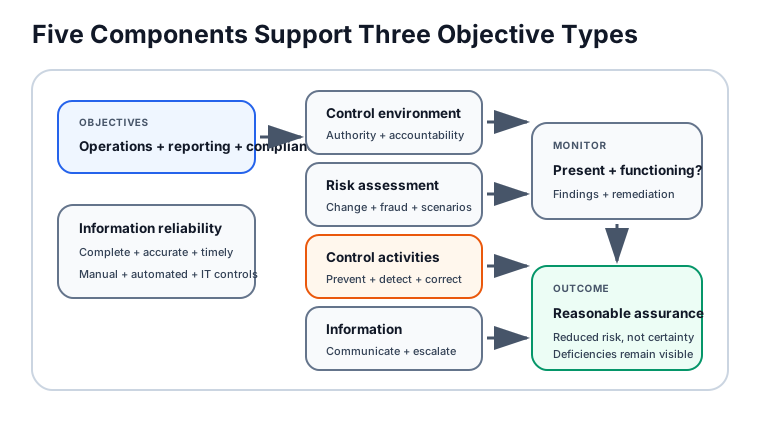
The Five COSO Components
The COSO Internal Control - Integrated Framework organizes effective internal control around five connected components:
| Component | Purpose | Example evidence |
|---|---|---|
| Control environment | Establish integrity, authority, accountability, competence, and oversight | Organization chart, board challenge, conduct decisions, and delegated authority |
| Risk assessment | Identify and analyze threats to objectives, including change and fraud risk | Risk scenarios, assumptions, ratings, owners, and updates |
| Control activities | Perform actions that address identified risks | Approvals, reconciliations, access restrictions, calculations, and reviews |
| Information and communication | Obtain and share complete, timely, relevant information | Data lineage, reports, escalation records, and external communication |
| Monitoring activities | Determine whether components and controls remain present and functioning | Ongoing checks, separate evaluations, deficiencies, and remediation testing |
The components are integrated. A reconciliation cannot compensate fully for a culture that rewards override, and a strong control environment cannot replace transaction-level evidence.
Control Objectives
Operations
Operations controls support effective and efficient processes, asset use, continuity, quality, and achievement of business objectives. Examples include inventory access, payment authorization, production monitoring, and incident response.
Reporting
Reporting controls support reliable, timely internal and external financial or nonfinancial information. They can address completeness, accuracy, occurrence, valuation, rights and obligations, classification, presentation, and disclosure.
Compliance
Compliance controls support adherence to applicable laws, regulations, licence conditions, contracts, and internal commitments. Examples include sanctions screening, trade surveillance, regulatory reporting, and approval of customer disclosures.
An organization may use the same control for more than one objective. Access management can protect assets, support reliable reporting, and restrict prohibited activity.
Preventive, Detective, and Corrective Controls
| Control type | When it acts | Example | Limitation |
|---|---|---|---|
| Preventive | Before an unwanted event | System blocks a payment above authority limit | Poor configuration or override can bypass it |
| Detective | During or after an event | Daily bank reconciliation identifies an unmatched payment | Detection may be too late to prevent loss |
| Corrective | After a problem is identified | Reverse error, recover funds, and fix master data | Correction does not address root cause by itself |
| Monitoring | Across controls or periods | Manager reviews exception trends and overdue remediation | High-level review may lack precision |
A balanced system often combines types. A vendor approval prevents unauthorized setup, payment analytics detect unusual activity, reconciliation identifies exceptions, and remediation closes the access or process gap.
Design, Implementation, and Operating Effectiveness
Design effectiveness asks whether the control, if performed by a competent person as described, could address the risk at the required level of precision.
Implementation asks whether the designed control has actually been put into use. A procedure stored in draft form is not implemented.
Operating effectiveness asks whether the implemented control operated consistently, at the right time, by qualified and authorized people, using reliable information, throughout the period tested.
These stages should not be collapsed. A well-designed monthly review that occurred only twice is not operating effectively. A daily sign-off that never examines the relevant exception is poorly designed even if completed every day.
Worked Example: Revenue Cut-Off Control
Assume a distributor ships products near year-end. The reporting risk is that revenue is recorded in the wrong period because invoice dates do not match contractual transfer of control.
One control design is:
- the system identifies every shipment recorded in the final five business days of the year and first five days of the next year;
- an independent revenue accountant compares contract terms, shipping evidence, acceptance, invoice date, and ledger period;
- differences above a defined threshold are corrected or escalated before close;
- the reviewer signs and dates the report, records evidence, and resolves every exception; and
- a controller checks report completeness and overdue exceptions.
Suppose the report contains 240 shipments, but the reviewer checks only the invoice date and signs without examining transfer terms. The control operated in form, not at the precision required to address cut-off risk. If testing later finds a material early-recognition error, the organization must evaluate the misstatement and control deficiency separately.
The remedy may include better data fields, a revised review instruction, training, access changes, automated matching, and retrospective testing. Adding another signature without changing the evidence test is unlikely to solve the problem.
Manual, Automated, and IT-Dependent Controls
- Manual control: A person performs the procedure, such as approving a journal entry.
- Automated control: Configured logic performs the action, such as rejecting a duplicate invoice.
- IT-dependent manual control: A person reviews a system-generated report or calculation.
- IT general control: Access, change management, operations, backup, and other controls support application and data reliability.
Automation can improve consistency and population coverage, but code, configuration, access, source data, model changes, and interfaces require controls. A manual reviewer cannot rely on an incomplete exception report merely because it came from a trusted system.
Entity-Level and Transaction-Level Controls
Entity-level controls influence the organization broadly: board oversight, delegated authority, ethics and incentives, risk assessment, whistleblower processes, close governance, and monitoring. Some operate with enough precision to address a particular reporting risk; others affect how much reliance can be placed on more detailed controls.
Transaction-level controls apply to specific processes such as revenue, purchasing, payroll, treasury, inventory, tax, or consolidation. Their design should connect to relevant assertions and failure scenarios.
Internal Control Over Financial Reporting
Internal control over financial reporting (ICFR) focuses on reasonable assurance regarding reliable financial reporting and preparation of external financial statements under the applicable framework. It does not cover every operational or legal risk merely because that risk could eventually cost money.
For covered U.S. issuers, SEC rules implementing Sarbanes-Oxley Act Section 404 require management’s annual report on ICFR. The precise management and external-auditor requirements depend on issuer status and current SEC rules.
In a PCAOB integrated audit, the financial-statement audit and ICFR audit have related evidence but different objectives. Management remains responsible for establishing and maintaining ICFR and for its assessment.
Control Deficiencies and Material Weaknesses
A control deficiency exists when design or operation does not allow management or employees, in the normal course of their functions, to prevent or detect misstatements on a timely basis under the applicable definition.
A material weakness is a deficiency, or combination of deficiencies, creating a reasonable possibility that a material financial-statement misstatement will not be prevented or detected on time. Under PCAOB AS 2201, ICFR cannot be considered effective when one or more material weaknesses exist.
A material weakness can exist without an identified material misstatement. Conversely, an error does not automatically prove a material weakness; reviewers assess likelihood, magnitude, compensating controls, cause, and affected accounts and disclosures.
How to Test a Control
- Define the objective, risk, assertion, and required precision.
- Identify the owner, frequency, population, systems, and evidence.
- Walk through one or more transactions from initiation to reporting.
- Test completeness and accuracy of information used by the control.
- Select periods or items appropriate to frequency and risk.
- Inspect evidence, reperform steps, observe activity, and inquire as appropriate.
- Evaluate deviations, causes, compensating controls, and possible misstatement.
- Determine whether remediation was implemented and sustained long enough to retest.
Inquiry alone usually does not establish operating effectiveness. A signature proves that someone signed, not necessarily that the required review occurred.
Inherent Limitations
Internal control can fail because of:
- human error, fatigue, misunderstanding, or poor judgment;
- collusion between employees or third parties;
- management override;
- incomplete or inaccurate data;
- unauthorized system or configuration changes;
- poorly designed thresholds or models;
- rapid business, regulatory, or technology change;
- cost and resource constraints; or
- controls that operate too late to prevent significant harm.
Reasonable assurance balances risk, benefit, cost, and feasibility. It does not permit ignoring a required control solely because noncompliance appears inexpensive.
Common Mistakes
Using a mathematical control score as proof. There is no universal formula that converts control ratings into effectiveness.
Equating policy with control. A policy needs operational steps, ownership, evidence, and monitoring.
Testing signatures instead of review quality. Inspect what the reviewer compared, challenged, and resolved.
Adding approvals without segregation. Two approvals are weak if both users rely on the same incomplete data or one can override the other.
Assuming automation cannot fail. Configuration, data, access, interfaces, and changes remain control risks.
Closing deficiencies before validation. A redesigned control must be implemented and operate for enough time to test.
Official Sources
- COSO: Internal Control guidance describes the integrated framework’s operations, reporting, and compliance objectives and five components.
- PCAOB: AS 2201, An Audit of Internal Control Over Financial Reporting addresses top-down risk assessment, control testing, deficiencies, material weaknesses, and reporting.
- SEC: Management’s Report on Internal Control Over Financial Reporting implements management reporting requirements under Sarbanes-Oxley Act Section 404.
- SEC: Role of Audit Committees in Financial Reporting discusses oversight of ICFR, estimates, audit quality, and auditor independence.
Related Terms
- COSO Framework: A widely used principles-based framework for internal control.
- Audit Committee: The board committee overseeing financial reporting, external audit, control, and related complaints.
- Compliance: The process of identifying and meeting applicable obligations and internal commitments.
- Corporate Governance: Structures for direction, oversight, accountability, and challenge.
- Material Misstatement: An error or omission that could reasonably affect financial-statement users.
- Financial Statement Fraud: Intentional material misstatement or omission designed to deceive users.
FAQs
What is the purpose of internal control?
What are the five components of internal control?
Does a completed checklist prove a control worked?
Can internal control prevent every error or fraud?
This article provides general internal-control, governance, and reporting education, not audit, accounting, legal, regulatory, cybersecurity, or investment advice. Apply the framework and requirements relevant to the organization and jurisdiction.