Office of Foreign Assets Control (OFAC)
OFAC administers U.S. economic sanctions, including sanctions lists, blocking rules, transaction restrictions, licenses, reporting, and enforcement.
The Office of Foreign Assets Control (OFAC) is the U.S. Department of the Treasury office that administers and enforces economic and trade sanctions based on U.S. foreign-policy and national-security goals. OFAC publishes sanctions regulations, program information, lists, licenses, guidance, and civil enforcement actions.
OFAC is not a general financial regulator and an OFAC list search is not a complete sanctions analysis. The governing program determines who is covered, what conduct is prohibited, whether property must be blocked, whether a transaction must be rejected, and whether an exemption or license permits the activity.
Key Takeaways
- All U.S. persons generally must comply, including U.S. citizens and permanent residents wherever located, persons in the United States, and U.S.-organized entities and their foreign branches.
- Some programs also reach specified foreign subsidiaries or conduct by non-U.S. persons, so jurisdiction must be checked program by program.
- The SDN List is only one OFAC list, and not every list carries the same restrictions.
- An unlisted entity can be blocked under OFAC’s 50 Percent Rule based on direct or indirect aggregate ownership by blocked persons.
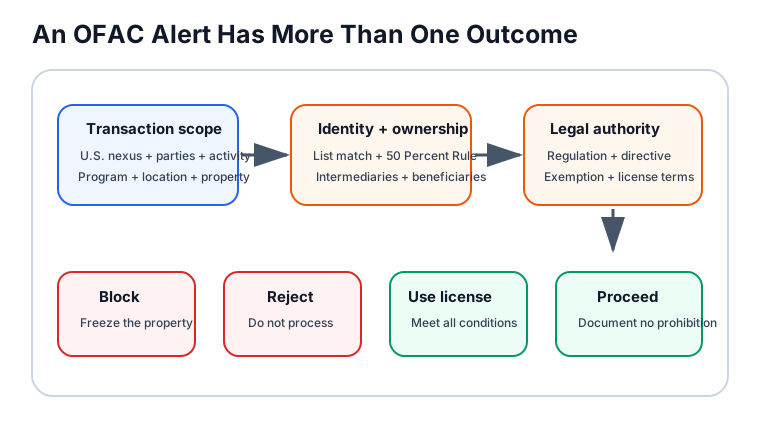
- Blocking freezes property; rejection stops a prohibited transaction without holding blocked property. The correct response depends on the authority.
- General and specific licenses can authorize activity that would otherwise be prohibited, subject to their exact conditions.
- OFAC can impose civil penalties on a strict-liability basis under applicable sanctions authorities; criminal prosecution is a separate Justice Department process.
What OFAC Administers
OFAC sanctions programs can target countries, governments, sectors, activities, individuals, entities, vessels, aircraft, digital-currency addresses, or other property interests. Programs are based on different statutes, executive orders, and regulations in 31 CFR Chapter V.
Sanctions can include:
- blocking property and interests in property of designated or otherwise blocked persons;
- prohibiting specified trade, services, investment, financing, or transactions;
- restricting dealings in specified debt, equity, securities, or sectors;
- requiring reports concerning blocked or rejected transactions; and
- authorizing otherwise prohibited activity through exemptions or licenses.
The words “comprehensive” and “targeted” are useful descriptions, not substitutes for the regulations. Even a country-focused program can contain exemptions, licenses, and activity-specific rules, while a targeted program can affect an unlisted company through ownership.
Who Must Comply
OFAC states that U.S. persons include:
- U.S. citizens and permanent resident aliens wherever located;
- all persons and entities within the United States; and
- entities organized under U.S. law, including their foreign branches.
Certain programs extend obligations to foreign subsidiaries owned or controlled by U.S. persons. Non-U.S. persons also can face prohibitions on causing a U.S. person to violate sanctions, evading sanctions, or engaging in conduct covered by a particular program.
The presence of a U.S. bank, U.S. dollar clearing path, U.S. employee, U.S. company, U.S.-origin item, or activity in the United States can be relevant, but it does not produce one automatic answer. The actual sanctions authority and transaction chain control.
Lists, Programs, and the 50 Percent Rule
The Specially Designated Nationals and Blocked Persons List, or SDN List, identifies many blocked persons. OFAC also maintains non-SDN lists whose restrictions differ. A screening system must preserve the list name and program tag rather than reducing every result to “OFAC hit.”
List screening alone is incomplete for three reasons:
- A program can prohibit conduct based on country, sector, service, or transaction even when no party is named on a list.
- An entity owned 50% or more in the aggregate, directly or indirectly, by one or more blocked persons is generally treated as blocked under OFAC’s 50 Percent Rule even if it is not separately listed.
- A similar name can be a false positive; OFAC instructs users to compare identifiers such as entity type, address, nationality, date of birth, passport, tax identifier, aliases, and other available data.
Control without 50% ownership does not by itself make an entity blocked under that ownership rule, although a controlled entity can present other sanctions or designation risk. The specific program and facts still require review.
Block, Reject, License, or Proceed
| Outcome | When it can apply | Operational effect |
|---|---|---|
| Block | Property contains a blockable interest under the applicable authority | Freeze the property, prevent dealings, record it, and report as required |
| Reject | Transaction is prohibited but no blockable property interest is present | Do not process; return or stop the transaction and report when required |
| Process under license | A general or specific license authorizes the activity | Satisfy every condition and retain supporting evidence |
| Proceed | No prohibition applies after reasonable analysis | Document disposition and apply normal controls |
| Escalate | Identity, ownership, program, or authorization remains unclear | Hold within lawful authority and seek qualified guidance before action |
Asset Freezing does not automatically transfer ownership to the government. Blocked property remains immobilized until authorized release, delisting, program change, or another lawful event.
Worked Example: An Unlisted Company
Assume a U.S. bank receives a payment involving Atlas Components Ltd. Atlas does not appear in the Sanctions List Search results. Reliable ownership records show that Blocked Person A owns 30% and Blocked Person B owns 25%, with both interests direct and current.
The bank should not clear the payment merely because Atlas is unlisted. Under OFAC’s 50 Percent Rule, the aggregate blocked ownership is 55%, so Atlas is generally treated as blocked. If Atlas has a property interest in the payment and the applicable program requires blocking, the bank blocks rather than returns the funds and files the required report.
The conclusion changes if:
- the ownership evidence is wrong or outdated;
- one shareholder is restricted under a nonblocking list rather than blocked;
- the relevant interest is below the rule’s threshold after tracing indirect ownership;
- a general or specific license authorizes the transaction; or
- another program-specific provision changes the treatment.
The case file should preserve ownership calculations, list records, program authority, payment details, decision, reviewer, timestamp, and any license relied upon.
Resolving a Screening Alert
An automated alert is a starting point:
- Identify the exact OFAC list, program, and matched field.
- Compare the full name and entity type, not only one token.
- Gather reliable identifiers and resolve differences.
- Trace direct and indirect ownership by blocked persons.
- Map all transaction parties, intermediaries, banks, locations, goods, and services.
- Read the current regulation, executive order, directive, exemption, and license.
- Decide whether to block, reject, process under authorization, proceed, or escalate.
- File reports and retain records under the current rules.
OFAC’s public search tool uses fuzzy logic, but users remain responsible for their analysis. A low score does not override known identity or ownership evidence, and a high score does not prove a match.
Sanctions Compliance Program
OFAC’s Framework for Compliance Commitments describes five core components of an effective risk-based program:
- management commitment;
- risk assessment;
- internal controls;
- testing and auditing; and
- training.
The framework does not prescribe one identical software system or screening frequency for every organization. Design should reflect products, services, customers, counterparties, locations, payment paths, supply chains, acquisitions, technology, and changes to programs or lists.
Important controls include list updates, ownership review, data quality, alternative spellings, payment-message fields, exception governance, escalation, licence conditions, reporting, and testing of filter performance.
Licenses and Humanitarian Activity
A general license authorizes a category of transactions without a separate application when all conditions are met. A specific license is issued to identified applicants for stated activity.
Food, medicine, humanitarian assistance, communications, legal services, and other activities may be exempt or authorized under particular programs. There is no safe assumption that every humanitarian transaction is automatically permitted. Parties, banks, goods, end use, documentation, reporting, and license conditions still require review.
Enforcement and Penalties
OFAC publishes civil enforcement information and Economic Sanctions Enforcement Guidelines. Applicable laws can permit civil penalties on a strict-liability basis, meaning knowledge is not always required for civil liability. OFAC considers facts that can aggravate or mitigate a civil response, including the compliance program and voluntary self-disclosure.
OFAC does not itself sentence people to imprisonment. Willful violations can create criminal exposure under the governing statute, with investigation and prosecution handled through the appropriate law-enforcement and Justice Department process.
Common Mistakes
Treating every list alert as a confirmed match. Compare identifiers and ownership before reaching a conclusion.
Checking only the SDN List. Other OFAC lists and program-based prohibitions may apply.
Ignoring unlisted owned entities. The 50 Percent Rule can block entities not named on a list.
Returning every prohibited payment. Some property must be blocked; other transactions are rejected.
Assuming humanitarian purpose is enough. Verify the exemption or license and all conditions.
Saying OFAC requires one standard compliance program. Controls should be tailored to actual sanctions risk.
Assuming authorization removes commercial risk. A license permits specified conduct; it does not guarantee payment, legality under other regimes, or transaction success.
Official Sources
- OFAC: Mission, programs, lists, and guidance is the primary starting point for current program information.
- OFAC FAQ 11: Who must comply explains the general scope for U.S. persons and selected non-U.S. conduct.
- OFAC FAQ 10: Lists and the 50 Percent Rule distinguishes the SDN List, other lists, and owned entities.
- OFAC FAQ 5: Determining a valid match provides an identity-resolution workflow.
- OFAC Framework for Compliance Commitments describes the five components of a risk-based sanctions compliance program.
- OFAC: Blocking and rejecting transactions explains the different operational outcomes.
Related Terms
- Financial Sanctions: Restrictions on parties, property, sectors, activities, or regions under a specific legal authority.
- Asset Freezing: Restricting dealings with specified property without necessarily changing ownership.
- Watch List: A list used for screening or monitoring whose source determines the required response.
- Bank Secrecy Act (BSA): The U.S. framework for specified AML records, reports, and controls.
- Beneficial Ownership: Ownership or economic interest behind a legal entity or nominal holder.
FAQs
Does OFAC regulate only banks?
Is every OFAC alert a confirmed sanctions match?
What is the difference between blocking and rejecting?
Can OFAC authorize a prohibited transaction?
This article provides general U.S. sanctions education, not legal or compliance advice. Programs and lists change frequently; check the current authority, parties, ownership, transaction, license, and official guidance.