Financial Services Act 1986
The Financial Services Act 1986 established the UK's former investment-business authorization, SIB, SRO, exchange, and conduct framework.
The Financial Services Act 1986 was the United Kingdom statute that created a broad regulatory system for investment business before the main regime under the Financial Services and Markets Act 2000 took effect. It restricted investment business to authorized or exempt persons and used a two-tier structure in which the Securities and Investments Board (SIB) oversaw recognized self-regulating organizations, exchanges, and other bodies.
The 1986 Act is primarily important for historical research. It should not be used as a statement of current UK authorization or conduct requirements without checking later legislation and the current FCA or PRA framework.
Key Takeaways
- Section 3 generally prohibited a person from carrying on or purporting to carry on investment business in the UK unless authorized or exempt under the Act.
- “Investment” and “investment business” depended on the activities, assets, and exclusions in Schedule 1, not merely on a firm’s commercial label.
- A person could obtain authorization through routes that included membership in a recognized self-regulating organization.
- The SIB became the designated agency at the center of the system, while recognized organizations performed much front-line rulemaking and supervision.
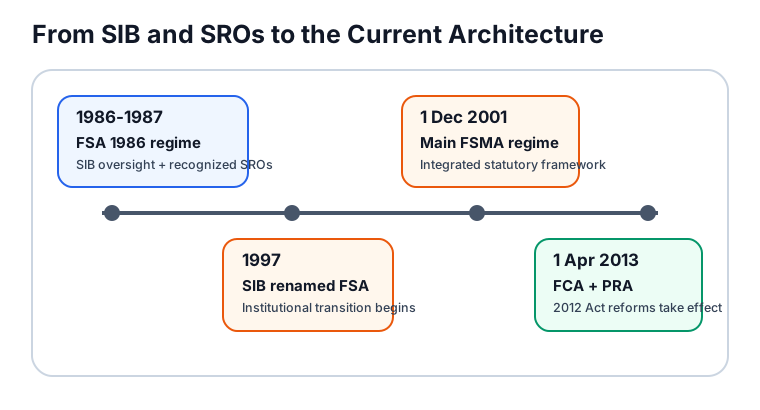
- The SIB changed its name to the Financial Services Authority in 1997; the main FSMA 2000 regime then replaced the former structure on 1 December 2001.
- The FCA and PRA architecture dates from the 2013 reforms made under the Financial Services Act 2012, not from the 1986 Act.
Why the Act Was Introduced
The Act followed major changes in UK securities markets and concern that investor-protection arrangements were fragmented. It brought a wide range of investment activities within one statutory structure while retaining substantial industry-based self-regulation.
Its scope was wider than stockbroking alone. Schedule 1 classified investments and investment activities, while other Parts addressed matters including collective investment schemes, offers of securities, insider dealing, and mutual recognition within the European Community as it then existed.
Historical scope must be read from the version in force on the relevant date. Amendments, commencement orders, exemptions, and transitional rules could change the result.
Authorization and the Regulatory Perimeter
Section 3 was the core restriction: a person could not carry on, or purport to carry on, investment business in the UK unless authorized or exempt. The analysis therefore required several questions:
- Was the asset, right, or interest an “investment” under the statutory schedule?
- Was the person performing an activity classified as investment business?
- Did an exclusion apply to that activity?
- Was the activity carried on as a business in the UK under the territorial test?
- Was the person authorized through a statutory route or exempt for that business?
Contravention could have criminal, civil, injunction, and restitution consequences under the Act. The exact consequence depended on the provision, facts, and law in force at the time.
The Two-Tier Regulatory Structure
| Level | Institution | Main function under the framework |
|---|---|---|
| Government | Secretary of State | Held statutory powers, including recognition and transfer of functions |
| Designated agency | Securities and Investments Board | Exercised transferred functions and oversaw recognized bodies |
| Front-line bodies | Recognized self-regulating organizations | Authorized members and enforced binding rules for their investment business |
| Market infrastructure | Recognized investment exchanges and clearing houses | Operated under statutory recognition arrangements |
| Professional route | Recognized professional bodies | Provided another route within defined professional contexts |
| Courts and tribunal | Courts and Financial Services Tribunal | Addressed specified enforcement, restitution, and review matters |
This was not a single-regulator model in the modern sense. A recognized organization’s member could be an authorized person by virtue of membership, while the SIB sat above the front-line bodies. The structure could produce specialized supervision, but it also distributed responsibility across multiple organizations.
SIB, SROs, and Recognized Markets
The Securities and Investments Board was a company before it received transferred statutory functions as the designated agency. It recognized and oversaw organizations whose rules and arrangements had to satisfy statutory criteria.
Recognized self-regulating organizations supervised categories of investment firms through membership rules. Recognized investment exchanges and clearing houses had separate recognition requirements. The labels mattered because authorization, oversight, and available legal routes could differ.
The system therefore combined statute, delegated authority, recognition orders, organizational rules, and firm-level membership. Reading only the Act’s title or an SRO rulebook would give an incomplete picture.
Worked Example: Reading a 1992 Brokerage File
Assume an archive shows that a brokerage advised retail clients and arranged share transactions in London in 1992. A memo says only that the brokerage was “regulated.”
A careful historical review would seek:
- the legal entity’s exact name and trading names;
- the investment activities it performed and the investments involved;
- evidence that it was an authorized or exempt person for those activities;
- the relevant SRO membership and the period for which it was effective;
- the rules in force when the advice or transaction occurred;
- customer agreement, disclosure, suitability, and transaction records;
- any disciplinary decision, complaint, or compensation route then available.
A later FCA register entry would not by itself prove the firm’s 1992 status. Likewise, historical SRO membership would not prove that a successor entity has current permission.
From the 1986 Act to FSMA
The institutional transition occurred in stages:
- 1985-1986: The SIB was incorporated and the Financial Services Act 1986 established the statutory framework.
- 1987: Transferred functions and the new regime became operational through supporting orders and recognition arrangements.
- 28 October 1997: The SIB changed its name to the Financial Services Authority (FSA).
- 1 December 2001: The main Financial Services and Markets Act 2000 regime commenced and replaced the former investment-services, banking, insurance, and building-society regulatory regimes.
- 1 April 2013: Reforms under the Financial Services Act 2012 replaced the FSA architecture with the FCA, the PRA within the Bank of England, and enhanced Bank responsibilities.
These dates describe institutional milestones, not the effective date of every provision. A historical legal question still requires the relevant commencement and amendment record.
Why the Act Still Matters
The 1986 Act remains useful when interpreting:
- pre-December-2001 contracts, advice, transactions, and enforcement records;
- old prospectuses, compliance manuals, SRO rulebooks, and regulator correspondence;
- corporate histories that refer to SIB, FSA, or SRO authorization;
- the development of the UK’s activity-based regulatory perimeter;
- the policy shift from distributed self-regulation to an integrated statutory regulator.
Its importance is historical and analytical. It does not mean the old authorization or SRO structure remains available today.
Common Mistakes
Calling the Act the current UK licensing law. Current questions generally begin with FSMA as amended, secondary legislation, and the current FCA or PRA rules.
Saying the Act created one direct regulator for every firm. The framework relied heavily on SIB oversight of recognized front-line organizations.
Assuming every finance company conducted “investment business.” Scope depended on the statutory activities, investments, exclusions, territorial link, and business test.
Equating SIB with the modern FCA. There is an institutional lineage, but the bodies, powers, objectives, and legal framework changed.
Using a current register to prove historical status. Authorization must be established for the legal entity, activity, and date under review.
How to Verify a Historical Conclusion
- Use the original or point-in-time statute, not only the latest consolidated view.
- Check Schedule 1 and any amendment or scope order applicable on the date.
- Identify the firm’s legal entity, SRO, recognized body, and authorization route.
- Check commencement, repeal, and transitional instruments.
- Distinguish an SRO rule from a statutory requirement or regulator guidance.
- Preserve the source document and retrieval date in the research file.
Official Source Checks
- Financial Services Act 1986 provides the original statutory structure and links to legislative status information.
- Bank of England Quarterly Bulletin: Changes at the Bank of England records the 1997 institutional changes and transfer of banking supervision.
- Financial Services and Markets Act 2000 (Commencement No. 8) Order 2001 supports the 1 December 2001 transition to the main FSMA regime.
- Financial Services Act 2012 is the principal statute for the later FCA-PRA reorganization.
Related Terms
- Securities and Investments Board: The designated agency at the center of the 1986 framework.
- Financial Services and Markets Act 2000: The later statute underpinning the current amended UK framework.
- Financial Conduct Authority: The current UK conduct regulator for firms and markets within its remit.
- Regulatory Framework: The full system of laws, institutions, rules, supervision, and enforcement.
- Compliance Costs: The costs of implementing and evidencing regulatory requirements.
FAQs
Is the Financial Services Act 1986 still the main UK financial-services law?
What was the SIB's role under the 1986 framework?
Did the 1986 Act directly supervise every investment firm?
When did the main FSMA regime replace the old structure?
This article is educational and historical. It does not provide legal, compliance, regulatory, or investment advice, and it should not be used to determine a person’s current authorization status.