Regulatory Framework
A financial regulatory framework combines laws, rulebooks, permissions, supervision, disclosure, enforcement, and resolution arrangements.
A financial regulatory framework is the system of laws, institutions, rules, permissions, supervisory practices, and enforcement mechanisms that governs financial activity in a jurisdiction. It defines which activities are regulated, who may perform them, which regulator is responsible, what standards apply, and what can happen when a firm or market participant breaks the rules.
A framework is broader than one statute or regulator. Banking, securities, insurance, payments, financial-crime controls, insolvency, and consumer redress may involve different authorities and legal instruments.
Key Takeaways
- Statutes establish authority, but regulations, regulator rulebooks, licence conditions, guidance, and court decisions can determine how the law works in practice.
- The regulatory perimeter asks whether a person, product, activity, customer, and location fall within a rule.
- Prudential regulation focuses on resilience; conduct and market regulation focus on behavior, disclosure, conflicts, and market integrity.
- Authorization is not a general quality guarantee. A firm may be permitted for some activities but not others.
- International standards are usually implemented through national or regional law; they are not automatically binding on every firm.
- A current conclusion requires the rule version, effective date, jurisdiction, regulator, and any exemption or transitional provision.
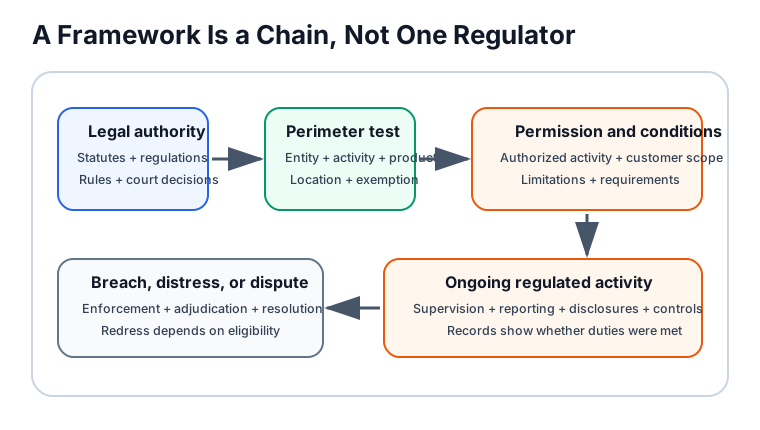
Layers of a Financial Regulatory Framework
| Layer | What it does | Evidence to check |
|---|---|---|
| Primary legislation | Creates powers, duties, offences, institutions, and appeal rights | Statute or treaty text and amendment status |
| Secondary legislation | Defines activities, products, thresholds, exemptions, and detailed requirements | Regulations, orders, effective dates, and schedules |
| Regulatory rules | Sets operational standards for authorized firms and markets | Current rulebook provision and application section |
| Permissions and conditions | Limits what a firm may do and for whom | Public register, licence, permission notice, or order |
| Supervision | Tests governance, capital, liquidity, controls, and conduct | Returns, examinations, correspondence, and remediation plans |
| Disclosure and reporting | Gives regulators, investors, or customers specified information | Filing instructions, forms, accounting basis, and deadlines |
| Enforcement and adjudication | Investigates breaches and imposes or reviews consequences | Statutory power, decision notice, court judgment, or settlement |
| Resolution and redress | Handles failure, complaints, compensation, or orderly exit | Insolvency law, resolution rules, scheme eligibility, and limits |
The hierarchy matters. Guidance may explain a regulator’s approach but does not necessarily have the same legal status as a statute or binding rule. A press release does not replace the underlying instrument.
Regulatory Objectives and Instruments
Different rules address different problems:
- Prudential regulation addresses the safety and resilience of banks, insurers, and other designated firms through capital, liquidity, governance, risk-management, and recovery requirements.
- Conduct regulation addresses sales practices, customer communications, product governance, conflicts of interest, and treatment of customers.
- Market regulation addresses trading venues, issuers, intermediaries, disclosure, market abuse, clearing, settlement, and orderly markets.
- Financial-crime controls address money laundering, terrorist financing, sanctions, fraud controls, and reporting obligations.
- Competition and consumer law can apply alongside sector-specific financial rules.
- Resolution and deposit or investor-protection arrangements address some consequences of firm failure, subject to legal eligibility and limits.
These objectives can conflict. More capital may improve resilience but raise funding costs. More disclosure can help comparison but overwhelm users if it is poorly designed. Regulation reduces some risks; it does not eliminate business failure, misconduct, market loss, or fraud.
Who Does What
A jurisdiction may assign several roles to one body or divide them among many:
| Institution | Typical role |
|---|---|
| Legislature and government | Enact statutes, designate authorities, and set public policy |
| Central bank | Monetary policy, payment-system functions, liquidity facilities, and sometimes supervision |
| Prudential supervisor | Resilience of specified banks, insurers, or investment firms |
| Conduct or securities regulator | Market conduct, disclosure, intermediaries, and customer-facing rules |
| Financial-intelligence or sanctions authority | Financial-crime reporting and sanctions administration |
| Deposit insurer or resolution authority | Covered-deposit protection and management of certain failed firms |
| Courts, tribunals, and ombuds services | Review decisions, resolve disputes, or provide eligible redress |
| International standard setter | Develops common standards that participating jurisdictions may implement |
Names alone are not enough. The European Central Bank, a national securities commission, and a conduct regulator have different mandates. Responsibility may also depend on the firm’s legal entity, activity, size, and home or host jurisdiction.
Worked Example: Mapping a New Financial Product
Suppose a technology company plans to offer customers a stored-value account, an interest-bearing balance provided through a partner bank, and a feature that automatically invests spare cash in a fund.
A useful regulatory analysis separates the features:
- Identify the legal entities. Determine which company holds customer money, contracts with the customer, provides the bank account, and executes the investment.
- Classify each activity. Payment services, deposit taking, arranging investments, safeguarding assets, and marketing may have different definitions.
- Locate the jurisdiction. Customer residence, place of business, solicitation, booking entity, and service location can affect which rules apply.
- Check permissions and exemptions. A partner’s licence may not cover the technology company, and one permission may not cover every feature.
- Map ongoing obligations. Disclosures, capital, safeguarding, complaints, financial-crime controls, reporting, and recordkeeping may differ by activity.
- Plan for failure and redress. Verify which balances or investments, if any, are covered by a protection scheme and how customers would make a claim.
Calling the entire product a “banking app” would hide the important perimeter questions. The analysis must follow each legal entity, activity, contract, and flow of customer assets.
Domestic and International Rules
Financial regulation crosses borders in several ways:
- A home regulator may supervise the consolidated group while a host regulator supervises local activity.
- An overseas firm may need local authorization, registration, a branch, or an exemption.
- Market, clearing, reporting, privacy, sanctions, and tax rules may attach to different parts of one transaction.
- International standards, such as the Basel Framework, become operational through local implementation and can differ in timing or scope.
- Equivalence, substituted-compliance, passporting, or recognition arrangements are specific legal mechanisms, not assumptions.
Never infer that compliance in one country automatically satisfies another country’s rules.
How to Evaluate a Regulatory Question
Use a source-first workflow:
- State the entity, activity, product, customer type, and jurisdiction.
- Identify the primary statute and the regulator with the relevant mandate.
- Find the provision defining the perimeter, including exclusions and exemptions.
- Check the current consolidated text, commencement date, and transitional rules.
- Confirm the firm’s exact permissions or registration status on the official register.
- Read the applicable rulebook section, not only summaries or guidance.
- Separate legal requirements from supervisory expectations and voluntary standards.
- Record the evidence and date because permissions and rules can change.
For a material business or investment decision, qualified legal, compliance, tax, or accounting advice may be necessary.
Common Mistakes
Treating one regulator as the entire framework. Multiple authorities can have concurrent or sequential responsibilities.
Assuming authorization covers every service. Permission is normally limited by activity, product, customer, or condition.
Using an international standard as if it were local law. Implementation requires the relevant domestic or regional instrument.
Relying on an old consolidated text. Amendments, commencement orders, and transitional provisions can change the answer.
Confusing supervision with a guarantee. Regulatory oversight does not guarantee solvency, liquidity, fair value, investment performance, or recovery of losses.
Official Source Checks
- U.S. Securities and Exchange Commission: Mission explains the SEC’s investor-protection, market, and capital-formation mandate.
- Financial Conduct Authority: What the FCA does describes the FCA’s UK role and current statutory objectives.
- Bank of England: Prudential regulation explains the Prudential Regulation Authority’s role within the Bank of England.
- Basel Committee: Basel Framework is the consolidated source for Basel Committee global prudential standards; local implementation must be checked separately.
Related Terms
- Financial Services Act 1986: The historical UK investment-business regime that preceded FSMA’s main framework.
- Financial Services and Markets Act 2000: A central statute in the UK’s current amended financial-services framework.
- Market Integrity: Confidence that markets operate under reliable rules, information, and controls.
- Conduct Risk: Risk arising from inappropriate behavior toward customers, counterparties, or markets.
- Compliance Costs: Resources used to identify, implement, evidence, and monitor applicable requirements.
- Legislative Risk: Exposure to changes in laws or their effects on a transaction or business model.
FAQs
Is a regulatory framework the same as a regulator?
Does an authorized firm offer only regulated products?
Are Basel standards directly binding on every bank?
Can financial regulation prevent all losses?
This article is educational and does not provide legal, compliance, tax, accounting, or investment advice. Apply the current rules and permissions for the specific activity and jurisdiction.