Profit Warning
A profit warning tells the market that expected earnings are materially weaker than prior guidance or expectations; disclosure duties depend on jurisdiction and facts.
A profit warning is a public announcement that a company expects revenue, profit, earnings per share, margin, or another performance measure to be materially weaker than its previous guidance or the market’s reasonable expectations. The term describes the message, not one standardized filing used in every country.
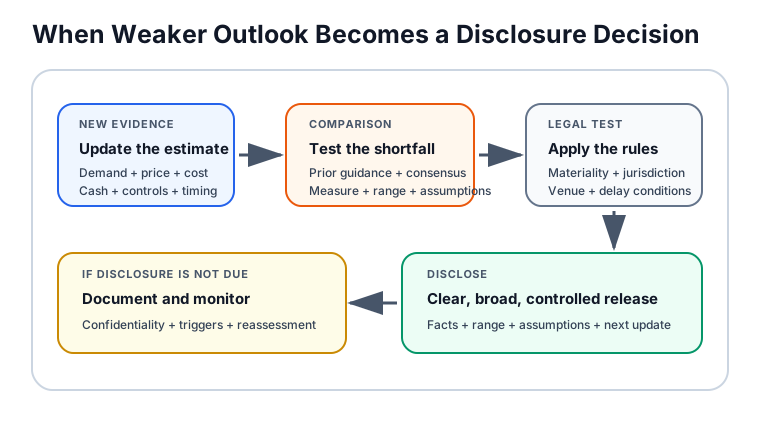
Whether and when a warning must be issued depends on the issuer, listing venue, jurisdiction, information available, materiality or inside-information test, earlier statements, and any lawful basis for delaying disclosure.
Key Takeaways
- A profit warning can revise a numerical range, withdraw guidance, or explain that prior objectives are no longer achievable.
- The legal trigger is not the label “profit warning”; it comes from applicable disclosure, market-abuse, antifraud, filing, and exchange rules.
- U.S. federal securities rules do not use one universal standalone profit-warning form for every earnings deterioration.
- Under UK MAR, covered issuers generally disclose inside information that directly concerns them as soon as possible, subject to specific delay conditions.
- A warning can cause a price decline, little reaction, or even a price increase if the revised outlook is better than feared.
- Management should distinguish confirmed facts, current estimates, assumptions, ranges, and unresolved uncertainty.
- Investors should compare the new outlook with prior guidance, consensus, valuation assumptions, liquidity, and management’s explanation.
What Can Trigger a Profit Warning
A warning can arise from one event or several smaller changes:
- loss, delay, or repricing of an important customer contract;
- weaker unit demand, selling prices, or order intake;
- cost inflation that cannot be passed to customers;
- production interruption, product recall, cyber incident, or supply constraint;
- foreign-exchange, commodity, or interest-rate changes;
- inventory write-down, impairment, restructuring, or litigation exposure;
- financing constraints, covenant pressure, or liquidity deterioration;
- regulatory action or loss of a licence; or
- an accounting estimate or control issue identified during period-end work.
Not every negative development requires an immediate public warning. The company first evaluates reliability, scale, timing, existing public information, applicable law, and whether the information is sufficiently precise and significant.
Warning vs. Guidance Revision vs. Results
| Communication | What it usually conveys | Main analytical question |
|---|---|---|
| Profit warning | Expected performance is materially weaker than prior guidance or expectations | What changed, by how much, and why now? |
| Guidance revision | Any increase, decrease, narrowing, widening, or withdrawal of outlook | Are definitions and assumptions comparable? |
| Preliminary results | Estimated results for a completed period before final statements | What remains unaudited or subject to adjustment? |
| Earnings release | Reported period results, often with updated outlook | How do reported results and future guidance interact? |
| Trading update | Operating metrics or business developments between formal reports | Does it contain complete enough context for comparison? |
A guidance increase is not a profit warning. A guidance withdrawal can function as one if it communicates a materially weaker or less certain outlook, but withdrawal alone does not reveal the size of the expected shortfall.
Disclosure Rules Depend on Jurisdiction
United States
U.S. issuers do not follow one general federal form called a profit warning. A deterioration can implicate several requirements:
- Regulation FD if material nonpublic earnings information is selectively disclosed to covered recipients;
- Form 8-K when a specified item applies or the issuer chooses a current-report channel;
- Item 2.02 when the issuer publicly announces material nonpublic information about results of operations or financial condition for a completed period;
- Item 7.01 for information furnished under Regulation FD in appropriate circumstances;
- antifraud rules if a statement is materially false or misleading, including through omission; and
- exchange rules concerning prompt disclosure of material information.
The exact filing item and timing depend on the content. A forward-looking revision for an incomplete period is not automatically an Item 2.02 event merely because it concerns earnings.
United Kingdom
Under UK MAR, covered issuers must disclose inside information that directly concerns them as soon as possible. An issuer can delay on its own responsibility only while the required conditions are met, including that immediate disclosure is likely to prejudice legitimate interests, delay is not likely to mislead the public, and confidentiality can be maintained.
A worsening forecast may become inside information before final accounts are complete. FCA guidance cautions against using positive news to offset negative inside information or waiting for scheduled results when delay conditions are not met.
Other markets
European Union MAR, exchange rules, continuous-disclosure regimes, and local securities laws use their own definitions, channels, and delay procedures. A multinational issuer may need coordinated announcements across venues and time zones.
Worked Example: Guidance Falls Below the Prior Range
Assume a manufacturer publicly guided to full-year operating profit of USD 120 million to USD 130 million. Three months later, a major customer cancels orders, raw-material costs rise, and management’s updated supportable estimate is USD 80 million to USD 90 million.
| Measure | Prior guidance | Updated estimate |
|---|---|---|
| Low end | USD 120 million | USD 80 million |
| High end | USD 130 million | USD 90 million |
| Midpoint | USD 125 million | USD 85 million |
| Midpoint change | -32% |
The arithmetic is important, but the disclosure analysis requires more:
- Is the updated range supported by current orders, costs, and assumptions?
- Does the shortfall make prior public guidance misleading if left uncorrected?
- Is the information material or inside information under the applicable framework?
- Can disclosure lawfully be delayed, and is confidentiality still secure?
- Which exchange, filing, and dissemination channels are required?
- Are insiders and employees subject to trading restrictions while the information is nonpublic?
- Which non-GAAP definitions and reconciliations are needed?
The announcement should explain the main drivers and comparability without promising a recovery that management cannot support.
How Investors Should Read a Profit Warning
Rebuild the comparison
Compare the new range with the prior range, analyst consensus, and assumptions in the valuation model. A headline percentage may use a different baseline.
Separate volume, price, cost, and accounting effects
Revenue weakness, gross-margin compression, higher operating costs, impairment, tax, and share-count changes affect earnings differently. Identify recurring operating changes versus one-time accounting charges.
Check cash and financing
Lower accounting profit can affect operating cash flow, covenant headroom, borrowing capacity, dividends, buybacks, and capital expenditure. The warning may not quantify all of these effects.
Evaluate management credibility
Review how recently guidance was affirmed, whether risk factors were specific, and whether previous ranges were consistently conservative or frequently revised. A warning does not by itself prove misconduct.
Read later filings
Preliminary estimates can change. Compare the warning with the next earnings release, periodic report, covenant disclosure, and cash-flow statement.
Preparing a Useful Warning
A decision-useful announcement generally identifies:
- the measure, period, currency, and accounting basis;
- prior guidance and the revised range or reason for withdrawal;
- key operational and financial drivers;
- known versus uncertain effects;
- assumptions that could change the result;
- cash, liquidity, covenant, or financing effects when material;
- relevant non-GAAP definitions and reconciliations; and
- the date or event for the next expected update.
Boilerplate caution cannot repair a numerical range that management lacks a reasonable basis to issue.
Market Reaction Is Not Predetermined
Price reaction depends on the gap between the announcement and expectations already reflected in price. A company can warn about lower profit and see its shares rise if investors expected a worse outcome or if the warning resolves uncertainty. Conversely, a modest revision can cause a large decline if it challenges the business model, balance sheet, or management credibility.
Short-term price movement does not prove legal materiality or long-term value impact. Trading liquidity, positioning, options, index flows, and broader markets can also affect the response.
Common Mistakes
Assuming every profit warning causes an immediate price drop. Markets react to surprises relative to expectations, not only to the direction of guidance.
Treating consensus as company guidance. Analyst estimates are external forecasts even when management has spoken with analysts.
Assuming every negative development requires the same filing. Jurisdiction, issuer status, materiality, form item, and exchange rule matter.
Waiting for exact final results. Some continuous-disclosure regimes can require action once sufficiently precise inside information exists.
Using optimistic commentary to offset a shortfall. Positive context should not obscure the current financial effect.
Comparing unlike measures. GAAP, adjusted, constant-currency, organic, and per-share guidance require separate definitions.
Official Sources
- SEC: Regulation FD adopting release explains selective disclosure of advance earnings information.
- SEC: Official Form 8-K and instructions provides the current-report items and filing framework.
- FCA: Market Abuse Regulation explains UK MAR disclosure and delay conditions.
- FCA: Primary Market Bulletin 52 discusses financial deterioration, prior objectives, delay, and clear issuer communications.
Related Terms
- Company Guidance on Earnings: Management’s quantitative or qualitative outlook for future performance.
- Forward-Looking Statements: Statements about expected future events, assumptions, or results.
- Material Information: Information whose importance to a reasonable investor can affect disclosure analysis.
- Regulation FD: The U.S. rule addressing selective issuer disclosure of material nonpublic information.
- Form 8-K: The U.S. current report for specified events and voluntary disclosures.
- Market Integrity: Fair, orderly, and transparent market functioning supported by reliable information and conduct controls.
FAQs
Is a profit warning legally required in every market?
Can a company delay a profit warning?
Is withdrawing guidance the same as issuing a profit warning?
This article provides general financial and securities-regulation education, not legal, accounting, disclosure, or investment advice. Current rules and issuer-specific facts determine a disclosure obligation.