Financial Services and Markets Act 2000
FSMA is a central UK financial-services statute covering regulated activities, authorization, permissions, markets, enforcement, and consumer mechanisms.
The Financial Services and Markets Act 2000 (FSMA) is a central statute in the United Kingdom’s financial-regulation framework. As amended, it governs matters including regulated activities, authorization and permissions, financial promotions, official listing and markets, regulator powers, enforcement, complaints, and compensation arrangements.
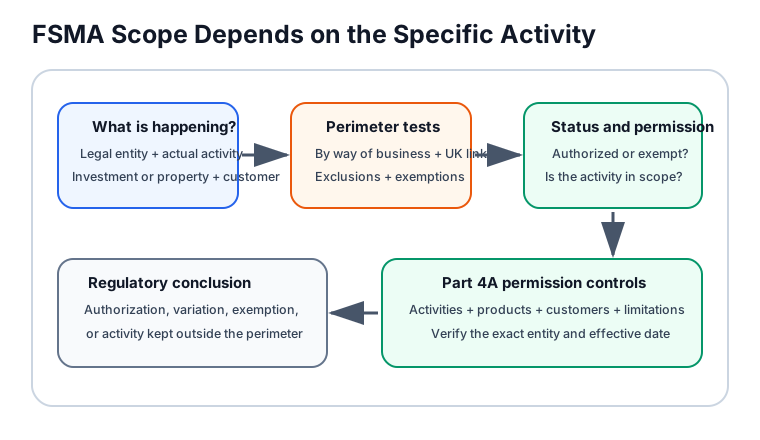
FSMA does not mean that every financial product or business is regulated in the same way. Scope depends on the legal entity, activity, investment or property, business context, customer, territorial connection, exemption, and permission in force.
Key Takeaways
- FSMA received Royal Assent in June 2000, and its main regulatory regime commenced on 1 December 2001.
- Section 19 contains the “general prohibition”: a person must not carry on a regulated activity in the UK, or purport to do so, unless authorized or exempt.
- The Regulated Activities Order and other secondary legislation help define which activities and investments fall inside the perimeter.
- An authorized firm’s Part 4A permission specifies the regulated activities it may carry on; authorization is not unlimited.
- The 2013 FCA and PRA structure resulted from amendments made by the Financial Services Act 2012.
- Register status is a starting point, not a guarantee of product quality, solvency, liquidity, suitability, or investment returns.
Historical Development
Before FSMA’s main regime, UK investment business operated under the Financial Services Act 1986, while banking, insurance, and building societies also had separate statutory arrangements.
The Securities and Investments Board changed its name to the Financial Services Authority (FSA) in 1997. FSMA did not originate that company name change; it gave the integrated FSA regime its broad statutory foundation. The main provisions came into force on 1 December 2001, replacing several prior regimes.
After the global financial crisis, the Financial Services Act 2012 amended FSMA and reorganized supervision. From 1 April 2013:
- the Financial Conduct Authority (FCA) became responsible for conduct and market functions within its remit and for prudential supervision of many firms;
- the Prudential Regulation Authority (PRA), within the Bank of England, became the prudential regulator for specified banks, building societies, insurers, and major investment firms; and
- the Bank of England received broader financial-stability and market-infrastructure responsibilities.
FSMA should therefore be read as an amended framework, not as a frozen description of the original FSA model.
The General Prohibition
Section 19 provides that no person may carry on a regulated activity in the UK, or purport to do so, unless the person is authorized or exempt. Determining whether the prohibition applies requires a perimeter analysis rather than a job-title test.
1. Identify the activity
Examples can include accepting deposits, effecting or carrying out insurance contracts, dealing in investments, arranging transactions, managing investments, giving specified investment advice, operating certain schemes, or providing other activities designated by legislation.
2. Identify the investment or property
An activity is not regulated in the abstract. The relevant shares, debt instruments, fund units, insurance contracts, deposits, mortgages, or other specified property must fall within the applicable definition.
3. Apply the business and territorial tests
Many regulated activities must be carried on “by way of business.” The UK connection must also be analyzed. Cross-border websites, overseas firms, branches, agents, and remote services can require specific treatment.
4. Check exclusions and exemptions
The statutory framework contains exclusions and exemptions. Their wording and conditions matter; a broad commercial description such as “technology provider” or “professional adviser” does not settle the issue.
5. Check authorization and permission
An authorized person needs permission for the activities it performs. Under the current framework, a Part 4A permission records the scope and may include limitations or requirements.
Authorization Is Activity-Specific
| Check | Question | Evidence |
|---|---|---|
| Legal entity | Is this the exact company or individual providing the service? | Registered name and company details |
| Status | Is the person authorized, exempt, an appointed representative, or outside scope? | Statute, FCA Register, or official order |
| Activity | Does the permission cover advice, arranging, dealing, managing, custody, deposits, or insurance? | Permission details and limitations |
| Product | Is the specific investment or service within scope? | Contract, product terms, and statutory definition |
| Customer | Do retail, professional, eligible-counterparty, or other classifications change the rule? | Client classification and applicable rule |
| Date | Was the status and permission effective when the activity occurred? | Effective dates and historical records |
The FCA’s Financial Services Register can help verify status and permissions. It should be matched to the exact legal entity and service. A genuine authorized firm can also be impersonated by a clone, and an authorized firm’s unregulated activity may not receive the same protections as its regulated business.
Financial Promotions
Section 21 establishes a separate restriction on communicating invitations or inducements to engage in investment activity in the course of business unless the communication is made or approved by an authorized person or an exemption applies.
Authorization to conduct one activity does not automatically permit every promotion. The communicator, audience, medium, product, approval route, and exemption conditions all matter. FCA rules can add requirements concerning whether communications are fair, clear, and not misleading for firms within scope.
Regulators and Current Responsibilities
Financial Conduct Authority
The Financial Conduct Authority authorizes or registers many firms, maintains the Financial Services Register, makes rules, supervises conduct, regulates markets within its remit, and can use statutory enforcement powers. Its current objectives and powers come mainly from FSMA as amended.
Prudential Regulation Authority
The Prudential Regulation Authority is part of the Bank of England. It prudentially regulates specified deposit takers, insurers, and major investment firms. PRA-authorized firms can also be regulated by the FCA for conduct, so dual regulation does not mean duplicate roles.
Bank of England and other bodies
The Bank of England has financial-stability, resolution, payment-system, and market-infrastructure responsibilities under FSMA and related statutes. HM Treasury, courts, the Financial Ombudsman Service, the Financial Services Compensation Scheme, and other authorities also perform distinct functions.
No single body resolves every FSMA question.
Worked Example: Advice and Arrangement Platform
Assume a UK company launches an online platform that asks users about their goals, recommends one of several investment funds, arranges the purchase, and receives a distribution fee.
The company cannot settle its position by calling itself a “software marketplace.” A perimeter review would ask:
- Does the personalized output amount to a regulated recommendation rather than generic information?
- Is the company arranging a transaction in a specified investment?
- Which legal entity communicates with users and receives the fee?
- Does an exclusion or exemption apply, and are all conditions met?
- If authorization is required, do its Part 4A permissions cover both advice and arranging?
- Who holds client money or assets, and do separate custody or client-asset rules apply?
- Are the promotions approved and compliant for the intended audience?
- Which complaint and compensation arrangements may apply, and what are their limits?
If the firm is permitted only to arrange investments, adding personalized recommendations may cross into an activity outside its permission. The correct response is to verify and, if necessary, vary permission before launching the feature, not to rely on a broad “FCA authorized” label.
Enforcement, Redress, and Failure
FSMA supplies powers and mechanisms that can include investigation, public notices, financial penalties, injunctions, restitution, variation or cancellation of permission, and criminal consequences for specified conduct. Procedure, burden, appeal rights, and available remedies depend on the provision and facts.
The framework also supports:
- complaint handling and eligible referrals to the Financial Ombudsman Service;
- compensation through the Financial Services Compensation Scheme for eligible claims against failed firms; and
- special resolution or insolvency arrangements for certain financial institutions under FSMA and related legislation.
These mechanisms have jurisdiction, eligibility, time, product, and compensation limits. They do not reimburse every loss or convert a risky investment into a guaranteed one.
How to Verify the Current Position
- Read the current FSMA provision on legislation.gov.uk and inspect amendment status.
- Check the Financial Services and Markets Act 2000 (Regulated Activities) Order 2001 and relevant exemptions.
- Use the FCA Handbook’s perimeter guidance as guidance, then return to the binding legislation and rules.
- Check the exact entity and activity on the FCA Financial Services Register.
- Review Part 4A permission details, limitations, requirements, and effective dates.
- Determine whether PRA authorization or dual regulation applies.
- Check the current FCA or PRA rulebook provision and any transitional rule.
- Obtain qualified advice where the conclusion affects a launch, transaction, filing, or customer communication.
Common Mistakes
Saying FSMA applies identically to all financial-service providers. The perimeter is based on defined activities and other statutory conditions.
Claiming FSMA created the FCA and PRA in 2000. The 2013 architecture followed the Financial Services Act 2012 amendments.
Treating “authorized” as an unlimited licence. Permission scope and limitations are central.
Assuming the FCA Register guarantees safety. The register helps establish regulatory status; it does not endorse a product or guarantee recovery, liquidity, or returns.
Using guidance without checking legislation. Perimeter guidance aids interpretation but does not replace the Act, orders, rules, or case law.
Assuming all losses qualify for compensation. Eligibility depends on the claimant, firm, activity, product, failure, timing, and scheme rules.
Official Source Checks
- Financial Services and Markets Act 2000 is the primary statutory source and provides links to amendment information.
- FSMA Commencement No. 8 Order 2001 supports the 1 December 2001 commencement of the main regime.
- Regulated Activities Order 2001 defines many regulated activities, specified investments, exclusions, and related scope rules.
- FCA: Apply for authorization explains the need to identify regulated and excluded activities before applying.
- FCA Handbook PERG 2 provides perimeter guidance on regulated activities and authorization.
- FCA: Check a firm or individual is authorized explains how to use the register and why status does not mean every activity is regulated.
- Financial Services Act 2012 provides the legislative basis for the later regulatory reorganization.
Related Terms
- Regulatory Framework: The wider system in which FSMA operates.
- Financial Services Act 1986: The historical investment-business regime replaced by the main FSMA framework.
- Financial Conduct Authority: The UK’s conduct regulator for firms and markets within its remit.
- Prudential Regulation Authority: The Bank of England body responsible for prudential regulation of specified firms.
- Conduct Risk: Exposure to harm from inappropriate behavior toward customers or markets.
- Systemic Risk: Risk that distress or disruption impairs the wider financial system.
FAQs
When did FSMA 2000 come into force?
Does every UK financial company need FCA authorization?
What is a Part 4A permission?
Does FCA authorization guarantee an investment?
This article is general education, not legal, regulatory, compliance, tax, or investment advice. FSMA is frequently amended, and a current conclusion requires the specific facts, instruments, permissions, and effective dates.