M-Pesa
M-Pesa is a mobile-money service that records electronic value, supports transfers and payments, and connects cash users through agents. Learn how its accounts, trust structure, and risks work.
M-Pesa is a branded mobile-money service that lets eligible users hold electronic value, transfer it to other users, make payments, and exchange value for cash through authorized agents. It began in Kenya through Safaricom and is now used in multiple markets, but the provider, features, limits, fees, and legal protections can differ by country.
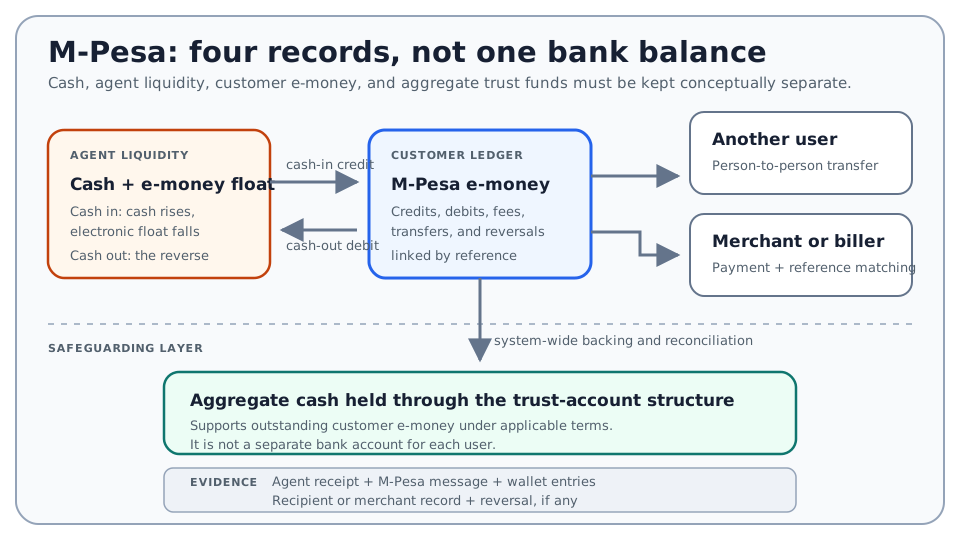
M-Pesa is not simply another name for mobile banking. The M-Pesa account records e-money under a payment-service arrangement, while Kenyan payment regulations require relevant customer funds to be held through a trust structure. That arrangement is different from a customer holding an ordinary deposit account directly at a bank.
Key Takeaways
- M-Pesa is a mobile-money service and account system, not one universal banking product in every country.
- Customer e-money, agent electronic float, agent cash, and trust-account funds are related but separate records.
- Agents convert cash into electronic value and electronic value back into cash, subject to liquidity and current service rules.
- A transaction message helps identify an instruction, but wallet entries, recipient records, agent records, and reversals may also be needed.
- Regulation, safeguarding, fees, identity checks, transaction limits, and complaint processes depend on the market and service used.
Why M-Pesa Matters
M-Pesa is an important finance term because it demonstrates how a regulated nonbank payment service can deliver stored value and payments through mobile channels and a physical agent network. The model can extend transaction access where bank branches, card acceptance, or conventional accounts are less practical.
Its importance should not be reduced to account totals or promotional claims. A useful analysis asks whether people can register, reach a liquid agent, understand fees, complete payments reliably, protect their credentials, and resolve errors. Those factors connect M-Pesa to financial inclusion without implying that every user or transaction has the same outcome.
E-Money, Cash, and Trust Funds
In a mobile-money system, e-money is the value recorded in customer, agent, and provider ledgers. A customer’s displayed balance is an electronic claim under the service terms; it is not a stack of physical currency stored inside the phone.
Kenya’s National Payment System Regulations define e-money as monetary value stored electronically or magnetically, issued against receipt of authorized currency, and accepted as payment by parties other than the issuer. The regulations require a payment service provider to establish a trust, hold money received in the trust fund, and keep the fund balance at least equal to amounts owed to customers. The trust-account balance is an aggregate safeguarding arrangement, not a separate conventional bank account opened in each customer’s name.
The distinction creates four records to keep separate:
| Record | What it represents | Why it matters |
|---|---|---|
| Customer M-Pesa balance | E-money credited to the customer’s mobile-money account | Shows value available under the service terms |
| Agent e-money float | Electronic value the agent can transfer to customers | Constrains the agent’s ability to accept cash in |
| Agent physical cash | Currency available at the agent location | Constrains the agent’s ability to provide cash out |
| Trust or safeguarding funds | Cash held through the structure supporting outstanding customer e-money | Protects customer value according to the governing trust, law, and provider terms |
Safeguarding reduces certain custody risks but does not guarantee against every fraud, mistaken payment, outage, agent dispute, or account-access problem.
How Cash In Works
In a typical agent cash-in transaction:
- The customer confirms that the outlet and agent identifiers are valid.
- The customer states the intended amount and checks any applicable fee or limit.
- The customer gives physical cash to the agent.
- The agent initiates an electronic transfer from agent float to the customer’s M-Pesa account.
- The system records the customer credit and corresponding agent entry.
- The customer and agent receive transaction evidence through the available channel.
- The customer checks the amount, reference, and resulting balance before leaving.
Economically, the agent receives more cash and gives up an equal amount of e-money float, excluding fees or commissions. The customer’s wallet receives the electronic value. If cash changes hands but no wallet credit appears, the receipt, agent number, store number where applicable, amount, time, and transaction reference become critical evidence.
How Cash Out Works
Cash out reverses the exchange:
- The customer starts a withdrawal through an available M-Pesa channel.
- The customer identifies the agent and amount and completes the required verification.
- The customer’s M-Pesa account is debited after successful processing.
- The agent’s e-money float increases.
- The agent gives physical cash to the customer.
- Both parties retain the transaction record.
The agent needs enough physical cash to complete the withdrawal. A well-funded electronic account does not guarantee that a particular agent has sufficient currency on hand. Current provider procedures should be followed if the account is debited but the agent cannot provide the correct cash.
Worked Example: Agent Float and Customer Balance
Assume a customer deposits KSh 8,000 in cash with an authorized agent. Fees are excluded from this simplified example.
| Position | Change after cash in |
|---|---|
| Customer M-Pesa balance | +KSh 8,000 |
| Agent e-money float | -KSh 8,000 |
| Agent physical cash | +KSh 8,000 |
The customer then sends KSh 2,500 to another M-Pesa user. The sender’s balance falls to KSh 5,500, and the recipient’s balance increases by KSh 2,500, before any applicable fee.
Later, the recipient withdraws KSh 1,000 from a different agent:
| Position | Change after cash out |
|---|---|
| Recipient M-Pesa balance | -KSh 1,000 |
| Withdrawal agent e-money float | +KSh 1,000 |
| Withdrawal agent physical cash | -KSh 1,000 |
No physical cash travels from the first agent to the recipient during the wallet transfer. The provider’s ledger moves e-money between users, while each agent manages local cash and float. Provider, agent, bank, and trust arrangements later keep the system’s aggregate positions aligned.
Transfers and Merchant Payments
A person-to-person transfer debits one M-Pesa account and credits another eligible destination under the service rules. A merchant or bill payment can add a merchant identifier, account reference, till, paybill, or other destination field. The exact fields and product names vary.
For a merchant payment, distinguish:
- the customer’s payment instruction;
- the M-Pesa debit and transaction reference;
- the merchant’s receipt of value in its account;
- the merchant’s match to the underlying sale or invoice;
- any transfer from the merchant account to a bank; and
- later reversal, refund, or adjustment records.
A customer confirmation does not prove that a merchant applied the payment to the correct invoice. The merchant reference and transaction ID should be preserved until the underlying obligation is reconciled.
Example: Wrong Recipient or Delayed Credit
A sender intends to transfer KSh 4,000 but enters the wrong recipient details. Alternatively, the sender sees a debit while the intended recipient reports no credit.
The sender should not assume that deleting a message, restarting the phone, or sending a second payment will reverse the first instruction. The relevant evidence includes:
- sender and intended-recipient identifiers;
- displayed recipient name before confirmation, if available;
- amount, fee, date, and time;
- transaction reference and status message;
- sender and recipient account entries; and
- any reversal, refund, or support case reference.
Current M-Pesa reversal and support procedures should be used promptly. Recovery is not guaranteed, especially where value has reached and been used by a valid but unintended recipient. Users should contact the provider through verified channels and never share a PIN or one-time credential with someone offering to recover funds.
M-Pesa vs. Related Services
| Service | Primary balance or credential | Main distinction |
|---|---|---|
| M-Pesa | E-money in a mobile-money account | Value is recorded by the mobile-money system and can be exchanged through agents |
| Mobile banking | Bank deposit or credit account | The phone is a channel to an account held by a bank |
| Card-based mobile wallet | Token or credential linked to a card or account | The wallet may not hold monetary value itself |
| Bank transfer | Deposit-account payment instruction | Uses the bank and applicable transfer rail rather than an internal mobile-money transfer alone |
| Cash | Physical currency | Does not require an electronic account, but cash-in or cash-out connects it to M-Pesa |
An M-Pesa user may also access linked banking, credit, savings, remittance, or merchant products. Those products can involve separate providers, agreements, eligibility rules, costs, and risks. The M-Pesa label should not be used to collapse them into one balance or legal relationship.
Fees, Limits, and Access Channels
M-Pesa fees and limits can vary by country, transaction type, amount, customer status, and channel. Access may include a SIM toolkit, USSD, provider application, merchant interface, agent, or supported ATM, but availability changes over time and across markets.
Before confirming a transaction, check:
- the provider and country;
- the exact sender debit and recipient amount;
- transfer, withdrawal, conversion, remittance, or third-party charges;
- minimum and maximum transaction or account limits;
- required identification and registration status;
- the destination name and identifier;
- whether the instruction can be reversed or disputed; and
- the current support and escalation process.
An old tariff table or tutorial should not be treated as current evidence. Use the provider’s live transaction screen and current terms.
Kenya Regulatory Context
The Central Bank of Kenya (CBK) states that mobile-phone money transfer operators are authorized as payment service providers under the National Payment System Act and National Payment System Regulations. The CBK oversees payment systems and publishes mobile-payment and agent statistics.
This regulatory context does not make M-Pesa a bank deposit. It establishes a payment-service framework covering authorization, e-money issuance, trust funds, agents, customer records, redemption, and oversight. The provider’s current customer terms remain relevant to a particular user’s contractual rights and duties.
M-Pesa services outside Kenya operate under other entities, rules, currencies, and customer agreements. Kenyan terms should not be used to answer a legal, tax, safeguarding, fee, or transaction question in another country.
Risks and Common Mistakes
- Calling M-Pesa a conventional bank account without checking the legal account model.
- Assuming the customer balance, agent float, agent cash, and trust funds are the same record.
- Treating a PIN as a guarantee against scams, coercion, SIM-related attacks, or account takeover.
- Giving cash to an unverified agent or leaving before checking the wallet credit.
- Sending a second payment after a delay without checking the first reference.
- Assuming every agent has enough cash or float for every transaction.
- Relying on old fees, limits, menus, support numbers, or service availability.
- Treating all M-Pesa countries as governed by Kenyan rules.
- Assuming a transaction message proves that a bank, merchant, or biller posted the payment correctly.
- Presenting financial-inclusion benefits without considering cost, reliability, fraud, accessibility, and redress.
How to Evaluate an M-Pesa Transaction
- Identify the country, provider entity, customer account, and product.
- Determine whether the transaction is cash in, cash out, wallet transfer, merchant payment, bank transfer, remittance, credit, or another service.
- Record the amount, currency, fee, destination, date, time, channel, agent details, and transaction reference.
- Separate instruction, authorization, wallet posting, recipient posting, cash exchange, settlement, reversal, and refund.
- Reconcile the provider message with the wallet statement, agent receipt, merchant or biller record, and bank record where applicable.
- Use official provider support and regulator information for unresolved issues.
Official Resources
- Central Bank of Kenya: National Payments System explains authorization and oversight of mobile-money payment service providers.
- Central Bank of Kenya: Mobile Payments provides official aggregate mobile-money and agent statistics.
- Central Bank of Kenya: Legislation and Guidelines links the National Payment System Act and Regulations.
- Kenya Law: National Payment System Regulations provides the consolidated definitions and requirements for e-money, agents, cash services, trust funds, redemption, and payment service providers.
Provider materials are contractual or operational sources, not independent guarantees. Check the current terms and regulator for the relevant country when a transaction or legal conclusion matters.
FAQs
Is M-Pesa a bank account?
What does M-Pesa mean?
Does every M-Pesa transaction use SMS?
Is money in M-Pesa guaranteed to be safe?
Related Terms
- Paga: Nigerian mobile-money service using stored-value accounts, digital channels, and agents.
- Mobile Payments: Payments initiated, authenticated, or presented through a mobile device or service.
- Mobile Wallet: Software or account interface that can hold value or payment credentials, depending on the model.
- Mobile Banking: Remote access to banking services through a mobile channel.
- Digital Payments: Payments initiated or processed through electronic channels.
- Financial Inclusion: Access to useful, affordable, and responsibly delivered financial services.
Educational Use
This article provides general financial education. It is not a recommendation to use M-Pesa and is not banking, payment, legal, regulatory, tax, or cybersecurity advice.