Electronic Funds Transfer at Point of Sale (EFTPOS)
Learn what EFTPOS means, how a point-of-sale debit moves from authorization to settlement, and how EFTPOS differs from a terminal or credit-card payment.
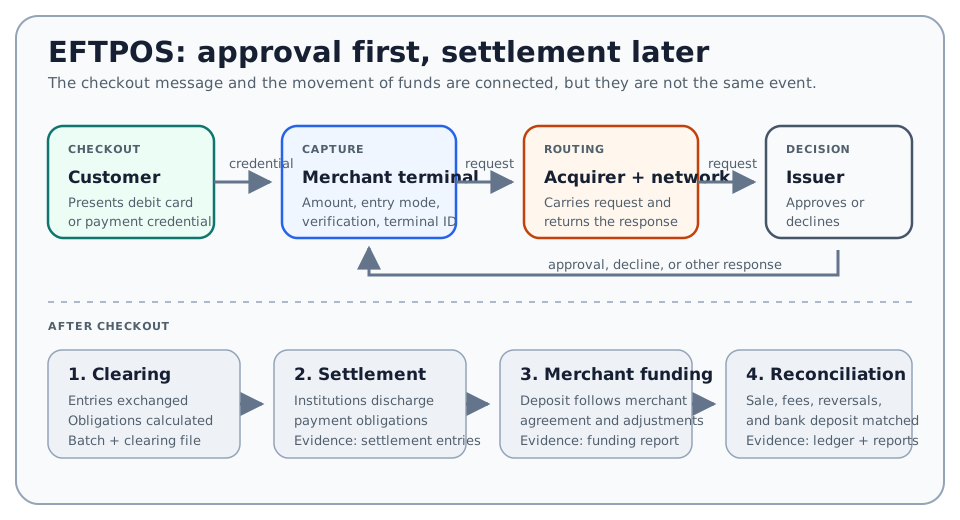
Electronic funds transfer at point of sale (EFTPOS) is an electronic payment initiated at a merchant checkout that debits an eligible customer account. A customer presents a debit card or compatible payment credential, the merchant sends an authorization request, and the transaction later moves through clearing, interbank settlement, and merchant funding.
The term depends on context. EFTPOS can describe point-of-sale electronic debit generally, while eftpos is also the name of an Australian domestic debit-card network. A receipt that says EFTPOS does not, by itself, identify the network, legal protections, settlement speed, or cardholder-verification method.
Key Takeaways
- EFTPOS concerns an account-based electronic payment at a merchant checkout.
- The checkout system, payment terminal, processor, acquirer, network, and issuer perform different jobs.
- An authorization approval is not the same as final settlement or merchant funding.
- A debit card may support more than one network, so the entry method or card brand alone may not reveal the route used.
- Cash out, receipts, surcharges, routing, disputes, and consumer protections depend on the network, account, merchant, and jurisdiction.
What EFTPOS Can Mean
| Context | Likely meaning | What the label does not prove |
|---|---|---|
| General payment usage | Electronic debit initiated at a merchant checkout | A particular card network, settlement time, or legal regime |
| Australia | A transaction over the domestic eftpos network, or point-of-sale debit more broadly | That eftpos rather than an international debit network carried a dual-network card transaction |
| New Zealand and some other markets | Common shorthand for merchant card acceptance or its terminal | The exact acquiring, routing, and settlement arrangement |
| Merchant or bank statement | A POS channel, processing category, or network-specific transaction | Whether the entry is pending, settled, reversed, or disputed |
The transaction record is more reliable than the everyday label. Check the country, account type, card product, entry mode, processor code, network identifier, and status before drawing a conclusion.
Participants and Their Records
| Participant or component | Main role | Typical evidence |
|---|---|---|
| Customer | Presents the credential and confirms the transaction as required | Card or wallet activity, receipt, account alert, and statement |
| Merchant POS | Records the sale, tax, tip, cash out, and tender | Sales ticket, receipt, refund record, and register totals |
| Payment terminal | Captures the credential and sends transaction data | Terminal ID, entry mode, verification result, response, and transaction ID |
| Processor or acquirer | Connects the merchant to enabled payment networks and manages funding | Authorization log, batch, clearing report, fee statement, and deposit report |
| Debit network | Routes messages under its rules and supports clearing | Network identifier, response codes, clearing entries, and adjustments |
| Issuer | Holds or provides access to the customer’s account and approves or declines | Authorization record, account hold, posted debit, reversal, and customer statement |
| Settlement institutions | Discharge obligations between participating institutions | Settlement account entries and reconciliation reports |
One organization can perform several roles, and terminology varies among providers. Contracts and transaction records establish the actual responsibilities.
How an EFTPOS Transaction Moves
- Sale creation: The merchant POS calculates the amount due, including any tax, tip, surcharge, discount, or cash-out amount.
- Credential presentation: The customer inserts, taps, swipes, or otherwise presents an eligible card or payment credential.
- Cardholder verification: The terminal applies the method required for that transaction, which may involve a PIN, a consumer device, a signature prompt, or no additional prompt.
- Authorization routing: The merchant’s processor or acquirer sends the request over an enabled network to the issuer or another authorized decision point.
- Issuer decision: Account status, available funds, security signals, limits, and other controls contribute to an approval or decline.
- Checkout completion: The terminal and POS record the response. The merchant supplies the goods, services, or cash only when its procedures permit.
- Clearing: Approved transactions are submitted and exchanged so participants can calculate what is owed.
- Settlement and funding: Financial institutions settle their obligations, and the acquirer or processor funds the merchant according to the merchant agreement.
- Posting and reconciliation: The customer’s institution posts the debit, while the merchant reconciles the sale, batch, fees, adjustments, and bank deposit.
The sequence can differ by network, transaction type, offline capability, and jurisdiction. Some stages happen quickly, but speed does not make authorization, clearing, settlement, and posting the same event.
Authorization Is Not Settlement
An approval generally indicates that the issuer or authorized decision process permitted the transaction to proceed. It can reduce the customer’s available balance, but it does not prove that the merchant has received irrevocable funds.
Several later events can change the record:
- the merchant may not complete or submit the transaction;
- a communication failure may trigger a reversal;
- the cleared amount may differ because of a tip, partial completion, or correction;
- the transaction may be returned, refunded, or disputed under applicable rules; or
- merchant funding may be reduced by fees, reserves, chargebacks, or other adjustments.
For account analysis, distinguish pending, posted, reversed, and refunded entries. For merchant analysis, distinguish approved, captured, batched, cleared, funded, and adjusted transactions.
Worked Example: Purchase with Cash Out
Assume a customer buys $60 of goods and requests $40 in cash from a merchant that supports cash out. The issuer approves one $100 debit transaction.
The economic records are different even though the customer sees one total:
| Record | Amount | Meaning |
|---|---|---|
| Merchandise sale | $60 | Merchant revenue before any applicable tax or other adjustments |
| Cash disbursed | $40 | Reduction in the merchant’s physical cash |
| Electronic debit | $100 | Amount submitted through the payment route |
| Merchant funding | Depends on agreement | Deposit after any separately presented fees or adjustments |
In a simplified accounting illustration, the merchant could initially record a $100 receivable from its payment provider, $60 of sales, and a $40 reduction in cash. If the provider later deposits $99.20 after deducting an $0.80 processing fee, the merchant records $99.20 of bank cash, $0.80 of processing expense, and clears the $100 receivable. Actual tax, fee, and settlement presentation depends on the facts and accounting policy.
Cash out is not universally available. Limits, fees, eligible accounts, verification, and merchant procedures can differ. In the United States, the phrase cash back can also mean card rewards, so the transaction context matters.
Example: Timeout and Possible Duplicate
A customer taps to pay $42. The terminal sends the request but displays a communication error before showing the issuer response. The cashier immediately starts a second transaction, which is approved.
The first request may have failed before transmission, reached the processor without a returning response, received issuer approval, or been approved and then automatically reversed. A blind retry can therefore create two approvals or two posted debits.
The merchant should compare the POS ticket, terminal transaction ID, amount, timestamp, authorization code, processor log, reversal message, batch, and funding report. The customer should preserve the receipt and review the account record. A pending duplicate may disappear, but a posted or unfamiliar transfer should be raised through the financial institution’s applicable reporting process rather than assumed to self-correct.
EFTPOS Routing in Australia
Many Australian debit cards can support both the domestic eftpos network and an international debit network. For eligible transactions, merchant routing arrangements may allow the transaction to use the lower-cost enabled network. The Reserve Bank of Australia describes this as least-cost routing.
Routing is not determined by the card’s appearance alone. It can depend on the card, transaction channel, merchant choice, acquirer capability, network availability, customer selection, and current rules. Routing cost also is not the only merchant consideration; acceptance, functionality, fraud controls, disputes, and service reliability matter.
This Australian use should not be projected onto every country. In the United States, the more common analytical terms are debit-card transaction, point-of-sale transfer, issuer, acquirer, and payment-card network.
EFTPOS vs. Related Payment Terms
| Term | What it identifies | Key distinction |
|---|---|---|
| EFTPOS debit | Electronic account debit initiated at merchant checkout | Describes the transaction context or, in Australia, may identify the domestic network |
| Debit card | Access device or credential linked to an eligible account | The card can support different transaction routes and entry methods |
| Credit-card payment | Purchase funded under a credit arrangement | It is not simply a debit to a deposit account |
| POS system | Merchant system that records the sale and tender | It can record cash and other payments that are not EFTPOS |
| POS terminal | Endpoint that captures payment data | It is equipment, not the payment network or settled transfer |
| Mobile wallet | Software that presents or manages a payment credential | The underlying funding can be debit, credit, prepaid, or another method |
| ACH debit | Account debit processed through an ACH system | It generally does not rely on a debit-card POS route |
Consumer Review Checklist
When a point-of-sale debit is unfamiliar, duplicated, or incorrect:
- preserve the receipt, merchant name, amount, date, and account notification;
- compare pending activity with the final posted transaction;
- identify whether a tip, cash out, surcharge, currency conversion, or partial reversal explains the difference;
- contact the merchant only through a verified channel if a merchant-side correction is appropriate;
- contact the financial institution promptly using its official reporting process; and
- do not disclose a PIN, password, or one-time security code to someone claiming they can reverse the charge.
Consumer liability, notice periods, provisional credits, and investigation duties are legal questions that depend on the account, transaction, timing, and jurisdiction. General examples cannot determine a specific consumer’s rights.
Merchant Controls and Reconciliation
- Reconcile POS sales by tender to terminal totals, processor batches, funding, fees, and bank deposits.
- Separate purchases, cash out, tips, surcharges, refunds, reversals, chargebacks, and manual adjustments.
- Review timeouts before retrying and monitor duplicate amounts within short intervals.
- Restrict refunds, voids, cash out, manual entry, offline processing, and routing changes by user role.
- Maintain a terminal inventory and inspect devices for substitution or tampering.
- Protect PIN and payment-account data and avoid retaining data the business does not need.
- Confirm that merchant descriptors and terminal identifiers allow customers and staff to recognize transactions.
- Apply current acquirer, network, consumer-protection, privacy, and recordkeeping requirements.
Risks and Common Mistakes
- Calling every card payment EFTPOS without identifying debit versus credit funding.
- Confusing the Australian eftpos network with the generic EFTPOS label.
- Treating approval as final merchant funding.
- Assuming every debit transaction requires a PIN.
- Inferring the transaction network from a logo, terminal, or card alone.
- Retrying after a timeout without checking the first request’s status.
- Comparing merchant costs without separating interchange, network, processor, acquirer, terminal, and service charges.
- Assuming cash out is available for every card, account, or merchant.
- Giving universal dispute or liability conclusions without identifying the jurisdiction and account type.
U.S. Regulatory Context
U.S. Regulation E covers qualifying electronic fund transfers involving consumer accounts and expressly includes point-of-sale transfers within its subject matter. It addresses issues such as disclosures, terminal receipts, unauthorized-transfer liability, periodic statements, and error resolution. Coverage and requirements have conditions and exceptions, and business accounts or credit-card transactions should not automatically be analyzed as covered consumer EFTs.
The Consumer Financial Protection Bureau’s official interpretation also explains that a POS terminal can be an electronic terminal when it captures data electronically for a debit or credit to a consumer asset account. The legal classification depends on what the transaction actually does, not simply whether the merchant calls its device an EFTPOS terminal.
Official Resources
- CFPB: Regulation E provides the U.S. electronic-fund-transfer rule and official interpretations.
- CFPB: Regulation E Coverage describes covered transfers and exclusions, including point-of-sale context.
- CFPB: Receipts at Electronic Terminals provides current U.S. receipt requirements and interpretations for covered transfers.
- Reserve Bank of Australia: Least-cost Routing explains routing choices for eligible Australian debit-card transactions.
- Reserve Bank of Australia: Backgrounder on Least-cost Routing explains dual-network debit cards and the roles of eftpos and international debit networks.
These sources address specific legal and payment-system contexts. Current account terms, merchant agreements, network rules, and applicable law control an individual transaction.
FAQs
Is EFTPOS the same as a debit card?
Does EFTPOS always mean Australia's eftpos network?
Can EFTPOS include cash out?
Does an EFTPOS approval mean the merchant has been paid?
Related Terms
- Electronic Fund Transfer: Broad category for transfers initiated through electronic instructions.
- Debit Card: Card or payment credential used to access an eligible deposit or prepaid account.
- Point of Sale: Checkout event and merchant sales system.
- POS Terminal: Device or endpoint used to capture the payment transaction.
- Card Authorization: Issuer approval or decline before clearing and settlement.
- Acquiring Bank: Institution providing or supporting the merchant’s card-acceptance and settlement relationship.
- Electronic Settlement: Electronic completion of payment or asset-transfer obligations among participants.
Educational Use
This article provides general financial education. It is not banking, payment, consumer-rights, legal, accounting, tax, or compliance advice.