Paga
Paga is a Nigerian mobile-money service for stored-value wallets, transfers, payments, and agent-assisted cash transactions. Learn how its records and risks differ from a bank account.
Paga is a Nigerian mobile-money service operated by Pagatech Limited that supports electronic stored-value accounts, transfers, payments, and agent-assisted cash transactions. The Central Bank of Nigeria (CBN) lists Pagatech Limited in its mobile-money operator licence category.
Paga is a company and service, not a generic payment rail. Its name does not tell you whether a transaction used wallet value, a linked bank account, a card, an agent’s cash position, or a Nigerian interbank switch. The transaction channel, funding source, recipient, status, and provider records determine what happened.
Key Takeaways
- A Paga wallet is an electronic stored-value account under the provider’s terms; it should not automatically be treated as an ordinary bank account.
- Users may interact through digital channels or an agent network, subject to current availability, identity checks, limits, and fees.
- Agents connect cash to electronic value, but their cash and electronic float must be managed separately.
- A confirmation message is useful evidence, but it does not resolve every failed, delayed, reversed, or disputed transaction.
- Licensing, consumer protection, and any deposit-insurance treatment are jurisdiction-specific and should be checked against current CBN, NDIC, and provider information.
What Paga Is and Is Not
| Description | Accurate interpretation |
|---|---|
| Mobile-money operator | Pagatech appears in the CBN’s mobile-money operator licence category. |
| Stored-value wallet provider | Paga’s customer terms define its wallet as an electronic stored-value account to which credits, debits, and charges are applied. |
| Agent-enabled service | Agents can provide a physical interface for eligible cash and payment transactions. |
| Payment channel | Paga can initiate or receive transactions involving other participants, but it is not every bank, switch, settlement institution, or biller in the route. |
| Not a universal bank substitute | Wallet functions, protections, statements, interest, limits, and dispute rules can differ from those of a deposit account. |
| Not a safety guarantee | Regulation and security controls reduce some risks but cannot guarantee that every user, agent, device, or transaction is safe. |
This distinction matters when comparing Paga with mobile banking, which usually provides remote access to a bank account, or with a card wallet that stores payment credentials rather than customer monetary value.
How the Mobile-Money Model Works
Nigeria’s mobile-money framework recognizes several possible account models, including bank-account, card-account, and stored-value wallet arrangements. A Paga transaction should therefore be traced by its actual funding and destination rather than described simply as “money sent by phone.”
Wallet and Ledger
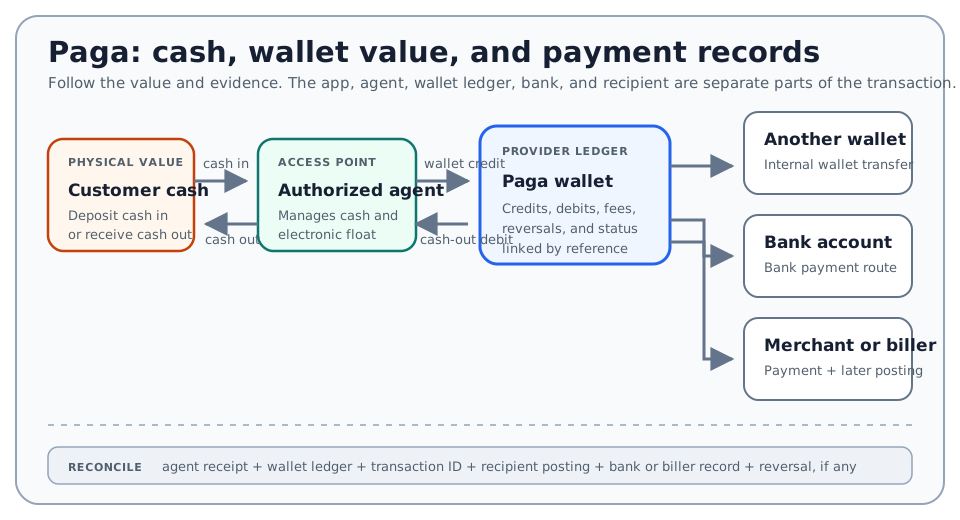
The wallet record shows value credited to or debited from a customer’s account on Paga’s system. The provider’s ledger must distinguish customer balances, fees, reversals, adjustments, and transaction status. This electronic record is different from physical cash held by an agent and from funds held within the banking system to support outstanding customer value.
Agent Network
An agent can connect cash users to the electronic system. In a cash-in transaction, the customer gives cash to an authorized agent and the customer’s wallet receives an electronic credit after successful processing. In cash-out, the wallet is debited and the agent provides cash after the required checks and confirmation.
The agent needs both:
- enough physical cash to fund customer withdrawals; and
- enough electronic float to accept cash deposits and issue corresponding wallet value.
An agent can be genuine but temporarily unable to complete a transaction because one side of that liquidity position is insufficient. Agent identity, available service, amount, fee, and completion status should be confirmed before cash changes hands.
Digital and Bank-Connected Transactions
Paga’s terms describe access through channels that can include mobile applications, web interfaces, USSD, and agents. They also describe multiple possible funding sources. The current channel and product must be checked because services can change.
A wallet-to-wallet transfer can update records within the provider’s system. A transfer to a bank account requires additional routing, recipient-bank processing, and reconciliation evidence. A bill payment adds a biller or service provider whose own posting can occur separately from the payment confirmation.
Transaction Types and Evidence
| Transaction | Main movement | Evidence to preserve |
|---|---|---|
| Cash in | Customer cash becomes a wallet credit through an agent | Agent identity, receipt, amount, fee, reference, and wallet credit |
| Cash out | Wallet debit is exchanged for agent cash | Withdrawal request, verification, reference, debit, and cash received |
| Wallet transfer | Value moves between customer wallet records | Sender and recipient identifiers, amount, status, and both ledger entries |
| Bank-account transfer | Wallet or another funding source supports a bank payment | Recipient-bank details, name check if available, route, reference, debit, and bank credit |
| Bill or merchant payment | Customer value is sent to a biller or merchant | Customer reference, biller account, provider confirmation, and biller posting |
| Reversal or refund | An earlier debit or payment is corrected | Original transaction ID, reason, reversal reference, and restored balance |
A single SMS, push notification, or screen image may not prove the entire transaction. Strong evidence connects the initiating record, provider ledger, agent or bank record, recipient posting, fees, and any reversal.
Worked Example: Cash In and Wallet Transfer
Assume a customer gives an authorized agent NGN 20,000 in cash and the disclosed cash-in fee is zero for this hypothetical example. The provider confirms a NGN 20,000 wallet credit. The customer then sends NGN 7,500 to another wallet and pays a separately disclosed NGN 100 transfer fee.
Ignoring other activity, the sender’s wallet should show:
| Entry | Wallet effect |
|---|---|
| Cash-in credit | +NGN 20,000 |
| Transfer to recipient | -NGN 7,500 |
| Transfer fee | -NGN 100 |
| Expected ending balance | NGN 12,400 |
The recipient’s wallet should show a NGN 7,500 credit. The agent’s records should show NGN 20,000 more physical cash and the corresponding reduction in electronic float used to create the customer’s wallet credit. The provider ledger should link both customer entries and the fee to unique transaction references.
The arithmetic is simple; the evidence is the important part. If the customer’s cash receipt exists but the wallet credit does not, the agent receipt, timestamp, agent identifier, amount, and transaction reference are needed to investigate the mismatch.
Example: Debit Succeeds but Bank Credit Is Missing
A user requests NGN 35,000 from a Paga wallet to a Nigerian bank account. The wallet is debited and the app displays a successful request, but the recipient does not see the credit.
Possible states include:
- the instruction is still being processed;
- the recipient details were wrong;
- an intermediary or recipient bank rejected the transaction;
- a delayed response caused inconsistent status records;
- the payment failed and a reversal is pending; or
- the recipient received the credit but cannot identify its descriptor.
The user should avoid sending a second payment until the first reference is checked. Useful evidence includes the Paga transaction ID, amount, time, funding source, destination bank and account, displayed recipient name, wallet debit, status history, bank statement, and any reversal. Current provider support and complaint channels should be used rather than contact details copied from an unverified message.
Paga, Bank Accounts, and Card Wallets
| Feature | Paga stored-value wallet | Mobile banking app | Card-based mobile wallet |
|---|---|---|---|
| Primary record | Mobile-money provider ledger | Customer bank-account ledger | Wallet credential and underlying issuer record |
| Value source | Stored value or supported external funding source | Deposit or credit account at the bank | Debit, credit, prepaid, or another linked method |
| Cash interface | May use authorized agents | Usually branch, ATM, or bank-supported channel | Normally depends on the underlying card or account |
| Transfer route | Internal wallet record or connected payment route | Bank internal system or external payment rail | Card network or other underlying payment method |
| Main review question | Where is value recorded and who controls the transaction? | Which bank account and rail were used? | Which credential and underlying funding source were charged? |
The categories can overlap. For example, a Paga transaction may use a linked bank account or card, but that does not turn every Paga wallet entry into a bank-account balance or card transaction.
Fees, Limits, and Identity Checks
Paga’s terms state that some transactions may carry fees and that limits can depend on channel, transaction type, and risk controls. Identity information and verification requirements can also differ by account status and service.
For a current transaction, verify:
- the exact amount the sender will pay;
- the amount and currency the recipient should receive;
- the funding source and destination;
- any agent, transfer, withdrawal, bill-payment, card, or third-party charge;
- the daily or transaction limit;
- the required identity or account-verification level; and
- whether the user can cancel, reverse, or dispute the instruction after confirmation.
Do not rely on a fee, limit, supported bank, agent count, or app procedure quoted in an undated article. Provider terms and regulatory requirements can change.
Regulation and Customer-Fund Protection
The CBN’s mobile-money framework covers licensing, participants, account models, agent networks, customer funds, risk management, consumer protection, and other operating requirements. The CBN’s current payment-service-provider list is the appropriate starting point for checking licence status.
The Nigeria Deposit Insurance Corporation (NDIC) describes pass-through deposit insurance for eligible mobile-money subscriber funds held through qualifying pool or trust accounts at deposit-taking institutions. This is not the same as saying that every wallet loss, fraud event, agent shortage, failed transfer, or provider claim is insured. Eligibility, coverage, records, limits, and the event causing the loss matter.
Users should distinguish:
- provider insolvency or failure;
- failure of a bank holding customer funds;
- unauthorized account access;
- an agent dispute or cash shortage;
- a payment sent to the wrong recipient; and
- a delayed, failed, or incorrectly posted transaction.
Different facts can lead to different remedies and evidence requirements.
Risks and Common Mistakes
- Treating the wallet as identical to an ordinary insured bank account.
- Handing cash to someone without verifying that the person and location are authorized for the requested service.
- Leaving an agent before checking the receipt and wallet confirmation.
- Sharing a PIN, password, one-time code, or device access with a caller or message sender.
- Sending again after a delay without checking whether the first transaction was completed.
- Confusing a successful provider instruction with confirmed recipient-bank or biller posting.
- Assuming every transaction is free, instant, reversible, or available through every channel.
- Using an old support number, fee schedule, app screen, or transaction limit.
- Believing that licensing eliminates operational, fraud, liquidity, or cybersecurity risk.
How to Evaluate a Paga Transaction
- Identify the user, wallet, agent, bank, biller, or merchant involved.
- Record the transaction type, amount, currency, fee, date, time, and reference.
- Confirm the funding source and destination rather than relying on the Paga label.
- Separate request, authorization, processing, completion, posting, reversal, and refund statuses.
- Match cash, wallet, bank, biller, and agent records where relevant.
- Use official provider support and escalation channels for unresolved errors.
- Check current CBN and NDIC information when licence or protection status matters.
Official Resources
- Central Bank of Nigeria: Payment Service Providers lists licensed payment-service providers by category, including mobile-money operators.
- Central Bank of Nigeria: Payments System Supervision provides the official policy and regulatory index, including the 2021 mobile-money framework and guidelines.
- Central Bank of Nigeria: Payment-System Oversight explains the CBN’s oversight role for mobile-payment operators and other payment providers.
- Nigeria Deposit Insurance Corporation: Deposit Insurance FAQs explains pass-through deposit insurance for eligible mobile-money subscriber funds.
- Paga Nigeria: Customer Terms of Use defines the Paga account or wallet, channels, funding sources, fees, limits, and customer obligations.
Provider terms describe the contractual service and may change. Regulatory and deposit-insurance sources should be checked directly when a current legal or financial decision depends on them.
FAQs
Is Paga a bank?
Can a person use Paga without a smartphone?
Are all Paga transactions free and instant?
Related Terms
- Mobile Payments: Payments initiated, authenticated, or presented through a mobile device or service.
- Mobile Wallet: Software or account interface used to hold value or payment credentials, depending on the model.
- Stored-Value Card: Payment instrument that records or provides access to prepaid value under a different product model.
- Digital Payments: Payments initiated or processed through electronic channels.
- Bank Transfer: Movement of funds from one bank account to another.
- Financial Inclusion: Access to useful and appropriately delivered financial services.
Educational Use
This article provides general financial education. It is not a recommendation to use Paga and is not banking, payment, legal, regulatory, insurance, or cybersecurity advice.