Taxable Year
A taxable year is the accounting period used to measure and report income, deductions, credits, and tax liability.
A taxable year, or tax year, is the accounting period used to measure and report income, deductions, credits, and tax liability. It is commonly a calendar year or fiscal year, but a taxpayer can also have a 52–53-week year or a short tax year when the governing rules permit or require one.
The tax year supplies the period boundaries used to assign tax items to a return. It does not by itself determine when cash was received, when income is recognized, which accounting method applies, or when the return is due.
Key Takeaways
- A calendar tax year runs from January 1 through December 31.
- Under U.S. federal tax terminology, a regular fiscal tax year is 12 consecutive months ending on the last day of a month other than December.
- A 52–53-week tax year ends on a consistent weekday and can vary between 52 and 53 weeks.
- A short tax year is less than 12 months and can arise when a taxpayer begins, ends, or validly changes its accounting period.
- Individuals generally use a calendar tax year; businesses and other entities may have additional choices or required years.
- Changing an adopted U.S. tax year can require Form 1128, automatic-approval procedures, a ruling request, or an applicable exception.
- A financial-reporting fiscal year and a tax year may align, but they should be verified separately.
- Filing deadlines and tax rules depend on the return, period, and current law; April 15 is not a universal tax-return deadline.
Main Types of Tax Year
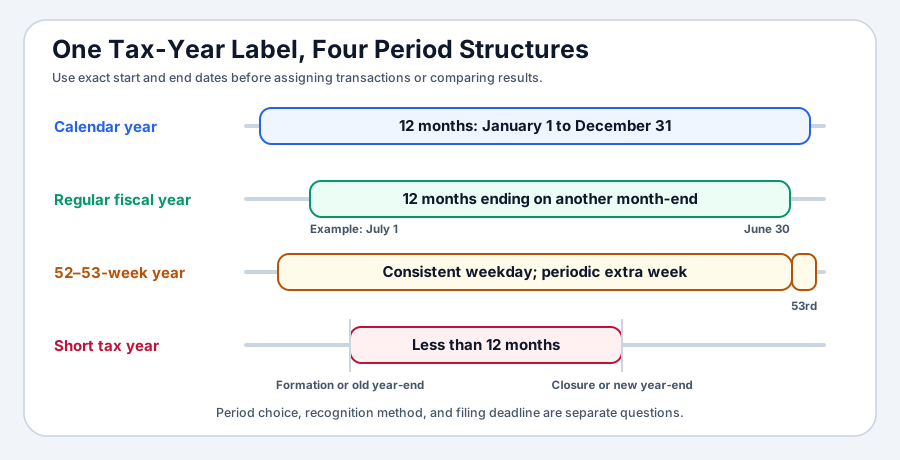
| Tax-year type | Period structure | Example | Main caution |
|---|---|---|---|
| Calendar year | January 1 through December 31 | January 1, 2026 to December 31, 2026 | Do not assume every return using this period has the same filing deadline |
| Regular fiscal year | 12 consecutive months ending on the last day of a month other than December under U.S. federal terminology | July 1, 2025 to June 30, 2026 | Entity rules can restrict the year that may be adopted |
| 52–53-week year | 52 or 53 weeks ending on a selected weekday by reference to a month | Saturday nearest January 31 | Period length and calendar dates shift; compare weekly data carefully |
| Short tax year | Less than 12 months because of formation, termination, or a valid year change | January 1, 2026 to June 30, 2026 | Special filing and tax-computation rules may apply |
A short tax year is a tax period, but it is not a normal annual accounting period. It should not be described as merely a “fiscal year of six months” without explaining why the short period exists.
Calendar Tax Year
The calendar year is the simplest tax-year structure: records and tax items are reported from January 1 through December 31. The IRS states that anyone can generally adopt the calendar year, and specified taxpayers must use it when they have no qualifying annual accounting period, keep no books or records, or are otherwise required to do so.
Individuals generally use the calendar year. Publication 538 explains that an individual can adopt a fiscal year when the individual’s books and records are maintained on that basis, but other restrictions and approval requirements still matter. Starting a sole proprietorship does not automatically let a calendar-year individual adopt a different business year.
Fiscal Tax Year
In U.S. federal tax guidance, a regular fiscal year consists of 12 consecutive months ending on the last day of a month other than December. A year running from July 1 through June 30 is one example.
This definition is narrower than common financial-reporting usage. In financial statements, Fiscal Year can mean an organization’s annual reporting period even when it matches the calendar year. Tax documents use the definitions in the applicable tax rules.
A non-calendar tax year can align the return with an operating cycle or financial close, but convenience alone does not override a required tax year. Partnerships, S corporations, personal service corporations, trusts, tax-exempt organizations, and consolidated groups can face specialized rules.
52–53-Week Tax Year
A 52–53-week tax year ends on the same weekday each year, either on the last occurrence of that weekday in a selected month or on the occurrence nearest the final day of that month. This keeps weekly operating periods consistent while holding the year-end near a selected calendar date.
A 52-week year has 364 days and a 53-week year has 371 days. The extra week can distort unadjusted revenue, payroll, inventory-turnover, and tax-period comparisons. Analysts should identify the exact start and end dates and normalize period length before interpreting growth.
The existence of a 53rd week does not automatically create an extra tax rate or separate return. It changes the measurement period. Elections, adoption procedures, and treatment of statutory effective dates must follow the applicable rules.
Short Tax Year
A short tax year can occur when a taxpayer:
- begins existence after the start of its normal tax year;
- ceases to exist before the end of the year;
- changes from one permitted tax year to another; or
- enters another transaction or status change that requires a short-period return.
The IRS explains that a taxable entity not in existence for an entire year generally files for the period it existed. A change in accounting period can also produce a short return that bridges the old and new year-ends.
Do not assume annual deductions, exemptions, brackets, or tax are always prorated by dividing by 12. Short-year computations can differ by taxpayer and reason for the short period, and current forms and instructions control.
Worked Example: Changing a Tax Year
Assume a corporation has used a calendar tax year ending December 31. It receives the required approval to change to a June 30 year-end.
The transition can create these periods:
| Return period | Dates | Length | Purpose |
|---|---|---|---|
| Last old tax year | January 1, 2025 to December 31, 2025 | 12 months | Final full calendar-year return |
| Transition short year | January 1, 2026 to June 30, 2026 | 6 months | Bridges the old year-end and new year-end |
| First full new fiscal year | July 1, 2026 to June 30, 2027 | 12 months | Establishes the new recurring period |
Suppose the company earns $4.8 million of taxable income during the six-month transition period and $9.6 million during the following 12-month fiscal year. Those amounts belong to separate returns even though the dollar totals happen to imply the same monthly average.
The company should not combine the 18 months into one return merely because the business continued without interruption. Nor should an analyst compare the $4.8 million short-period amount directly with the $9.6 million annual amount and call the difference a 50% decline. The periods have different lengths.
This example illustrates period assignment only. It does not calculate short-year tax or reproduce the approval requirements for any particular taxpayer.
How a U.S. Tax Year Is Adopted
The IRS states that a taxpayer generally adopts a tax year by filing the first income-tax return using that year, unless a required tax year applies. Merely requesting an extension, obtaining an employer identification number, or paying estimated tax does not adopt a tax year.
Before using a proposed year, verify:
- whether the taxpayer is permitted or required to use a calendar, fiscal, or 52–53-week year;
- whether books and records are maintained on that basis;
- whether the first return validly adopts the period;
- whether an election or form is required; and
- whether ownership, entity classification, or group membership creates a required year.
A newly formed C corporation may have more flexibility than a partnership or S corporation. A taxpayer should not generalize one entity’s adoption rules to another.
Required Tax Years and Entity Differences
| Taxpayer type | General U.S. federal orientation | What to verify |
|---|---|---|
| Individual | Generally calendar year; fiscal-year use is constrained | Books and records, prior adoption, and approval rules |
| Sole proprietorship | Usually follows the owner’s tax year because it is not a separate federal income-taxpayer | Owner’s adopted year and reporting method |
| Partnership | Can be subject to a required tax year tied to partners or other statutory rules | Ownership, permitted deferral, elections, and Form 1065 instructions |
| S corporation | Generally subject to required-year rules unless an allowed election or business purpose applies | Election, permitted year, and Form 1120-S instructions |
| C corporation | A newly formed corporation generally establishes its year with its first return, subject to special rules | Initial period, consolidated group, personal service, and other restrictions |
| Trust or estate | Can be subject to separate statutory period rules | Trust type, estate status, initial adoption, and Form 1041 instructions |
This table is intentionally high level. It is not a substitute for entity-specific authority.
Changing an Adopted Tax Year
Once a U.S. taxpayer has adopted a tax year, changing it may require IRS approval. Form 1128 is the application to adopt, change, or retain a tax year, but saying “every change requires filing Form 1128” is too broad.
The Form 1128 instructions contain:
- circumstances in which the form is not filed;
- automatic-approval procedures for qualifying applicants;
- ruling-request procedures when automatic approval is unavailable;
- filing windows and attachments; and
- entity-specific requirements.
A valid change often creates a short transition year. Approval to change the year does not by itself resolve every accounting-method, estimated-tax, consolidated-return, or financial-reporting issue.
Tax Year vs. Accounting Method
The tax year answers which period is being reported. An accounting method answers when and how income and expenses are recognized within that period.
| Question | Tax-year issue | Accounting-method issue |
|---|---|---|
| What dates does this return cover? | Yes | No |
| Is income recognized when received, earned, sold, or constructively received? | Not by itself | Yes |
| Does the taxpayer use cash or accrual accounting? | No | Yes |
| Does a transaction fall before or after year-end? | Establishes the boundary | Recognition rules determine which side of the boundary applies |
Changing a year-end is not the same as changing from cash to accrual accounting. Each change can have its own permission, transition, and reporting rules.
Tax Year vs. Financial-Reporting Year
A company’s tax year and financial-reporting year may use the same end date, but the labels are not interchangeable. Differences can arise from:
- local tax requirements for subsidiaries;
- consolidated financial statements containing entities with different tax years;
- a tax year required by entity or ownership rules;
- a financial-reporting transition period;
- a 52–53-week calendar treated differently under a tax rule; or
- changes approved for one reporting system but not yet effective in another.
Analysts should reconcile the return period to the financial-statement period before comparing taxable income, current tax expense, tax payable, or cash taxes paid.
Filing Deadlines Depend on the Return
A tax year’s ending date helps determine a filing deadline, but it is not the only input. Return type, taxpayer, weekend and holiday rules, extensions, statutory relief, and special year-ends can alter the date.
For example, current Form 1120 instructions express corporate deadlines by reference to months after the tax year closes and include a special rule for certain June year-ends. That is why replacing the full rule with “returns are due April 15” is unreliable.
An extension to file may not extend the time to pay. Always use the current form instructions and official tax calendar for the relevant return and period.
Why Taxable Years Matter in Finance
Tax-year boundaries affect:
- which return reports income, gains, deductions, losses, and credits;
- whether a transaction falls before or after a law’s effective date;
- estimated-tax and payment timing;
- loss and credit carryforward or carryback periods;
- comparison of tax expense with tax-return liability;
- merger, liquidation, and consolidated-return short periods;
- seasonal business analysis; and
- valuation models that forecast cash taxes.
Moving a transaction by a few days around year-end can change its reporting period, but it may not change its ultimate tax character or economic value. Recognition, anti-abuse, related-party, settlement, and constructive-receipt rules can prevent a simple date change from producing the assumed result.
How to Verify a Taxable Year
- Identify the taxpayer and return. Determine which person or entity files and on which form.
- Read the exact start and end dates. Do not rely only on a label such as “tax year 2026.”
- Classify the period. Calendar, regular fiscal, 52–53-week, or short year.
- Confirm adoption or required-year rules. Review the first return, elections, ownership, entity classification, and group status.
- Check for an approved change. Inspect Form 1128, an automatic-approval statement, ruling, election, or applicable exception.
- Reconcile books and returns. Match the tax period to trial balances, transaction records, schedules, and financial statements.
- Use current deadlines. Verify the return instructions, extensions, and relief for the exact year.
- Normalize comparisons. Adjust analysis for short periods and 53-week years before drawing performance conclusions.
Common Mistakes and Limitations
- Treating every taxable year as exactly 12 calendar months.
- Calling a short year an annual accounting period.
- Assuming every individual or business may freely choose any fiscal year.
- Saying every tax-year change always requires Form 1128 without reviewing exceptions.
- Assuming Form 1128 automatically means approval was required or granted.
- Equating a tax year with a financial-reporting fiscal year.
- Treating a tax-year change as an accounting-method change.
- Hard-coding April 15 as the deadline for every taxpayer and return.
- Comparing a short period or 53-week year directly with a normal 12-month or 52-week year.
- Allocating income by simple monthly proration when transaction-level recognition rules control.
Official Sources
- IRS: Tax Years explains calendar, fiscal, 52–53-week, and short tax years, adoption, and changes.
- IRS Publication 538: Accounting Periods and Methods provides detailed U.S. federal rules for accounting periods and methods.
- IRS: Instructions for Form 1128 describes exceptions, automatic-approval requests, ruling requests, and filing procedures for tax-year changes.
- IRS: Instructions for Form 1120 provides current corporate return-period and filing-deadline rules.
- IRS Publication 509: Tax Calendars provides current filing and payment calendars for specified taxpayers and returns.
Related Terms
- Fiscal Year: The annual accounting and reporting period used for financial statements.
- Fiscal Year-End: The final date of an organization’s annual reporting cycle.
- Income Tax: The framework for measuring income and calculating tax for a defined period.
- Federal Income Tax: The U.S. national income-tax system administered by the IRS.
- Taxable Event: A transaction or occurrence with a tax consequence that must be assigned to a period.
- Taxable Income: The income base measured for the applicable taxpayer and tax year.
FAQs
Is a taxable year always 12 months?
Can an individual choose any fiscal tax year?
Does changing a tax year require IRS approval?
Is a tax year the same as a fiscal year?
This article provides general U.S. federal tax and financial education. It is not individualized tax, legal, accounting, filing, business, or investment advice and does not establish a tax-year election or filing position. Use current official instructions and qualified professional advice for a specific taxpayer.