Tax-Loss Harvesting
Tax-loss harvesting realizes selected investment losses to offset capital gains or support a capital-loss deduction under applicable tax rules.
Tax-loss harvesting is the deliberate sale of an investment below its adjusted tax basis to realize a capital loss that, if recognized under the applicable rules, can offset capital gains or contribute to an allowable net capital-loss deduction. The strategy changes the timing of taxes; it does not recover the investment loss, guarantee tax savings, or make a replacement investment economically equivalent.
This article focuses on U.S. federal rules for individual investors. Corporate, trust, estate, fund, state, local, and non-U.S. rules can produce different results.
Key Takeaways
- A price decline becomes useful for tax purposes only after a recognized disposition or another qualifying event.
- Capital gains and losses are classified and netted across the full tax year; one harvested loss is not a standalone deduction.
- Short-term and long-term character matters because the categories are netted separately before opposing results are combined.
- Under current general U.S. individual rules, a remaining net capital loss can offset only a limited amount of other income, with unused loss generally carried forward.
- The wash-sale rule can defer a stock or securities loss when substantially identical property is acquired during the 61-day window centered on the sale.
- Broker reporting may not capture replacement purchases in another account, at another firm, in an IRA, or by another covered person.
- A replacement investment can introduce tracking error, fees, spreads, liquidity differences, or unintended market exposure.
- Harvesting often defers tax rather than eliminating it because the replacement investment begins with a new basis and may create a later gain.
- Transaction costs, future tax rates, loss expiration or usability, portfolio risk, and administrative burden can outweigh the expected benefit.
- Tax considerations should support an investment process, not override diversification, liquidity, or risk controls.
How Tax-Loss Harvesting Works
A basic harvesting transaction has four stages:
- An investment has an unrealized loss because its market value is below adjusted basis.
- The investor sells the position, creating a realized loss.
- Tax rules determine whether the loss is recognized, its character, and how it nets with other gains and losses.
- The investor decides whether to remain in cash or acquire a replacement that fits the portfolio without creating a wash sale.
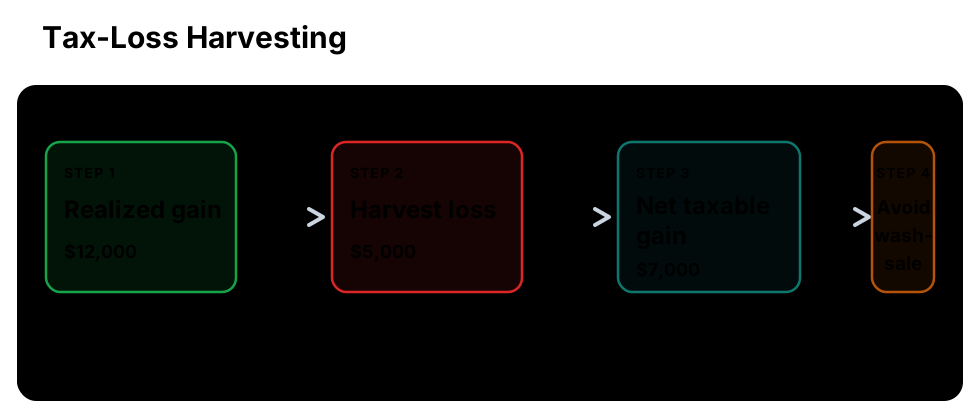
The figure isolates the capital-gain netting effect. It does not show wash-sale adjustments, replacement-investment risk, holding-period character, or later gains.
The sequence matters. Selling a position at a loss does not prove that the loss will reduce the current tax bill. A wash sale can defer it, a related-party rule can disallow it, capital-loss limitations can postpone its use, and a tax-advantaged account can prevent an owner-level capital loss from arising in the first place.
Tax-Loss Harvesting Workflow
    flowchart TD
	    A["Investment is below adjusted tax basis"] --> B{"Sell or otherwise recognize the loss?"}
	    B -->|"No"| C["Unrealized loss; no harvesting transaction"]
	    B -->|"Yes"| D["Confirm basis, proceeds, and holding period"]
	    D --> E{"Wash sale or another limitation?"}
	    E -->|"Yes"| F["Apply deferral, disallowance, or basis rule"]
	    E -->|"No"| G["Classify short-term or long-term loss"]
	    G --> H["Net with gains, losses, and carryovers"]
	    F --> H
	    H --> I["Determine current use and future carryover"]
	    I --> J["Measure tax effect, costs, and portfolio impact"]
	    J --> K["Preserve tax-lot and replacement records"]
This workflow is a review framework, not a filing calculation. The return-year forms and transaction-specific rules control the reported result.
Start With Adjusted Basis
The preliminary realized result is generally measured from net sale proceeds and adjusted basis:
1Realized gain or loss
2= net amount realized - adjusted basis
Adjusted basis can differ from the original purchase price because of commissions, return-of-capital distributions, stock splits, reinvested distributions, gifts, inheritances, partnership adjustments, wash sales, and other events.
Tax-lot selection can therefore change the amount and character of the harvested loss. Selling a high-basis lot may realize a larger loss than selling a low-basis lot, but the investor must use a permitted identification method and satisfy the broker and tax-record requirements. A platform’s default lot does not necessarily match the investor’s intended tax result.
Before trading, reconcile:
| Input | Evidence |
|---|---|
| Quantity and tax lot | Purchase confirmation and lot-level account history |
| Adjusted basis | Broker basis record plus external basis adjustments |
| Expected proceeds | Current bid, estimated spread, commissions, and fees |
| Holding period | Acquisition and disposition dates plus special rules |
| Replacement activity | All relevant accounts, automatic plans, and related persons |
U.S. Capital-Loss Netting Sequence
For individuals, capital gains and losses do not simply enter one combined bucket. The general sequence is:
- Combine short-term gains, short-term losses, and short-term carryovers.
- Combine long-term gains, long-term losses, and long-term carryovers.
- Net an opposing gain and loss between the two categories.
- If the final result is a net capital loss, apply the individual deduction limit and determine any carryover.
Under current general U.S. federal rules, a taxpayer other than a corporation can deduct the lesser of the net capital loss or $3,000 against other income, reduced to $1,500 for a married individual filing separately. An unused individual capital loss generally carries forward under Section 1212 and retains its short-term or long-term character.
Those amounts are not a universal allowance for every taxpayer. Corporations have different capital-loss rules, and taxable income, filing status, entity type, state law, and specialized transactions can alter the outcome.
Worked Example 1: Offsetting a Short-Term Gain
Assume an individual has already realized an $18,000 short-term capital gain. The investor sells another stock with a valid $7,000 short-term capital loss. Ignore other transactions and limitations.
| Short-term category | Amount |
|---|---|
| Realized short-term gain | $18,000 |
| Harvested short-term loss | ($7,000) |
| Net short-term gain | $11,000 |
The harvested loss reduces the net short-term gain from $18,000 to $11,000. It does not create $7,000 of tax savings. The actual federal tax effect depends on the rate applied to the reduced gain, other return items, and any additional rules.
Worked Example 2: Loss Exceeds Gains
Assume another individual has:
$4,000of recognized short-term capital gains;$10,000of recognized short-term capital losses after harvesting; and- no other capital transactions or prior carryovers.
The category result is a $6,000 net short-term capital loss.
For a taxpayer eligible for the current general $3,000 individual limit, and assuming the return supports the full deduction:
| Use of the net loss | Amount |
|---|---|
| Net short-term capital loss | $6,000 |
| Current deduction against other income | ($3,000) |
| Short-term loss carried forward | $3,000 |
The carryover enters the next year’s short-term category. It is not a refundable credit and is not deducted before that year’s gains and losses are calculated. See Capital Loss Carryover for the full worksheet and character rules.
Worked Example 3: Tax Deferral and Basis Reset
Assume an investor buys an investment for $12,000, later sells it for $9,000, and recognizes a $3,000 loss. The investor acquires a different replacement investment for $9,000 without triggering a wash sale.
If the replacement later rises to $12,000 and is sold, it has a simplified $3,000 gain:
1$12,000 later proceeds - $9,000 replacement basis = $3,000 gain
The original loss may reduce tax in an earlier year while the replacement gain increases tax in a later year. That timing difference can have value, but it is not the same as permanent tax elimination. Future prices, holding period, tax rates, distributions, additional harvesting, transaction costs, and law changes affect the final result.
If the replacement were substantially identical and acquired within the wash-sale period, the original loss might instead be deferred through a basis adjustment under the wash-sale rule.
Why Loss Character Matters
A harvested loss generally retains the short-term or long-term character of the disposed asset. The distinction affects what the loss offsets first and the character of any carryover.
| Harvested loss | Initial category | Why readers care |
|---|---|---|
| Short-term capital loss | Short-term gains and losses | Short-term net gains are generally taxed at ordinary individual rates |
| Long-term capital loss | Long-term gains and losses | Long-term gains can fall within preferential individual rate categories |
| Section 1256 loss | Specialized 60/40 framework | Character can be split regardless of actual holding period |
| Ordinary loss | Not part of ordinary capital-loss harvesting | Separate eligibility and limitation rules apply |
A loss does not automatically offset the highest-taxed gain chosen by the investor. Statutory netting determines the sequence. Estimating value requires the complete short-term and long-term record, not just the targeted sale.
The Wash-Sale Constraint
The U.S. Wash-Sale Rule can disallow a current loss on stock or securities when substantially identical property is acquired within 30 days before or after the loss sale. Including the sale date, the review covers 61 calendar days.
Commonly missed replacement acquisitions include:
- a purchase made before the loss sale;
- automatic dividend reinvestment;
- a recurring investment plan;
- a purchase at another broker;
- a transaction in another account at the same broker;
- an option or contract to acquire substantially identical property;
- a spouse’s or controlled corporation’s purchase; and
- an acquisition in the taxpayer’s IRA or Roth IRA.
In a standard taxable-account wash sale, the disallowed loss generally increases the replacement property’s basis and its holding period is adjusted. An IRA or Roth IRA replacement is more severe under current IRS guidance because the ordinary replacement-basis increase does not apply.
A broker’s Form 1099-B may capture only part of this activity. Taxpayer-level review should cover the full household and account record required by the rule.
Choosing a Replacement Investment
Remaining invested can reduce the market-timing risk of sitting in cash, but a replacement should be evaluated from both tax and investment perspectives.
The phrase substantially identical has no universal percentage-overlap safe harbor. Two funds can have similar labels while differing in index methodology, holdings, weights, fees, liquidity, distributions, securities-lending practices, and tracking behavior. Conversely, changing a ticker does not by itself prove that two positions are not substantially identical.
Review:
| Dimension | Question |
|---|---|
| Tax classification | Is the replacement substantially identical under the relevant facts? |
| Exposure | Does it preserve the intended asset-class, sector, factor, duration, or credit exposure? |
| Tracking error | How far might returns differ from the original holding? |
| Cost | What are the expense ratio, spread, commissions, market impact, and tax friction? |
| Liquidity | Can the position be entered and exited at a reasonable price? |
| Portfolio fit | Does the replacement create concentration, overlap, or policy-limit issues? |
Tax uncertainty should not be hidden behind a model label such as “wash-sale safe.” When substantial identity is unclear, document the comparison and obtain qualified advice for the actual filing position.
When Harvesting May Add Value
Tax-loss harvesting is more likely to be useful when:
- the loss is recognizable and not blocked by a wash sale or another rule;
- the taxpayer has gains or sufficient future opportunity to use the loss;
- the loss offsets a category taxed at a meaningful rate;
- a suitable replacement preserves the intended portfolio exposure;
- transaction costs and tracking differences are modest relative to the expected tax-timing value;
- basis and cross-account records are complete; and
- the transaction supports an existing rebalancing or risk decision.
The benefit is generally more relevant in taxable accounts. Trades inside an IRA, Roth IRA, 401(k), or similar tax-advantaged account normally do not create a current owner-level capital loss deduction. Those accounts can still create wash-sale complications for a loss realized elsewhere.
When Harvesting May Not Help
The strategy can have little or negative value when:
- the taxpayer cannot use the loss for a long time;
- the harvested loss merely offsets a low-rate gain while creating a later higher-rate gain;
- the sale triggers a wash sale, related-party restriction, or straddle rule;
- the replacement has higher fees, poor liquidity, or materially different risk;
- the portfolio misses a sharp rebound while waiting or holding cash;
- bid-ask spreads and taxes on distributions exceed the timing benefit;
- harvesting disrupts a concentrated-position, charitable, estate, or employee-plan strategy; or
- recordkeeping across brokers and family accounts is incomplete.
A larger realized loss is not automatically a better outcome. It may simply reflect a larger economic loss or create a carryover that cannot be used promptly.
Tax Selling and Year-End Activity
Tax selling is a market phrase for sales motivated by tax considerations. It often overlaps with tax-loss harvesting near year-end, but the phrase can also include realizing gains to use existing loss carryovers, reducing a concentrated position, or completing a tax-aware rebalance.
| Term | Primary action | Main distinction |
|---|---|---|
| Tax-loss harvesting | Sell an investment to recognize a usable loss | Focuses on loss realization and netting |
| Tax selling | Sell for a tax-related reason | Broader, informal market label |
| Portfolio Rebalancing | Trade to restore target exposures | Portfolio risk is the primary objective |
| Wash sale | Loss sale combined with a covered replacement acquisition | Can defer or alter the expected loss treatment |
Market commentary often attributes year-end activity to tax selling, but a price decline or volume increase does not prove that taxes caused it. Fundamentals, index changes, fund flows, liquidity, and ordinary risk reduction can produce the same market pattern.
Harvesting also does not have to wait until December. Reviewing losses throughout the year can reduce rushed trades, improve replacement planning, and identify cross-account conflicts before the year-end window becomes crowded.
Automated and Direct-Indexing Programs
Robo-advisers and direct-indexing systems can scan many lots and realize losses throughout the year. Automation can improve consistency, but it does not remove the need for taxpayer-level controls.
Ask whether the system can see:
- outside brokerage accounts;
- IRAs and Roth IRAs;
- a spouse’s transactions;
- employer stock and equity-compensation plans;
- dividend-reinvestment and recurring-purchase instructions;
- mutual-fund average-basis elections;
- prior capital-loss carryovers; and
- restrictions on replacement securities.
An algorithm that sees only one managed account may create a transaction that appears compliant locally but conflicts with a replacement purchase elsewhere. It may also harvest losses with little current value while increasing fees, turnover, or tracking error.
How to Evaluate a Harvesting Trade
- Identify the taxpayer and account. Confirm that a recognized capital loss can arise in the relevant account and jurisdiction.
- Reconcile adjusted basis. Include lot-level and external basis adjustments rather than relying only on purchase price.
- Estimate net proceeds. Include spreads, commissions, redemption fees, and market impact.
- Determine holding-period character. Separate short-term and long-term positions before estimating the offset.
- Build the full tax-year picture. Include realized gains, losses, and carryovers across all accounts and pass-through statements.
- Test the 61-day wash-sale window. Review purchases before and after the sale, options, automatic plans, IRAs, and covered persons.
- Evaluate the replacement. Compare substantial-identity risk, exposure, liquidity, fees, and tracking error.
- Estimate timing value. Distinguish current tax reduction from a later gain caused by the replacement’s lower basis.
- Check other limitations. Consider straddles, related parties, short sales, and specialized asset rules.
- Preserve records. Retain confirmations, lot identification, basis, replacement analysis, Forms 1099-B, Form 8949, and Schedule D support.
Common Mistakes and Limitations
- Treating an unrealized decline as if it were already deductible.
- Calling the gross sale loss the tax benefit.
- Ignoring short-term and long-term netting order.
- Assuming every harvested loss offsets ordinary income without a limit.
- Harvesting inside a retirement account and expecting a current capital-loss deduction.
- Counting only purchases made after the sale for wash-sale purposes.
- Assuming a different account, broker, or ticker automatically avoids a wash sale.
- Letting automatic reinvestment acquire a small replacement lot during the window.
- Choosing a replacement solely for tax similarity while ignoring investment differences.
- Failing to measure the later gain created by a lower replacement basis.
- Assuming a year-end broker report includes all household transactions and basis adjustments.
- Allowing tax timing to override liquidity, diversification, or investment-policy constraints.
Official Sources
The following sources describe U.S. federal rules. Use current return-year materials because forms, thresholds, and guidance can change.
- 26 U.S.C. Section 1211: Limitation on Capital Losses provides the individual and corporate capital-loss limitations.
- 26 U.S.C. Section 1212: Capital Loss Carrybacks and Carryovers provides carryover rules and entity-specific treatment.
- 26 U.S.C. Section 1091: Wash Sales provides the federal stock and securities wash-sale rule.
- IRS Topic 409: Capital Gains and Losses summarizes capital-asset classification, holding periods, individual loss limits, carryovers, and reporting.
- IRS Publication 550: Investment Income and Expenses explains basis, capital gains and losses, wash sales, options, straddles, and investment reporting.
- IRS Instructions for Form 8949 provide current transaction and wash-sale adjustment instructions.
Related Terms
- Capital Loss: A recognized disposition loss with capital character, subject to netting and limitations.
- Capital Loss Carryover: An unused net loss entering a later year’s short-term or long-term category.
- Wash-Sale Rule: The main replacement-purchase constraint for harvested stock or securities losses.
- After-Tax Return: Investment performance after applicable taxes and tax timing.
- Tax Efficiency: The broader relationship between investment outcomes and tax cost.
- Portfolio Rebalancing: Restoring target exposures, sometimes coordinated with loss realization.
FAQs
Does tax-loss harvesting have to happen at year-end?
Can a harvested loss reduce ordinary income?
Is a different ETF automatically safe from the wash-sale rule?
Does tax-loss harvesting work inside an IRA or 401(k)?
Is tax selling the same as tax-loss harvesting?
This article provides general financial and U.S. tax education. It is not individualized tax, legal, accounting, retirement, filing, or investment advice and does not establish a tax position. Current law, jurisdiction, taxpayer type, account ownership, basis, holding period, replacement activity, and the complete tax-year record control the result.