Curve Rates
Forward-rate, par-yield-curve, and quoted-curve terms used in fixed-income pricing and rate-risk analysis.
Benchmark curve showing how government-bond yields differ across maturities and what curve shape implies for fixed income and the economy.
The yield curve, also called the term structure of interest rates, shows how yields differ across maturities for otherwise similar debt instruments, most often government bonds such as U.S. Treasuries. It is one of the bond market’s clearest summaries of how investors price time, policy expectations, inflation, and recession risk.
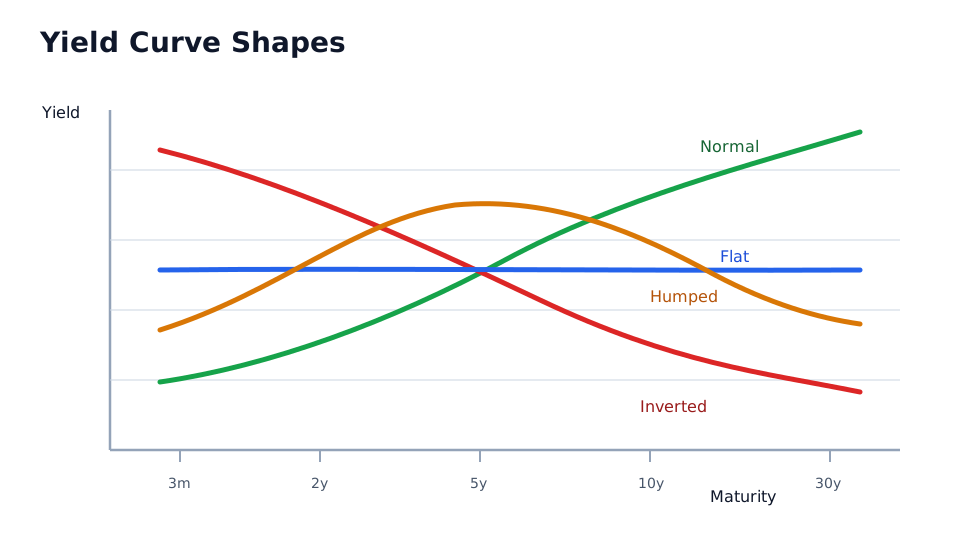
The basic curve shapes give investors a compact way to discuss how markets price maturity risk and macro expectations.
The yield curve matters because it influences:
| Shape | What it looks like | What it often suggests | Learn more |
|---|---|---|---|
| Normal Yield Curve | Longer maturities yield more than shorter maturities | Stable growth expectations and positive term premium | Upward-sloping baseline curve |
| Flat Yield Curve | Short and long maturities offer similar yields | Transition or uncertainty between regimes | Compression of term spread |
| Inverted Yield Curve | Short maturities yield more than long maturities | Tight policy, slowdown fears, or recession concern | Downward-sloping curve |
| Humped Yield Curve | Intermediate maturities yield more than short and long maturities | Uneven curve pressure in the belly | Localized maturity stress or transition |
The shape of the curve is only part of the story. Analysts also use competing theories to explain why longer maturities yield more or less than shorter ones, and whether those differences reflect expected policy paths, extra compensation for holding maturity risk, or supply-and-demand pressure inside different maturity buckets.
| Framework | Core claim | Best used for | Learn more |
|---|---|---|---|
| Expectation Theory | Long yields mainly reflect expected future short-term rates | Policy-expectation reading of the curve | Pure expectations baseline |
| Unbiased Expectations Hypothesis | Forward rates are unbiased forecasts of future short rates | Testing whether forwards predict future rates | Stronger empirical claim than pure expectations |
| Liquidity Preference Theory | Investors usually demand extra yield to hold longer maturities | Explaining upward bias from term premium | Expectations plus maturity premium |
| Market Segmentation Theory | Different maturity zones are priced by separate investor habitats | Liability-matching and supply-demand analysis | Curve segments can move independently |
Bond desks do not treat the curve as just a macro chart. They use it to judge which maturities look rich or cheap, how portfolio exposure is distributed across time, and how benchmark-rate moves may affect funding or valuation.
A portfolio manager might prefer the front end when policy rates look close to peaking, or shift farther out the curve when long-duration bonds appear attractive relative to expected future short rates.
For deeper curve structure, Par Yield Curve, Forward Rate, and Term Premium explain how benchmark curves are built, what future periods are implied by today’s rates, and why long maturities may carry extra yield beyond simple policy expectations.
Suppose Treasury yields look like this:
4.40%4.75%That is a normal upward-sloping curve because the longer maturity offers more yield than the shorter one. If instead the 2-year rose above the 10-year, investors would describe the curve as inverted.
For U.S. curve work, compare the curve label and date with U.S. Treasury interest rate statistics and Federal Reserve H.15 selected interest rates. For term-premium interpretation, treat New York Fed term premia data as a model estimate rather than a directly observed market price.
This page is for financial education only. It does not predict rates, recessions, bond returns, or the suitability of any fixed-income strategy for a particular reader.
Choose a subsection first. Deeper term pages live inside each subsection, which keeps large topic hubs readable.
Forward-rate, par-yield-curve, and quoted-curve terms used in fixed-income pricing and rate-risk analysis.
Term-structure theory, expectations, market-segmentation, liquidity-preference, and term-premium terms.
Normal, flat, inverted, and humped yield-curve shape terms used in fixed-income and macro-rate analysis.