Futures Trading
Futures trading uses standardized exchange-traded contracts to hedge or take market exposure through leveraged, daily-settled positions.
Futures trading is buying or selling standardized exchange-traded contracts to hedge an existing exposure or take a view on the future price of a commodity, index, interest rate, currency, or other underlying measure. A futures position creates leveraged exposure, is usually marked to market daily, and must be closed, rolled, cash settled, or handled through physical delivery under the contract rules.
Trading the correct direction is not enough. The outcome also depends on contract size, tick value, delivery month, settlement method, margin liquidity, basis risk, order execution, price limits, and the deadline for exiting or entering settlement.
Key Takeaways
- Buying a futures contract creates a long position; selling one creates a short position without requiring a prior long position.
- Futures margin is a performance bond, not a down payment and not the maximum possible loss.
- Contract notional value can be much larger than the cash posted as initial margin.
- Gains and losses are converted into cash through daily or intraday settlement under clearing rules.
- A hedge can reduce one risk while retaining basis, timing, liquidity, and margin-funding risk.
- Most positions are offset before delivery, but every trader must know the contract’s settlement and broker deadlines.
- A stop order can trigger an exit instruction, but it cannot guarantee the execution price or cap the loss.
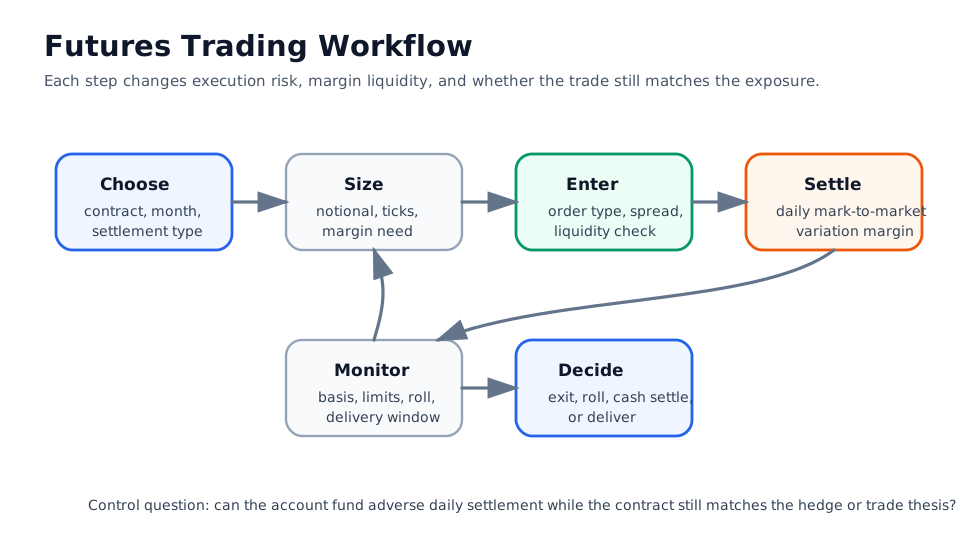
Futures Trading Workflow
| Step | What to check |
|---|---|
| Choose contract | Underlying, exchange, symbol, contract size, month, and settlement type |
| Translate exposure | Dollar value per point, tick value, notional amount, hedge ratio, and margin need |
| Enter order | Order type, bid-ask spread, depth, trading hours, and price-limit status |
| Monitor position | Daily settlement, variation margin, basis, open interest, and roll timing |
| Exit, roll, or settle | Offset the position, move to a later month, cash settle, or enter delivery procedures |
Read the Contract Before Trading
Every futures product has its own specification. At minimum, identify:
| Specification | Why it matters |
|---|---|
| Underlying and contract unit | Defines what one contract represents |
| Quote convention | Determines how the displayed price maps to money |
| Contract multiplier | Converts a price-point move into dollar P&L |
| Minimum tick and tick value | Shows the smallest quoted move and its cash effect |
| Listed contract months | Determines which maturity matches the exposure |
| Trading and settlement hours | Affects liquidity, order handling, and daily settlement |
| Price limits or circuit controls | Can restrict execution during large moves |
| Settlement method | Determines cash settlement or physical delivery obligations |
| Notice and last-trade dates | Establishes when the position must be managed |
A familiar underlying does not make two futures contracts interchangeable. Standard and smaller-sized contracts can have different multipliers, liquidity, and margin requirements. Nearby and deferred months can also produce different basis and roll exposure.
From Screen Price to Dollar Exposure
For a contract quoted as price per physical unit:
For an index future:
The value of a minimum move is:
Assume a hypothetical commodity contract represents 1,000 units, trades at $70.00 per unit, and has a minimum tick of $0.01.
| Measure | Calculation | Amount |
|---|---|---|
| Notional value | 1,000 x $70.00 | $70,000 |
| Tick value | 1,000 x $0.01 | $10 |
| 50-cent move | 1,000 x $0.50 | $500 |
$1.50 move | 1,000 x $1.50 | $1,500 |
If a long enters at $70.00 and the contract settles at $68.50, the position loses $1,500 per contract before fees. A short entered at the same price gains $1,500. The initial margin requirement does not change that economic exposure.
How Daily Settlement Works
Futures clearing converts price changes into account cash flows. The process generally follows this pattern:
- The trader posts initial margin through a futures commission merchant or broker.
- The position is valued using the applicable exchange or clearing settlement process.
- A loss is deducted and a gain is credited through variation settlement.
- If available equity falls below the required level, the firm may demand more funds or liquidate positions.
- Margin requirements can increase when volatility or concentration rises.
The settlement price may differ from the last trade. The exchange’s methodology and settlement window control the official daily value used for clearing.
Customer margin can exceed exchange minimums. A broker can also impose earlier liquidation, delivery, or funding deadlines. Traders should not assume that meeting the published exchange minimum guarantees that a position can remain open.
Hedging Versus Speculation
| Purpose | Example | Main risk |
|---|---|---|
| Hedging | A producer sells futures against an expected commodity sale | Basis, quantity, timing, liquidity, and margin funding |
| Speculation | A trader buys index futures expecting the market to rise | Directional loss, leverage, gaps, and execution |
| Spread trading | A trader buys one contract month and sells another | Curve movement, leg risk, and liquidity |
| Relative value | A desk compares futures with cash, forwards, or swaps | Funding, model, settlement, and operational risk |
A hedge should be mapped to a documented exposure. Record the asset, quantity, location, quality, timing, expected transaction, and selected contract month. A futures gain does not by itself prove a hedge worked; the combined cash and futures result is what matters.
Orders and Execution
| Order or condition | Practical concern |
|---|---|
| Market order | Prioritizes execution, but the fill can differ from the displayed price |
| Limit order | Controls the worst acceptable price, but may not execute |
| Stop order | Activates after a trigger, then may fill with slippage or remain constrained |
| Thin contract month | Wider spreads and less depth can increase execution cost |
| Locked limit market | Orders may queue without an available offsetting trade |
| Overnight session | Liquidity and price behavior may differ from core trading hours |
Closing a position requires an offsetting trade in the same contract, not merely a trade in the same underlying asset. A long June contract is not offset by selling September; that creates a calendar spread unless the June position is separately closed.
Exit, Roll, or Settle
| Action | What it does | Residual concern |
|---|---|---|
| Offset | Closes the same contract with an opposite trade | Fill price, fees, and final variation settlement |
| Roll | Closes one month and opens another | Calendar spread, liquidity, and changed basis |
| Cash settle | Leaves the expiring contract to final cash settlement | Benchmark and final-settlement methodology |
| Make or take delivery | Completes a physically delivered contract | Notice, assignment, funding, title, storage, and logistics |
Most futures positions are offset before delivery, but that market pattern is not a control procedure. The account holder must know the exact contract and broker deadlines.
Risks and Common Mistakes
- Sizing from initial margin instead of notional value and plausible price movement.
- Trading the wrong month, multiplier, or contract variant.
- Confusing futures margin with a securities margin loan.
- Assuming a stop order guarantees a maximum loss.
- Ignoring daily cash demands while focusing only on the final thesis.
- Treating the futures price as a guaranteed forecast of the future spot price.
- Using an imperfect hedge without measuring futures basis.
- Rolling by opening the deferred month without closing the expiring month.
- Holding a deliverable contract past a broker deadline unintentionally.
- Relying on stale contract specifications, margin schedules, or price-limit rules.
Futures are complex leveraged instruments. Losses can exceed the initial margin posted, and a profitable long-term view can still fail because the account cannot meet interim variation-margin calls.
Pre-Trade Checklist
- Identify whether the position is a hedge, speculation, spread, or relative-value trade.
- Confirm the exact exchange, symbol, month, multiplier, tick value, and settlement type.
- Calculate notional exposure and dollar loss for a range of adverse moves.
- Estimate initial, maintenance, variation, and broker-specific margin needs.
- Check volume, open interest, bid-ask spread, trading hours, and price limits.
- Define the order type and the risk of non-execution or slippage.
- Record the intended offset, roll, settlement, or delivery deadline.
- Verify whether the account can support delivery or final settlement.
- Keep independent liquidity for adverse daily settlement.
This page is for financial education only. It does not recommend futures trading or determine whether futures are suitable for a particular reader. Review the current exchange rulebook, clearing and broker terms, required risk disclosures, and qualified financial, legal, tax, and accounting advice where appropriate.
Authoritative References
The CFTC Futures Market Basics page explains hedging, speculation, delivery, cash settlement, daily account adjustment, and the possibility of losses beyond initial funds. Its guide to the economic purpose of futures markets explains standardization, clearing, performance-bond margin, and mark-to-market. CME Group’s lessons on contract specifications and calculating futures profit or loss show how contract size, tick value, and price movement translate into dollar exposure.
Related Terms
- Futures Contract: The standardized legal and market instrument being traded.
- Futures Price: The quoted level for a specified contract month.
- Outright Futures Position: A single long or short directional exposure.
- Initial Margin: Collateral required when a position is opened.
- Limit Up, Limit Down: Price-limit conditions that can restrict execution.