Price Fixation
Price fixation sets a transaction or valuation price using a specified benchmark, auction, date, window, or contractual pricing election.
Price fixation is the process of setting a transaction, invoice, settlement, or valuation price using a contractually specified benchmark, auction, date, time window, average, or pricing election. In physical commodity markets, a buyer or seller may “fix” the floating benchmark component while retaining an agreed quality, location, or delivery differential.
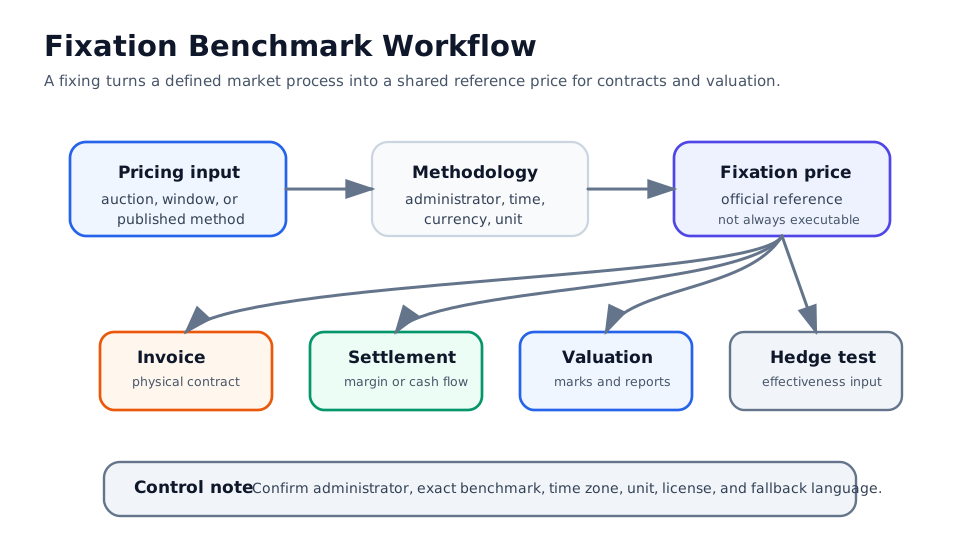
The term can describe two related but different events: a benchmark administrator determines an official reference price, or a contract party elects which published benchmark observation will set its transaction price. The contract and benchmark methodology must be read together.
Key Takeaways
- Price fixation converts an unknown or floating price component into a known contractual amount.
- A fixation can use an auction, official settlement, single observation, multi-day average, or another defined methodology.
- The benchmark price may not equal an executable quote available to every market participant.
- Commodity invoices often combine the benchmark with a location, grade, freight, or quality differential.
- The pricing date, time zone, unit, currency, and fallback provisions can materially change the result.
- Benchmark governance and licensing are separate from the commercial contract between buyer and seller.
- A futures hedge and a physical-price fixation must use compatible timing and exposure to reduce basis risk.
Two Meanings of Fixation
| Meaning | Who acts | Result | |—|—| | Benchmark determination | Administrator applies a published methodology | Official benchmark or fixing is produced | | Contractual pricing election | Buyer, seller, or designated agent selects a permitted pricing observation | Floating contract component becomes fixed |
An administrator may publish a daily metal benchmark after an auction. A supply contract may then allow the buyer to choose any eligible benchmark date during the shipment month. The administrator determines the benchmark; the buyer’s notice determines which observation enters the invoice.
Common Fixation Methods
| Method | How the price is set | Main concern |
|---|---|---|
| Single-day benchmark | One specified publication is used | Event and timing concentration |
| Pricing window | Trades or quotes during a defined interval determine the reference | Window liquidity and methodology |
| Multi-day average | Several observations are averaged | Missing days, corrections, and averaging convention |
| Auction fixing | Orders interact under an administrator’s auction rules | Participation, imbalance, and final-round process |
| Exchange settlement | Official futures or securities settlement value is used | Settlement methodology can differ from last trade |
| Formula price | Benchmark plus or minus a contractual differential | Unit, quality, location, and freight adjustments |
| Party election | One party selects a date or period within agreed limits | Notice deadlines and discretionary exposure |
Benchmark Plus Differential
Many physical commodity contracts use:
1Final unit price = Benchmark fixation + Contract differential
The differential can reflect grade, location, freight, processing, delivery timing, or commercial terms.
Worked Example
Assume a physical contract covers 10,000 units and specifies:
| Input | Amount |
|---|---|
| Selected benchmark fixation | $2.50 per unit |
| Quality and location differential | +$0.08 per unit |
| Quantity | 10,000 units |
1Final unit price = $2.50 + $0.08
2                 = $2.58
3
4Invoice value = 10,000 x $2.58
5              = $25,800
The $0.08 differential remains economically important after the benchmark is fixed. If a futures hedge covers only the benchmark component, the firm retains differential or basis risk.
Price Fixation and Hedging
Fixation changes which price risk remains:
| Stage | Typical exposure |
|---|---|
| Benchmark not fixed | Benchmark movement plus differential risk |
| Benchmark fixed, delivery pending | Differential, quantity, credit, logistics, and performance risk |
| Futures hedge in place, physical price not fixed | Basis, timing, quantity, and margin risk |
| Hedge closed when price is fixed | Residual difference between hedge result and physical invoice |
A party can be economically hedged but still face variation-margin cash demands before the physical invoice is paid. Conversely, fixing a physical price does not automatically close the futures hedge.
Benchmark Example: LBMA Gold Price
The LBMA Gold Price illustrates an administrator-run benchmark rather than a dealer simply choosing a number. ICE Benchmark Administration operates electronic auctions in rounds. Participants enter or modify buy and sell interest, the methodology tests the imbalance, and the final round determines the published price when the applicable threshold is met.
The benchmark has specific administration, publication, participation, currency, licensing, correction, and methodology rules. A converted currency value or delayed public display is not necessarily directly tradeable through the auction.
This example should not be generalized to every “fix.” Oil, agricultural, FX, securities, and loan benchmarks can use different data and procedures.
How to Review a Fixation Clause
- Identify the exact benchmark name and administrator.
- Record the pricing date, time, time zone, and observation window.
- Confirm currency, quantity unit, grade, location, and delivery basis.
- Determine who can elect the pricing date and how notice must be given.
- Check whether the contract uses a single value, average, high/low, or settlement.
- Define holidays, non-publication, disruption, correction, and cessation procedures.
- Identify every premium, discount, freight, tax, and conversion adjustment.
- Match hedge close-out timing and quantity to the physical fixation.
- Confirm benchmark data licensing and permitted use.
- Retain notices, source data, calculations, approvals, and invoice evidence.
Benchmark Quality and Trust Signals
For a material benchmark, review:
- administrator governance and oversight;
- published methodology and data hierarchy;
- sufficiency and quality of transaction or market data;
- conflicts-of-interest controls;
- surveillance and audit trail;
- error and republication policy;
- consultation and methodology-change process; and
- fallback or cessation arrangements.
These controls improve benchmark reliability but do not guarantee that the benchmark matches a particular asset, location, trade size, or hedge.
Risks and Common Mistakes
- Using “fixing,” “settlement,” “spot,” and “last trade” as interchangeable terms.
- Omitting the time zone or choosing the wrong AM/PM publication.
- Applying a benchmark for one location, grade, or currency to another.
- Assuming the published benchmark was executable for the required quantity.
- Ignoring the contract differential after the benchmark is fixed.
- Failing to document a pricing election before the notice deadline.
- Overlooking benchmark corrections, holidays, or non-publication.
- Closing the hedge on a date that does not match the physical fixation.
- Redistributing or using benchmark data without checking licensing terms.
Authoritative References
ICE Benchmark Administration’s LBMA precious-metals benchmark page explains the auction, methodology, publication, participation, and licensing framework. The LBMA Gold Price information distinguishes the official benchmark, auction process, indicative converted prices, and licensing considerations. IOSCO’s Principles for Financial Benchmarks provides a broader framework for benchmark governance, quality, methodology, and accountability.
This page is for financial education only. It does not interpret a particular supply contract, benchmark license, derivative, or hedge-accounting designation. Obtain current legal, trading, accounting, tax, and operational advice for a real transaction.
Related Terms
- Price Discovery: Market process that helps form reference prices.
- Benchmark Rate: Published reference used by financial contracts and valuations.
- Precious Metals: Commodity group where benchmark fixings are widely referenced.
- Futures Basis: Cash-futures difference that remains relevant to fixation and hedging.
- Hedging: Risk-transfer process that should align with the pricing exposure.