Exchange for Physical (EFP)
An exchange for physical privately pairs a reported futures transaction with a bona fide transfer of a comparable cash-market position.
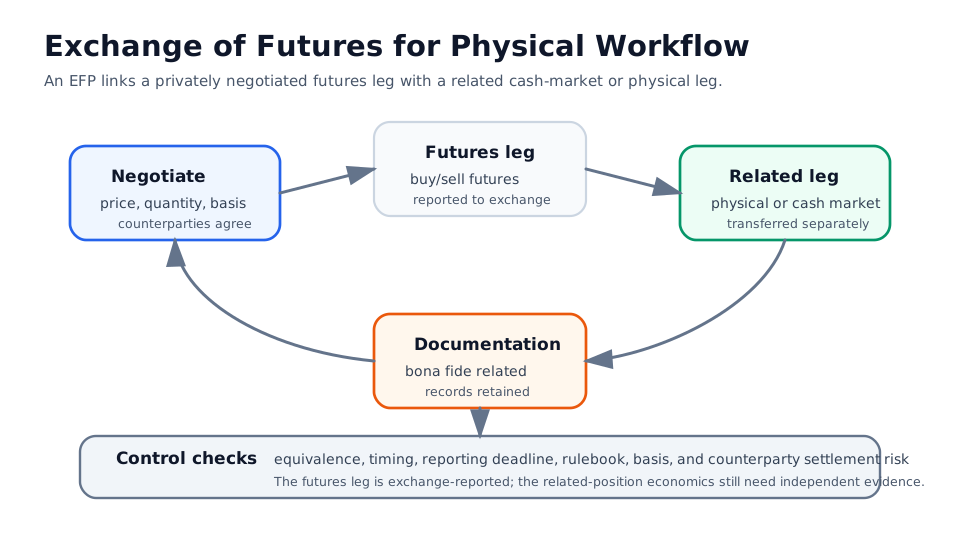
An exchange for physical (EFP) is a privately negotiated transaction that pairs a futures trade with a bona fide transfer of a comparable physical or cash-market position. The parties negotiate both components away from the central order book, then report the futures component to the exchange under its exchange-for-related-position rules.
EFPs are part of the broader exchange-for-related-position (EFRP) family. They allow qualified commercial or institutional participants to convert between futures and related cash exposure, but they do not bypass exchange rules. The related position, timing, quantity or risk equivalence, reporting, and documentation must satisfy the applicable rulebook.
Key Takeaways
- An EFP has two linked components: an exchange futures transaction and a related physical or cash-market transaction.
- The transaction is privately negotiated, but the futures component is reported to the exchange and submitted for clearing.
- The related-position component must be bona fide and sufficiently comparable under the applicable product rules.
- A paper entry with no genuine transfer, binding contract, or market exposure is not a valid EFP.
- EFP direction, quantity, value, timing, and beneficial ownership must be documented.
- An EFP is different from a block trade, a calendar spread, and futures delivery at expiration.
- Rules vary by exchange and product; CME Rule 538 is an example, not a universal rule for every venue.
How an EFP Works
| Step | What happens |
|---|---|
| Confirm eligibility | Parties verify the product, accounts, related position, and exchange rule |
| Negotiate both components | Parties agree on futures, cash-market, quantity, basis, price, and timing terms |
| Execute related position | Ownership or a binding cash-market obligation transfers between the parties |
| Execute futures component | One party buys and the other sells the corresponding futures exposure |
| Report and clear | The futures component is submitted with the required EFRP indicator and details |
| Retain evidence | Parties and firms preserve trade, payment, title, and related-position records |
The components should form one integrated transaction. Executing a futures trade today and attaching an unrelated prior cash transaction later does not establish a valid EFP merely because the quantities look similar.
Which Side Receives What?
A common commercial pattern begins with opposite hedges:
- A buyer needs the cash commodity and holds long futures as a price hedge.
- A seller owns or controls the cash commodity and holds short futures as a hedge.
- The seller transfers the physical position to the buyer.
- The corresponding futures interests are transferred or offset through the reported EFP.
- Both parties replace their futures hedge with the negotiated cash-market transaction.
The exact mechanics depend on the clearing and reporting system. Analysts should describe the resulting long and short positions rather than assuming that the word “exchange” means futures contracts are physically handed from one account to another.
Hypothetical Commercial Example
Assume a futures contract represents 1,000 units. A processor holds 10 long futures contracts against an expected purchase of 10,000 physical units. A supplier owns the physical units and holds 10 short futures contracts.
The parties negotiate:
- the physical product, grade, location, and delivery terms;
- the futures contract and month;
- the agreed cash-futures basis or package price;
- payment and title-transfer terms; and
- the EFP reporting details.
After the transaction, the processor has the physical commodity it needs and no longer needs the long hedge. The supplier has sold the physical commodity and no longer needs the short hedge. The package closes the two hedges while completing the commercial sale.
This example assumes one-to-one quantity equivalence. Actual rules may permit or require comparisons based on quantity, value, or risk exposure, depending on the product.
Bona Fide Related Position
The related component can differ by product, but review these tests:
| Test | Evidence to examine |
|---|---|
| Actual position or binding obligation | Invoice, purchase agreement, confirmation, title document, or enforceable contract |
| Comparable exposure | Quantity, value, risk, asset, location, grade, or permitted related product |
| Opposite economic direction | Futures and related legs transfer or offset corresponding exposure |
| Integrated timing | Records show the components were negotiated and executed as one EFRP |
| Real ownership transfer | Payment, title, custody, or beneficial ownership evidence |
| Permitted counterparties and accounts | Account records, authority, and clearing-member controls |
The related position may be the exact underlying cash commodity, a permitted by-product or related product, an ETF, a securities basket, or another qualifying cash instrument. Eligibility is not inferred from correlation alone; use the current product rule.
Why Market Participants Use EFPs
- Convert a futures hedge into the actual cash asset or reverse that process.
- Negotiate the cash-futures basis and commercial terms as one package.
- Reduce leg risk from separately executing a large futures trade and cash transaction.
- Transfer exposure where the cash market is bilateral or operationally specialized.
- Align a hedge with a physical sale, procurement, inventory, ETF, or securities-basket transaction.
An EFP may reduce one execution problem while introducing counterparty, documentation, reporting, basis, financing, and operational risks.
EFP vs. Similar Transactions
| Transaction | Futures component | Related component | Key distinction |
|---|---|---|---|
| EFP | Futures | Physical or qualifying cash-market position | Two linked components under EFRP rules |
| EFS | Futures | Qualifying swap or OTC derivative | Related leg is a swap rather than physical |
| EOO | Exchange-traded option | Qualifying OTC option | Option-for-option structure |
| Block trade | Privately negotiated futures or options | None required | Must meet block eligibility, size, and reporting rules |
| Calendar spread | Two futures months | None | Both legs are exchange futures |
| Physical delivery | Expiring deliverable futures | Contract delivery instrument or asset | Settlement under delivery rules, not a separately negotiated EFP |
Calling a transaction an EFP does not make it compliant. Substance, reporting, records, and product eligibility control.
Documentation Checklist
- Parties, accounts, authorized traders, and beneficial owners.
- Futures product, contract month, side, quantity, price, and execution time.
- Related asset, quantity, value, grade, location, and delivery or settlement terms.
- Agreed basis, package price, and allocation between components.
- Purchase agreement, invoice, confirmation, title, custody, or payment evidence.
- Proof that both components were bona fide and commercially binding.
- Exchange submission time, trade indicator, clearing details, and corrections.
- Method used to establish quantity, value, or risk comparability.
- Approvals, communications, and exception reviews.
- Retention under current exchange, clearing, regulatory, and firm policy.
Risks and Common Mistakes
- Reporting an EFP without a genuine related position.
- Using a related position that the product rules do not permit.
- Failing to transfer ownership, title, or a binding contractual obligation.
- Pairing quantities that are not reasonably comparable.
- Reporting late or with the wrong contract, month, side, or account.
- Treating a block trade as an EFP because both are privately negotiated.
- Assuming an EFP is anonymous or centrally priced.
- Ignoring counterparty credit and settlement risk on the bilateral component.
- Using circular transactions that remove meaningful market exposure.
- Failing to retain evidence beyond a trade ticket or spreadsheet label.
Authoritative References
The CFTC Futures Glossary defines exchange for physicals and the broader exchange-of-derivatives-for-related-position category. CME Group’s EFRP overview distinguishes EFP, EFS, and EOO and points users to Rule 538 reporting requirements. CME’s current Rule 538 advisory addresses private negotiation, simultaneous components, bona fide ownership transfer, comparability, due diligence, reporting, and records.
This page is for financial education only. It does not determine whether a proposed transaction qualifies as an EFP. Participants should obtain current exchange, clearing, legal, compliance, tax, accounting, and operational guidance before arranging or reporting an EFRP.
Related Terms
- Commodity Contract: Terms governing the physical or cash-market component.
- Spot Price: Cash-market quote and physical terms relevant to the EFP component.
- Futures Trading: Contract, margin, execution, and settlement mechanics.
- Futures Basis: Cash-futures difference often negotiated in the EFP package.
- Taking Delivery: Contract settlement process distinct from a privately negotiated EFP.