International Reserves
International reserves are external assets controlled by monetary authorities and readily available for external payments, currency intervention, and confidence.
International reserves are external assets that a country’s monetary authorities control and can readily use to meet balance-of-payments financing needs, intervene in foreign exchange markets, or support confidence in the currency and economy. The terms official reserves, official reserve assets, and reserve assets commonly refer to this same statistical concept.
Key Takeaways
- International reserves are defined by control, externality, liquidity, and usability, not simply by government ownership.
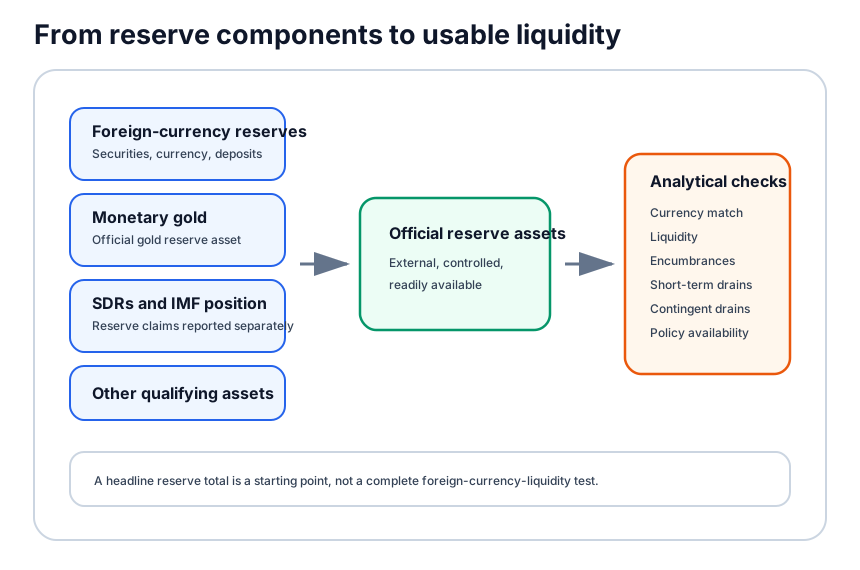
- The total can include foreign-currency securities and deposits, monetary gold, SDR holdings, the reserve position in the IMF, and limited other qualifying claims.
- Foreign exchange reserves are the foreign-currency component, not necessarily the entire international-reserves total.
- A large headline total does not by itself prove that a country can meet every near-term foreign-currency need.
- Analysts should review currency composition, valuation changes, encumbrances, and future foreign-currency drains before judging reserve adequacy.
What Counts as an International Reserve?
The IMF framework focuses on whether an asset is:
- External: It is generally a claim on a nonresident or another qualifying international reserve asset.
- Controlled by the monetary authorities: The central bank or other monetary authority has effective access to it for reserve purposes.
- Readily available: The asset can be mobilized under adverse conditions without a material legal or operational barrier.
- Usable for external purposes: It can help finance balance-of-payments needs, support exchange-market operations, or meet related policy objectives.
An asset does not qualify merely because a government entity owns it. Domestic real estate, nonconvertible claims, assets outside the authorities’ effective control, and some pledged or otherwise unavailable assets fail one or more of these tests.
The IMF’s reserve-assets guidance explains the control and usability criteria used in international reporting.
Main Components
| Component | What it generally includes | Important distinction |
|---|---|---|
| Foreign-currency reserves | Convertible foreign-currency securities, currency, and deposits | Usually the largest component, but not the whole aggregate |
| Monetary gold | Gold owned by the monetary authorities and held as a reserve asset | Gold value can change without a purchase or sale |
| SDR holdings | Holdings of the IMF-created international reserve asset | An SDR is not a national currency |
| Reserve position in the IMF | A member’s liquid reserve claim on the IMF | Different from outstanding IMF credit |
| Other reserve assets | Qualifying derivatives, loans, or other external claims | Inclusion depends on the reserve-asset criteria |
The IMF reserves data template reports these categories separately. That detail matters because two countries with the same total can have very different liquidity, market risk, and currency exposure.
International Reserves vs. Foreign Exchange Reserves
Foreign Exchange Reserve is a narrower term for reserve assets held as convertible foreign-currency securities, currency, and deposits. International reserves add other qualifying reserve assets, including monetary gold, SDR holdings, and the reserve position in the IMF.
| Term | Typical scope |
|---|---|
| International reserves / official reserve assets | Full qualifying reserve-asset aggregate |
| Foreign exchange reserves | Foreign-currency securities, currency, and deposits within that aggregate |
| Other official foreign-currency assets | Official foreign-currency claims that do not qualify as reserve assets |
| Bank Reserves | Commercial-bank cash and balances at the central bank; a domestic monetary concept |
Public releases sometimes use “foreign exchange reserves” loosely for the headline international-reserves total. Always inspect the reporting table and methodology rather than relying on the label.
Why International Reserves Matter
Reserves can give authorities time and options when external financing becomes difficult. Depending on the policy framework, they may be used to:
- provide foreign currency for external government obligations
- address disorderly conditions in the foreign exchange market
- supply foreign-currency liquidity to the domestic financial system
- support a fixed or managed exchange-rate arrangement
- reduce the risk of abrupt adjustment after a loss of market access
- demonstrate external liquidity to creditors and trading partners
These functions are not costless or unlimited. Selling reserves changes the public balance sheet, and reserve holdings can be exposed to market, credit, liquidity, currency, custody, and operational risks.
Worked Example
Assume a monetary authority reports 120 billion in official reserve assets:
| Component | Amount |
|---|---|
| Foreign-currency securities and deposits | 90 billion |
| Monetary gold | 15 billion |
| SDR holdings | 7 billion |
| Reserve position in the IMF | 5 billion |
| Other qualifying reserve assets | 3 billion |
| Reported official reserve assets | 120 billion |
Now assume the country’s foreign-currency-liquidity disclosure shows 18 billion of predetermined net drains over the next year and a further 7 billion of contingent drains in the analyst’s stress scenario.
Subtracting both amounts gives 95 billion, but that is only a scenario estimate:
1120 reported reserve assets
2- 18 predetermined net drains
3-  7 selected contingent drains
4= 95 analytical post-drain amount
It is not automatically the country’s official net international reserves measure. Net-reserve definitions vary across statistical publications, laws, and IMF-supported program documents. The example shows why a gross stock and a forward-looking liquidity assessment answer different questions.
Gross, Net, and Usable Reserves
Gross International Reserves
Gross reserves are the reported stock of qualifying reserve assets at a stated date. The figure is useful for trend analysis, but it does not deduct every future foreign-currency obligation.
Net International Reserves
Net international reserves generally deduct specified reserve-related liabilities from reserve assets. There is no single calculation that should be assumed across every country or analytical context. Use the definition supplied with the data.
Usable Reserves
Usable reserves is often an analytical rather than a standardized headline measure. An analyst may adjust for assets that are encumbered, difficult to monetize, needed for a separate policy commitment, or unavailable under the scenario being tested. Each adjustment should be explicit.
The IMF’s International Reserves and Foreign Currency Liquidity guidelines pair the reserve stock with predetermined and contingent short-term foreign-currency drains.
How Reserve Levels Change
The headline total can change for several reasons:
- purchases or sales of foreign currency
- interest income and other investment returns
- changes in gold prices
- exchange-rate translation when assets are reported in one common currency
- SDR allocations, exchanges, or valuation changes
- borrowing, repayment, swaps, repos, and other reserve-related transactions
A monthly increase does not necessarily mean the central bank bought foreign currency. Valuation effects alone can move the reported total. Flow analysis should reconcile transactions separately from price and exchange-rate changes.
How to Evaluate Reserve Adequacy
No single ratio is sufficient for every economy. Analysts often compare reserves with several potential demands:
- months of imports
- short-term external debt by remaining maturity
- broad money or other measures of potential capital flight
- scheduled public and private foreign-currency payments
- the exchange-rate regime and likely intervention needs
- access to markets, swap lines, and other committed liquidity
- commodity-price, banking-system, and fiscal stress scenarios
A reserve figure should be interpreted alongside the Balance of Payments, external debt maturity profile, and the authorities’ foreign-currency-liquidity disclosure. A benchmark is a screening tool, not proof that reserves are adequate or inadequate.
Risks and Limitations
- Valuation risk: Gold, bond prices, and exchange rates can move the reported total.
- Liquidity risk: A high-quality asset may still be difficult to sell quickly under stressed conditions.
- Currency mismatch: Reserve currencies may not match the currencies of upcoming obligations.
- Encumbrance: Pledged, swapped, lent, or otherwise committed assets may not be freely deployable.
- Short-term drains: Forwards, guarantees, debt service, and other commitments can create calls on foreign currency.
- Policy constraints: Authorities may be unwilling or legally unable to use reserves for a proposed purpose.
- Data lag and scope: Reporting dates, institutional coverage, and definitions can differ.
- False precision: One headline number cannot capture confidence, capital mobility, market access, or policy credibility.
Common Mistakes
- Treating all central-government foreign assets or sovereign wealth assets as international reserves.
- Adding foreign exchange reserves, gold, SDRs, and total official reserves together even when the total already includes those components.
- Confusing SDR holdings with cumulative SDR allocations or treating SDRs as ordinary cash.
- Confusing international reserves with domestic Bank Reserves.
- Reading a reserve decline as proof of intervention without checking valuation and other transactions.
- Comparing countries without checking reporting currency, date, definitions, and near-term drains.
Related Terms
- Foreign Exchange Reserve: The foreign-currency securities, currency, and deposits within reserve assets.
- Gold Reserve: Monetary gold held by a central bank or monetary authority.
- Special Drawing Rights: An IMF-created international reserve asset.
- Reserve Tranche Position: A member’s liquid reserve claim associated with its IMF quota and IMF currency holdings.
- Reserve Currency: A currency widely held for official reserves and international transactions.
- Exchange Rate: The price at which one currency exchanges for another.
FAQs
Are official reserves and international reserves the same?
Are foreign exchange reserves the same as international reserves?
Do higher reserves guarantee that a country can avoid a currency crisis?
This article is educational and does not provide investment, legal, accounting, or public-policy advice. Reserve definitions and availability can be jurisdiction- and program-specific; verify current official data and methodology.