Intergenerational Equity
Intergenerational equity evaluates how public policy distributes taxes, debt, assets, services, and environmental costs across present and future generations.
Intergenerational equity is the principle that public policy should distribute costs, benefits, risks, and opportunities fairly across people living at different times. In public finance, it asks whether today’s taxes, spending, borrowing, pension promises, public assets, and resource use leave future generations with a reasonable fiscal and economic position.
The concept does not require every generation to receive identical outcomes. Generations face different demographics, technologies, emergencies, and economic conditions. The analytical task is to identify what is transferred forward and whether the accompanying assets, services, productive capacity, and fiscal room justify the burden.
Key Takeaways
- Public debt is only one part of intergenerational equity; public assets, human capital, institutions, and environmental conditions also matter.
- Borrowing for a long-lived productive asset can distribute costs across beneficiaries more fairly than financing only current consumption, but project quality and debt sustainability remain critical.
- Pension and health promises can create future obligations even when they do not appear as ordinary public debt.
- Age-based comparisons alone can miss differences in income, wealth, family support, and exposure within each generation.
- Long-term projections are scenarios, not precise forecasts; results depend on demographics, growth, interest rates, policy, and valuation assumptions.
- Intergenerational equity is a decision framework, not a single universally accepted formula.
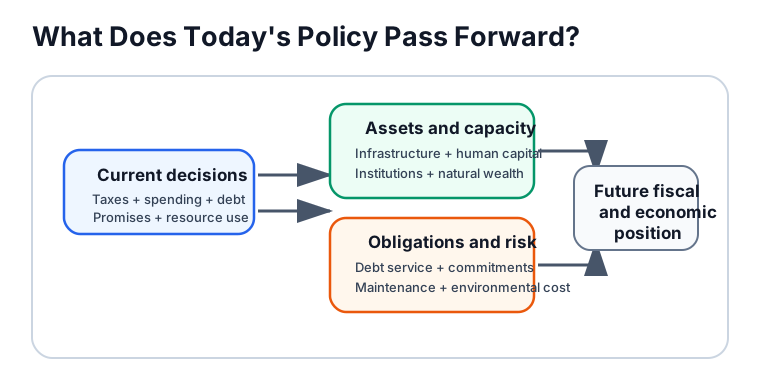
What Is Passed Between Generations
Public decisions transmit more than debt:
| Channel | Potential benefit passed forward | Potential burden passed forward |
|---|---|---|
| Public finance | Fiscal capacity, stable institutions, emergency reserves | Debt service, tax pressure, unfunded commitments |
| Physical capital | Transport, water systems, schools, energy networks | Maintenance backlogs, obsolete or poorly chosen projects |
| Human capital | Education, health, research, workforce skills | Underinvestment and unequal access |
| Social insurance | Income security and risk pooling | Pension and health obligations unsupported by revenue |
| Natural resources | Conserved assets and resource-fund wealth | Depletion, pollution, and remediation costs |
| Economic institutions | Rule of law, credible policy, resilient markets | Weak governance and reduced policy flexibility |
A complete analysis considers both sides of the public balance sheet and the broader economic inheritance.
Worked Example: Debt-Financed Infrastructure
Suppose a government borrows $2 billion to build a water system expected to provide reliable service for 40 years.
The debt is not automatically unfair to future taxpayers. Future residents receive part of the service benefit, so spreading some financing cost across time may align payment with use.
The conclusion changes if:
- construction costs are inflated
- the system is poorly maintained
- demand projections are unrealistic
- user charges and tax revenues cannot support operations and debt service
- the project creates environmental damage
- a cheaper or more effective alternative was available
Now compare the same $2 billion borrowing used for a temporary current benefit with no lasting asset or productivity effect. Future taxpayers inherit the debt service but little corresponding capacity. That use presents a stronger intergenerational concern.
The example shows why analysts should ask what was financed, who benefits, how long benefits last, and who bears the risk, not merely whether debt increased.
Major Public-Finance Applications
Government debt
Debt can shift taxes or spending constraints into the future, especially when interest costs compound faster than the revenue base. Yet the burden depends on who holds the debt, what the borrowing financed, economic growth, interest rates, maturity structure, currency exposure, and future policy choices.
Pensions and health programs
Pay-as-you-go benefits depend heavily on the future ratio of contributors to beneficiaries. Funded plans depend on contributions, assets, returns, longevity, and benefit design. Adequacy and sustainability must be evaluated together; cutting all future benefits can improve a narrow fiscal measure while worsening retirement security.
Public investment
Well-selected infrastructure, education, health, and research can raise future productive capacity. Poorly selected projects can leave debt, operating costs, and stranded assets instead.
Climate and natural resources
Current resource extraction may support consumption or finance a sovereign wealth fund. Environmental damage can impose costs that are difficult or impossible to reverse. Analysis should distinguish renewable income, depletion of natural capital, remediation liabilities, and investment of resource revenue.
Tax policy
Tax preferences and deferred obligations can change who pays and when. A temporary tax reduction financed by debt differs from a reform that increases long-run growth enough to strengthen future revenue, but growth effects should be supported rather than assumed.
How Intergenerational Equity Is Evaluated
No single indicator is sufficient. Common tools include:
Debt and interest ratios
Debt-to-GDP, interest-to-revenue, and refinancing measures help assess fiscal pressure. They do not measure public assets or distribution within generations.
Long-term fiscal projections
Scenario models project revenue, program spending, debt, and interest under demographic and economic assumptions. They reveal directional pressure but become more uncertain over long horizons.
Fiscal gap analysis
A fiscal gap estimates the sustained revenue or spending adjustment needed to reach a stated long-term fiscal target. Results depend on the target, horizon, discounting, and policy baseline.
Generational and lifetime accounts
These approaches estimate taxes paid and transfers received by birth cohort over time. They can make age patterns visible but require assumptions about incidence, future policy, discount rates, and economic behavior.
Public-sector balance sheets
Balance-sheet analysis compares liabilities with financial and non-financial assets. Asset values, service potential, liquidity, and maintenance needs can be difficult to measure consistently.
Distributional analysis
An average cohort can conceal large differences. Analysts should test outcomes by income, wealth, gender, region, health, housing status, and exposure to policy changes where data permit.
A Practical Review Framework
For a policy with long-term effects, document:
- Baseline: What happens without the policy?
- Beneficiaries: Which current and future groups receive services, income, or risk reduction?
- Payers: Which groups bear taxes, fees, debt service, inflation, or reduced services?
- Asset created: Is there a durable financial, physical, human, institutional, or environmental benefit?
- Obligation created: What operating, maintenance, pension, guarantee, or remediation cost continues?
- Risk: Who bears cost overruns, lower growth, higher interest rates, or forecast error?
- Time horizon: Does the analysis extend through the material life of the policy?
- Alternatives: Could the objective be achieved with a different timing or financing structure?
Common Mistakes and Limitations
Treating all debt as unfair. Debt-financed investment can benefit future users, while balanced-budget policy can still underinvest in future capacity.
Counting assets at cost without testing usefulness. A costly project is not valuable merely because it appears as infrastructure.
Ignoring implicit commitments. Pension, health, guarantees, and maintenance can matter even when excluded from headline debt.
Using one discount rate as a moral answer. Discounting changes the weight assigned to distant costs and benefits; the rate should be disclosed and sensitivity-tested.
Comparing age groups without within-group distribution. Younger and older cohorts are not economically uniform.
Presenting forecasts as certainties. Demographics may be relatively persistent, but growth, migration, technology, policy, and interest rates remain uncertain.
Official Source Checks
- U.S. GAO: America’s Fiscal Future explains how persistent debt growth can reduce fiscal flexibility and affect future investment and living standards.
- OECD: Governance for Youth, Trust and Intergenerational Justice reviews policy institutions and tools for incorporating intergenerational considerations.
- IMF Fiscal Monitor provides cross-country analysis of public debt, fiscal risks, and long-term pressures.
Related Terms
- Government Debt: Outstanding public borrowing that can affect future taxes, spending, and fiscal flexibility.
- Debt-to-GDP Ratio: A common scale measure for public debt.
- Fiscal Policy: Government revenue and spending decisions that distribute resources across time.
- Infrastructure: Long-lived public or private capital that can benefit multiple generations.
- Social Internal Rate of Return: A project measure that incorporates broader social costs and benefits.
- Sovereign Wealth Fund: A public investment vehicle that can preserve and invest wealth for future use.
- Pension Plan: A long-term benefit arrangement whose funding and design can affect different cohorts.
FAQs
Is government borrowing always unfair to future generations?
Can a balanced budget still be unfair across generations?
How is intergenerational equity measured?
Does intergenerational equity mean equal spending on every age group?
This article is educational and does not provide fiscal, investment, legal, tax, pension, or environmental-policy advice. Long-term conclusions depend on assumptions and the specific jurisdiction.