World Bank
The World Bank consists of IBRD and IDA, which provide development financing, guarantees, policy advice, and technical assistance to member countries.
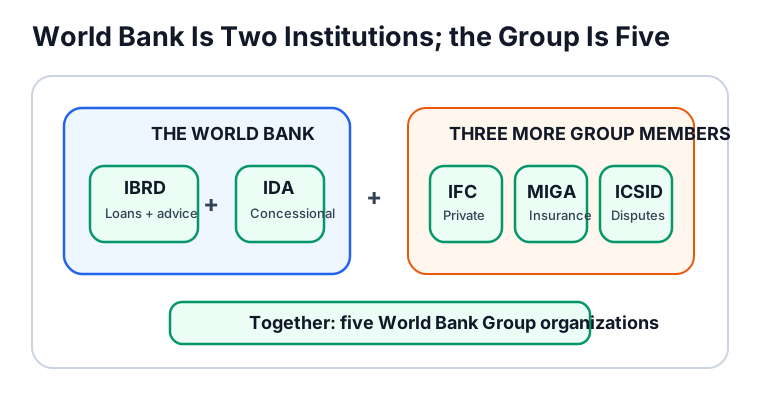
The World Bank is a multilateral development institution made up of the International Bank for Reconstruction and Development (IBRD) and the International Development Association (IDA). Together they provide loans, credits, grants, guarantees, policy advice, and technical assistance to eligible member countries.
The World Bank Group is broader. It includes IBRD, IDA, the International Finance Corporation (IFC), the Multilateral Investment Guarantee Agency (MIGA), and the International Centre for Settlement of Investment Disputes (ICSID).
Key Takeaways
- “World Bank” means IBRD plus IDA; “World Bank Group” includes five organizations.
- IBRD primarily serves middle-income and creditworthy lower-income borrowers using loans, guarantees, risk-management products, and advisory services.
- IDA provides concessional credits and grants to eligible lower-income countries.
- IFC focuses on private-sector investment, MIGA provides specified political-risk insurance and credit enhancement, and ICSID administers investment-dispute proceedings.
- World Bank financing is not free money: loans create obligations, grants have eligibility and program conditions, and projects carry implementation risk.
- The Bank is distinct from the IMF, which focuses more directly on macroeconomic surveillance and balance-of-payments support.
World Bank vs. World Bank Group
| Institution | Main role | Typical counterpart or activity |
|---|---|---|
| IBRD | Loans, guarantees, risk products, and advice | Middle-income and creditworthy lower-income governments |
| IDA | Concessional credits and grants | Eligible lower-income governments |
| IFC | Investment and advisory support for private enterprise | Companies and private-sector projects |
| MIGA | Political-risk insurance and credit enhancement | Investors and lenders in eligible cross-border projects |
| ICSID | Administration of investment-dispute proceedings | States and qualifying foreign investors |
IBRD and IDA form the World Bank. All five institutions form the World Bank Group. Their governing documents, members, balance sheets, instruments, and counterparties differ.
How IBRD Financing Works
IBRD is owned by member countries and raises much of its lending funding in global capital markets. Its financial model combines:
- member-country subscribed capital
- reserves and retained earnings
- bond issuance
- loan repayments and investment income
- guarantees and risk-management products
IBRD lends rather than simply passing bond proceeds directly to a single project. Its capital, portfolio, liquidity, credit policies, and shareholder support underpin the institution’s overall funding model.
Borrowers still face currency, interest-rate, refinancing, project, and repayment risks according to the financing terms. A World Bank loan should therefore be analyzed as sovereign or sovereign-supported financing, not as a grant unless the instrument explicitly is one.
How IDA Financing Works
IDA supports eligible lower-income countries through grants and concessional credits. Its resources can include:
- contributions from donor members
- repayments from earlier credits
- transfers from other World Bank Group income where approved
- capital-market funding
- other approved financial instruments
Concessional does not always mean interest-free or repayment-free. Terms vary by country eligibility, debt risk, instrument, currency, maturity, and replenishment rules. Current terms should be verified in the applicable financing documents.
Worked Example: Development Project Financing
Assume a country plans a $300 million water and sanitation program.
A hypothetical financing package could include:
$180 millionIBRD loan$60 millionIDA credit or grant, if the country and operation are eligible$40 millionnational government contribution$20 millionco-financing from another development institution
The amounts total:
$180 million + $60 million + $40 million + $20 million = $300 million.
Before approval and disbursement, the operation may require technical appraisal, environmental and social review, procurement planning, financial-management arrangements, implementation milestones, and legal agreements.
The financing package does not guarantee success. Analysts should monitor whether funds are disbursed, assets are completed, services reach intended users, operating budgets are available, debt remains sustainable, and outcomes persist after the project closes.
Common Financing Instruments
Investment project financing
Supports defined activities, assets, institutional capacity, or services. Disbursement and procurement follow the applicable project and financing framework.
Development policy financing
Provides budget financing linked to an agreed policy and institutional program. The economic impact depends on policy design, implementation, and country conditions.
Program-for-results financing
Links disbursement to specified program results and institutional systems rather than only project inputs.
Guarantees
Can cover specified government or project obligations and help mobilize private or public financing. A guarantee transfers defined risks; it does not eliminate them.
Advisory and analytical services
Include economic analysis, public-finance support, institutional diagnostics, data, and technical assistance. Advice may shape policy even when no new loan is made.
Typical Project and Country Cycle
A simplified operation may involve:
- country strategy and priority setting
- project or policy identification
- technical, economic, fiduciary, environmental, and social appraisal
- negotiation and approval
- legal effectiveness and conditions
- procurement, disbursement, and implementation
- supervision, restructuring, or corrective action
- completion reporting and independent evaluation
Not every instrument follows the same sequence. Emergency operations, policy financing, guarantees, and advisory engagements have different requirements.
World Bank vs. IMF
| World Bank | International Monetary Fund |
|---|---|
| Long-term development financing and institutional support | Macroeconomic surveillance and balance-of-payments financing |
| Project, program, policy, guarantee, and advisory instruments | Programs focused on external financing needs and macroeconomic adjustment |
| IBRD and IDA are the core World Bank institutions | Separate international organization with its own mandate and balance sheet |
The institutions often work with the same countries and may coordinate, but one does not replace the other.
Why the World Bank Matters to Finance
World Bank activity can affect:
- sovereign borrowing and debt sustainability
- infrastructure pipelines and public investment
- procurement and contractor opportunities
- public-private financing structures
- currency and interest-rate exposure
- financial-sector reform
- data standards and institutional capacity
- climate, health, education, and social-sector investment
- co-financing by governments, donors, and other multilateral lenders
For bond investors and country analysts, a Bank operation can provide useful information about financing needs, reform commitments, project risks, and official-sector support. It should not be treated automatically as a credit guarantee for unrelated sovereign debt.
Risks and Limitations
Debt sustainability
Even concessional financing can add to public obligations. Debt capacity, currency exposure, grace periods, maturity, and contingent liabilities matter.
Project execution
Procurement delays, weak institutions, cost overruns, land issues, conflict, corruption, and shortages of operating funds can reduce results.
Conditionality and policy tradeoffs
Policy actions can have uneven distributional effects. Analysts should distinguish formal conditions, policy advice, borrower decisions, and implementation outcomes.
Measurement
Outputs such as kilometers of road or number of connections do not automatically establish long-term economic or social impact.
Governance
Member-country voting power, board decisions, borrower ownership, local accountability, and stakeholder consultation can affect priorities and legitimacy.
Additionality
Public development finance should be evaluated against what governments or private markets could have financed without it and whether it mobilizes or displaces other capital.
How to Research a World Bank Operation
Check:
- institution: IBRD, IDA, IFC, MIGA, or ICSID
- borrower, guarantor, implementing agency, and beneficiaries
- instrument, currency, amount, maturity, and repayment terms
- project-development objective and results framework
- appraisal, legal, procurement, and environmental documents
- disbursement status and implementation ratings
- restructurings, cancellations, extensions, and cost changes
- completion report and independent evaluation
- co-financing and contingent obligations
- relationship to the country’s fiscal and debt position
Official Source Checks
- World Bank Group: Who We Are identifies the five World Bank Group organizations and their roles.
- World Bank Group and IMF explains that IBRD and IDA form the World Bank and distinguishes their work from the IMF.
- World Bank: IBRD describes IBRD ownership, funding, borrowers, and financial products.
- International Development Association: What Is IDA? explains IDA’s concessional credits and grants for eligible lower-income countries.
- World Bank Projects and Operations provides project documents, financing details, status, and results information.
Related Terms
- International Bank for Reconstruction and Development: The World Bank institution that lends to middle-income and creditworthy lower-income countries.
- International Finance Corporation: The World Bank Group institution focused on private-sector development.
- Multilateral Investment Guarantee Agency: The World Bank Group political-risk insurance and credit-enhancement institution.
- International Monetary Fund: A separate institution focused on monetary cooperation, surveillance, and balance-of-payments support.
- Multilateral Development Bank: A broader category of member-owned development-finance institutions.
- African Development Bank: A regional multilateral development bank.
- Asian Development Bank: A regional development-finance institution serving Asia and the Pacific.
FAQs
Is the World Bank the same as the World Bank Group?
Is the World Bank a commercial bank?
Does the World Bank only make loans?
Does World Bank financing guarantee a project will succeed?
This article is educational and does not provide sovereign-credit, development-policy, procurement, legal, or investment advice. Verify current institutional and project documents before relying on a financing conclusion.