Trading Sessions and Extended Hours
Trading sessions define when a market accepts orders and executes trades, while extended hours add venue-specific access before or after the core session.
A trading session is a defined period when a market or trading venue accepts orders, publishes market data, conducts auctions, or executes trades. Regular trading hours describe the core session; pre-market trading occurs before it; and after-hours trading occurs after it. The exact schedule, eligible securities, order types, and routing rules depend on the product, venue, broker, date, and jurisdiction.
For U.S. exchange-listed stocks, regular trading hours are generally 9:30 a.m. to 4:00 p.m. Eastern Time. That convention should not be applied automatically to futures, options, foreign exchange, bonds, digital assets, overseas exchanges, or a broker’s proprietary overnight session.
Key Takeaways
- Trading hours are product- and venue-specific, not universal.
- Pre-market and after-hours trading are both forms of extended-hours trading.
- A broker may offer less access than an exchange or alternative trading system technically supports.
- Extended-hours quotes can have lower displayed depth, wider spreads, and less connected market data.
- Many brokers restrict extended-hours orders to limit orders, but the accepted instructions vary.
- An extended-hours price does not guarantee the next regular-session opening price.
- An unfilled order may expire, remain active, or move into another session depending on its instructions.
- Exchange calendars, broker rules, quote timestamps, and execution reports are stronger evidence than a generic hours table.
Session Types at a Glance
| Session or event | Plain meaning | Evidence to check |
|---|---|---|
| Overnight session | Trading offered during some or all of the period between one after-hours session and the next pre-market session | Broker access, venue, eligible symbols, order types, maintenance window, and market-data coverage |
| Pre-market | Trading before the regular session opens | Start time, venue, quote source, accepted orders, and expiration rule |
| Opening auction | Price-discovery process near the regular open | Auction imbalance, indicative price, cutoff times, and execution report |
| Regular or core session | Main trading period for the market | Official calendar, continuous-trading rules, halts, and auction schedule |
| Closing auction | Price-discovery process near the regular close | Auction imbalance, closing-order eligibility, cutoff times, and official close |
| After-hours | Trading after the regular session closes | End time, route, spread, depth, accepted orders, and carryover rule |
| Market closed | No active session on the relevant venue | Holiday, weekend, maintenance, halt, or product-specific closure |
The words open and closed need a subject. A listing exchange can be outside its core session while another venue still accepts orders in the same security.
An Illustrative U.S. Equity Day
The timeline below shows commonly referenced U.S. equity periods. It is a framework, not a universal schedule.
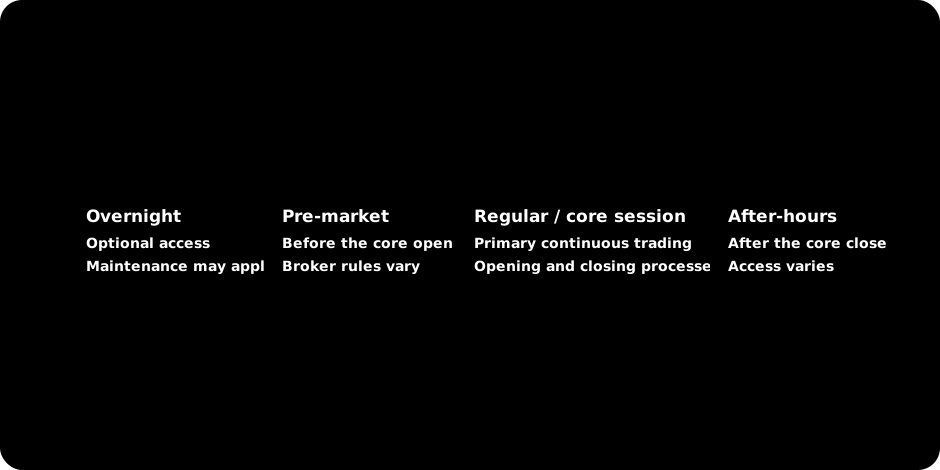
Some trading services now offer access during parts of the overnight period, while others begin later in pre-market or stop earlier after hours. Maintenance windows, holidays, early closes, and product restrictions can interrupt the sequence.
What Are Regular Trading Hours?
Regular trading hours, also called the core session, are the market’s principal continuous-trading hours. For U.S. exchange-listed stocks and certain related markets, the standard reference is 9:30 a.m. to 4:00 p.m. Eastern Time on eligible business days.
Core hours matter because they commonly have:
- broader participant access;
- more displayed liquidity for actively traded securities;
- consolidated quote and trade information;
- the primary opening and closing processes;
- full operation of market-wide and security-specific safeguards; and
- order-handling rules that can differ from extended hours.
These are tendencies, not guarantees. A thinly traded stock can remain illiquid during regular hours, and a highly active security can trade heavily after an announcement outside the core session.
Trading Hours Differ Across Markets
| Market | Why a single hours table can mislead |
|---|---|
| U.S. equities | Core exchange hours coexist with pre-market, after-hours, and some overnight access |
| Options | Hours can differ by option class and exchange, even when the underlying stock trades |
| Futures | Many contracts trade for most of the business day but have scheduled maintenance breaks and product-specific limits |
| Foreign exchange | Trading is decentralized across dealers and venues, with liquidity changing as regional business days overlap |
| Bonds | Many transactions are dealer-negotiated rather than governed by one universal continuous session |
| Overseas equities | Local time zones, daylight-saving rules, lunch breaks, and holidays vary |
| Digital assets | A platform may operate continuously, but maintenance, venue outages, and fragmented liquidity still matter |
Use the official schedule for the exact instrument and trade date. Do not rely on a memorized conversion between local time and Eastern Time because daylight-saving changes do not occur on the same dates in every jurisdiction.
What Is Pre-Market Trading?
Pre-market trading is trading before the regular session opens. It can incorporate information released overnight or before the opening bell, including company announcements, economic data, changes in overseas markets, and sector news.
Pre-market activity can contribute to price discovery, but the observed price may rest on limited quantity. A screen showing one trade at 52.00 does not establish that a large order can execute near 52.00, nor does it establish the opening-auction price.
Pre-Market Evidence to Check
- the quote and trade timestamps;
- whether data is real-time or delayed;
- the venue or alternative trading system;
- displayed bid, ask, and size;
- eligible order types;
- whether the order participates in the opening auction;
- whether an unfilled order expires before the core session; and
- the broker’s routing and session-selection rules.
Pre-market is not limited to institutional participants, but access and tools vary. The important distinction is not the participant label; it is whether the account, broker, security, and route support the intended order.
What Is After-Hours Trading?
After-hours trading is trading after the regular session closes. It allows prices and orders to react to information released after the closing bell, such as earnings, guidance, regulatory filings, or macroeconomic events.
The regular-session closing price remains a defined historical field. An after-hours trade is a later transaction in a different session. Neither number automatically becomes the next day’s opening price.
After-Hours Evidence to Check
- whether the displayed price is a bid, ask, last sale, or midpoint;
- the quote size and nearby depth;
- the session and venue attached to the print;
- whether the order is limited to one venue or can access competing interest;
- accepted order instructions and time-in-force;
- corporate-action or news status; and
- whether the order remains active in another session.
The generic claim that after-hours trading always runs until a particular time is unsafe. Venue schedules and broker access can differ, and an eligible security may have no available contra-side interest.
How Extended-Hours Orders Work
Extended-hours trading can occur on exchanges, alternative trading systems, and other trading centers. An order generally follows this sequence:
- The broker validates that the account, security, session, and order type are eligible.
- The broker routes the order according to its extended-hours procedures.
- The selected venue compares the order with available contra-side interest.
- A trade occurs only if compatible price and quantity are available.
- The broker sends an execution or status report.
- Any unfilled quantity is cancelled, retained, or transferred according to the order instructions.
Many brokers accept only Limit Orders in extended hours. A limit controls the worst acceptable execution price, but it does not guarantee a fill.
An Electronic Communication Network is one type of electronic matching system. It is not a synonym for every exchange, ATS, broker route, or extended-hours market.
Extended-Hours Example
Assume a company releases results after the regular close:
| Record | Price | Displayed or executed size | What it proves |
|---|---|---|---|
| Regular-session close | 50.00 | Closing process | The official or reported close under the relevant methodology |
After-hours ask at 4:20 p.m. | 52.40 | 100 shares | A displayed seller was offering a limited quantity at that moment |
| After-hours trade | 52.20 | 50 shares | A transaction occurred for that quantity |
| Next-day opening print | 51.10 | Opening-auction quantity | The opening process produced a different price |
The after-hours trade was real, but it did not guarantee that other quantities could trade there or that the next regular session would open at the same price. New orders, changed expectations, overnight news, and the opening auction altered the available market.
Regular and Extended Hours Compared
| Feature | Regular session | Extended hours |
|---|---|---|
| Participation | Generally broader | Can be narrower or venue-specific |
| Displayed liquidity | Often deeper in active securities | Often lower, but security and event matter |
| Bid-ask spread | Often narrower | Can be wider or absent |
| Market data | Core consolidated data commonly available | Coverage can be incomplete or system-specific |
| Order types | Broader set may be available | Frequently restricted |
| Volatility controls | Core-session protections apply under their rules | Some mechanisms may differ or be unavailable |
| Opening or closing auction | Central price-discovery event | Usually not equivalent to continuous extended-hours trading |
| Price continuity | Usually more competing interest | Prices can move sharply on limited volume |
The table describes common conditions, not a promise about a specific security.
Why Extended-Hours Prices Can Differ
Lower Liquidity
Fewer competing orders can make it harder to trade quickly without moving the price. An order may fill partly or remain unfilled.
Wider Spreads
The Bid-Ask Spread can widen when market makers and other participants display less interest.
Unlinked or Fragmented Markets
A price on one system may not reflect a better price on another system. The displayed market can depend on the broker’s data and routing coverage.
News and Information Timing
Announcements outside core hours can cause large revisions in value estimates while fewer orders are available. The resulting price move can reverse or continue as more participants respond.
Different Order Handling
Order types, time-in-force choices, routing obligations, and session carryover can differ. A regular-session order may not automatically participate after hours, and an extended-hours order may not automatically enter the next core session.
How to Evaluate a Session-Specific Price
- Identify the instrument: symbol, share class or contract, currency, and market.
- Identify the session: overnight, pre-market, auction, regular, after-hours, or closed.
- Confirm the time: timestamp, time zone, trade date, holiday status, and daylight-saving context.
- Classify the record: bid, ask, last sale, midpoint, auction indication, or execution.
- Check coverage: consolidated, venue-specific, broker-supplied, or delayed.
- Check quantity: displayed size, order size, and visible depth.
- Check instructions: order type, limit, time-in-force, and session eligibility.
- Check status: open, halted, suspended, auction, or maintenance.
- Use the execution report: only a fill record establishes the actual transaction.
For quote timing and executability, see Market Quotes and Executable Prices.
Common Mistakes and Risks
- Assuming one universal schedule: every product, venue, and broker can differ.
- Using stale time-zone conversions: daylight-saving transitions and local holidays matter.
- Treating the close as a live quote: the closing price is a historical session result.
- Treating one extended-hours trade as deep liquidity: the print may represent a small quantity.
- Assuming pre-market predicts the open: the opening auction can incorporate different orders and information.
- Assuming after-hours predicts the next day: later events and liquidity can change the price.
- Ignoring the spread: the last sale can sit far from the current bid or ask.
- Assuming all orders carry over: session and time-in-force rules control.
- Assuming a limit order will execute: price protection does not create liquidity.
- Ignoring halts and corporate actions: an apparent quote can be stale or unavailable for trading.
- Comparing platforms without checking coverage: two systems can show different venues or timing.
Extended-hours trading can increase execution uncertainty. Educational examples do not establish that a particular account, broker, strategy, or security is suitable for trading outside core hours.
Sources and Further Reading
- Investor.gov: Extended-Hours Trading explains session differences, order handling, liquidity, volatility, spread, and market-fragmentation risks for U.S. stocks.
- FINRA Rule 2265: Extended Hours Trading Risk Disclosure identifies the minimum risk topics covered by the U.S. member-firm disclosure rule.
- NYSE: Holidays and Trading Hours provides current schedules and calendars for NYSE markets.
- FINRA: Extended Hours Trading discusses current member-firm supervision, disclosure, reporting, and best-execution considerations.
These sources describe U.S. market practices. Other products and jurisdictions use different calendars and rules.
FAQs
What is the difference between pre-market and after-hours trading?
Are U.S. stocks always tradable from 4 a.m. to 8 p.m. Eastern Time?
Does an after-hours price become the next opening price?
Why do brokers often require limit orders in extended hours?
Can an order placed during regular hours execute after hours?
Related Terms
- Limit Order: Order that controls the worst acceptable price without guaranteeing execution.
- Market Quotes: Bid, ask, last-sale, midpoint, depth, and timing evidence.
- Liquidity: Ability to transact with limited delay and price impact.
- Execution: Completed fill that establishes transaction price and quantity.
- Trading Halts and Price Limits: Rules and events that interrupt trading or constrain prices.
Educational Use
This article is for financial education only. It does not provide personalized investment or trading advice, recommend extended-hours activity, or determine how a specific broker must handle an order.