Trade Lots, Odd Lots, and Block Trades
A trade lot classifies order quantity under market rules; round, odd, mixed, and block-size labels depend on the instrument, venue, and date.
A trade lot is a quantity convention used to describe an order, quote, or transaction. A round lot matches the applicable standard unit, an odd lot is smaller than that unit, and a mixed lot contains both round-lot and odd-lot portions. A block trade is a large transaction under a market’s product-specific rules or practices, not a universally fixed number of shares or dollars.
These labels matter because quantity can affect quote display, order handling, trade reporting, transaction costs, and market impact. The governing rule depends on the security or contract, venue, jurisdiction, and date.
Key Takeaways
- A round lot is rule-defined. It is not always
100shares. - An odd lot is smaller than the applicable round lot, not simply any order below
100shares. - A mixed-lot order combines one or more round lots with an odd-lot remainder.
- Options, futures, bonds, foreign exchange, and equities use different quantity conventions.
- A block trade is large relative to a stated rule or market context; there is no cross-market block threshold.
- Lot or block status does not by itself establish liquidity, fair value, or favorable execution.
Lot Terms at a Glance
| Term | Plain-English meaning | Main evidence |
|---|---|---|
| Lot size | Quantity unit or convention for an instrument | Product specification, market rule, or broker order ticket |
| Round lot | Quantity equal to the applicable standard unit or a whole multiple of it | Current rule and assigned round-lot size |
| Odd lot | Quantity smaller than one applicable round lot | Current rule, security, and quantity |
| Mixed lot | Order containing a round-lot portion and an odd-lot remainder | Original quantity and execution reports |
| Block trade | Transaction large enough to meet a product or venue definition, or described as unusually large in context | Block rule, minimum threshold, time, price, and report |
Round Lots and Odd Lots
The traditional U.S. equity example uses 100 shares as one round lot. That remains useful for learning, but it is not a universal definition.
For U.S. national market system stocks, the Regulation NMS round-lot definition implemented in November 2025 assigns round-lot sizes by the stock’s average closing price:
| Average closing price during the evaluation period | Assigned round lot |
|---|---|
$250.00 or less | 100 shares |
$250.01 to $1,000.00 | 40 shares |
$1,000.01 to $10,000.00 | 10 shares |
More than $10,000.00 | 1 share |
Assignments are evaluated semiannually under the rule. A newly eligible NMS stock receives a 100-share round lot until the applicable reassignment process. These U.S. rules do not define lots for non-U.S. securities, bonds, options, futures, foreign exchange, or digital assets.
An odd lot is an order or quote smaller than the applicable round lot. If the assigned round lot is 40 shares, a 25-share order is an odd lot but a 40-share order is a round lot. Market-data treatment can be date-sensitive: in January 2026, the SEC granted temporary relief through the first business day of May 2028 from part of the requirement to disseminate deeper odd-lot quotation information. Readers should verify current SEC, securities information processor, exchange, and broker documentation rather than infer data coverage from the label alone.
Mixed-Lot Example
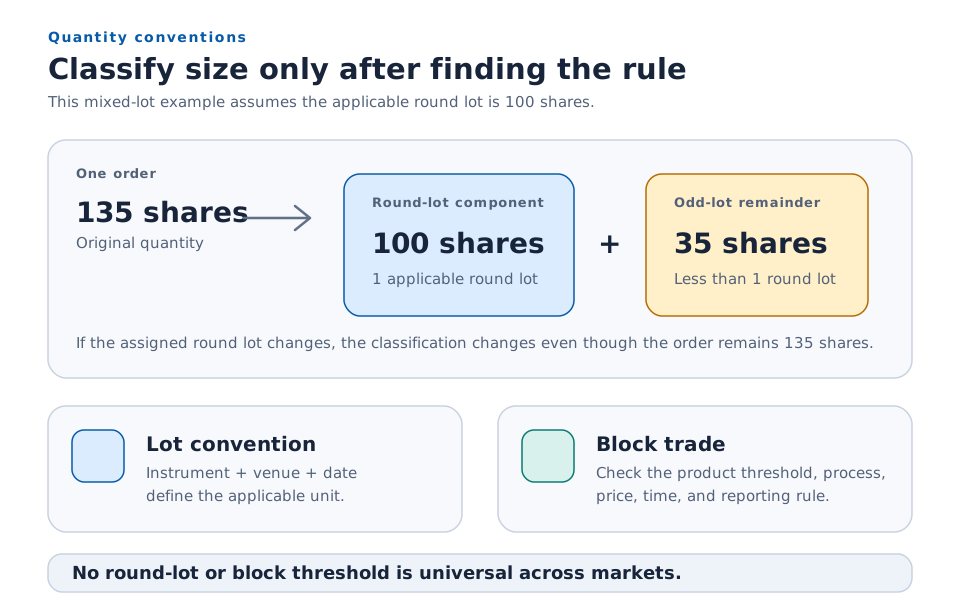
Assume, only for this example, that a stock’s applicable round lot is 100 shares and an investor submits an order for 135 shares.
| Order component | Quantity | Classification |
|---|---|---|
| Round-lot component | 100 shares | One round lot |
| Remainder | 35 shares | Odd lot |
| Total order | 135 shares | Mixed lot |
The investor entered one economic order, but the order can receive multiple fills. The round-lot and odd-lot portions may also be represented differently in market data or execution-quality analysis. The classification does not tell the investor which price will be received.
If the applicable round lot were 40 shares instead, the same 135-share order would contain three 40-share round lots plus a 15-share odd-lot remainder. Always start with the current assigned unit.
Lot Conventions Across Markets
| Market | What quantity can mean | Common mistake |
|---|---|---|
| Listed equities | Shares and an assigned or venue-defined round lot | Assuming every stock uses 100 shares |
| Listed options | Number of contracts; each contract has product-specific terms | Treating one contract as one share |
| Futures | Number of contracts with a stated contract unit and multiplier | Confusing contract count with underlying units |
| Bonds | Face amount, principal amount, or dealer-market size convention | Applying an equity-lot rule to fixed income |
| Foreign exchange | Currency units or a platform’s named lot convention | Assuming “standard lot” has identical handling everywhere |
| Funds or digital assets | Shares, units, or venue-defined increments | Ignoring minimum size and precision rules |
A minimum order quantity, order-size increment, contract unit, and round lot can be related but are not necessarily the same thing. For example, a futures contract specifies the underlying quantity represented by one contract, while an exchange can separately specify minimum price increments and block-trade thresholds.
What Is a Block Trade?
A block trade is a large transaction that meets the definition or threshold used by a particular market, exchange, reporting regime, or product. It may be privately negotiated and then reported to an exchange or reporting facility, or executed through another permitted mechanism. The details vary substantially.
Block rules can specify:
- minimum quantity or notional amount
- eligible products and contract combinations
- permitted participants or negotiation methods
- minimum or maximum reporting delays
- price, time, and recordkeeping requirements
- whether legs of a spread or related transaction can be aggregated
Do not use an old rule of thumb such as 10,000 shares or $200,000 as a universal definition. A transaction can be large for one security and ordinary for another, while a formal block threshold can differ even between products on the same exchange.
Block-Trade Example
Suppose a futures exchange defines a minimum block quantity for a specific contract and expiration month. Two eligible counterparties negotiate a transaction that meets that threshold and report it within the required window.
The relevant evidence is not merely the word “block.” An analyst should verify the product rule, quantity, price, timestamp, reporting status, counterparties’ permitted process, and any related legs. A large print on a market-data screen does not prove that every part of this workflow was satisfied.
Why Trade Size Matters
Order quantity interacts with market conditions:
| Issue | Why quantity matters |
|---|---|
| Market Depth | A larger order may consume several displayed price levels |
| Market Quotes | The best price may be displayed for less quantity than the order requires |
| Transaction Cost | Spread, fees, delay, and price impact can change with size |
| Reporting | Odd-lot, mixed-lot, and block transactions can have specific indicators or timing rules |
| Risk control | Position limits, credit, margin, and internal approvals may depend on quantity or exposure |
Lot classification does not replace execution evidence. The order ticket states the instruction; the execution report shows what actually filled. Review Execution for the distinction.
How to Evaluate a Lot or Block Description
Use this sequence:
- Identify the instrument: symbol, identifier, contract month, option series, currency, and venue.
- Define the unit: shares, contracts, face amount, currency units, or another product measure.
- Find the current rule: applicable round lot, minimum order increment, or formal block threshold.
- Classify the quantity: round lot, odd lot, mixed lot, or block only after the rule is known.
- Check the market: bid, ask, displayed size, depth, typical volume, and volatility at the time.
- Verify the transaction: order ID, fills, average price, timestamp, venue, reporting indicator, and settlement record.
- Date the conclusion: market rules and assigned lot sizes can change.
Common Mistakes and Limitations
- Assuming a round lot is always
100shares: current U.S. NMS stock rules include smaller price-based tiers. - Calling every large trade a formal block: descriptive size and rule-qualified block status are different.
- Using one market’s threshold elsewhere: equity, bond, option, futures, and FX conventions are not interchangeable.
- Treating quoted size as guaranteed capacity: displayed orders can trade, change, or be canceled before execution.
- Ignoring mixed-lot handling: one order can contain different lot components and receive partial fills.
- Inferring direction from a block print: a reported transaction has both a buyer and a seller and does not predict the next price.
- Using stale rule summaries: lot assignments, reporting requirements, and block thresholds can change.
Sources and Further Reading
- SEC: 2026 exchange filing describing the operative Regulation NMS round-lot tiers
- SEC: 2026 temporary exemptive relief for certain odd-lot information
- SEC: Regulation NMS amendments on round lots and odd-lot transparency
The cited U.S. securities rules do not govern every market. Use the current regulator, exchange, venue, or contract source for the instrument being evaluated.
FAQs
Can an investor submit an odd-lot order?
Is every large transaction a block trade?
Does a block trade move the market?
Related Terms
- Trading Volume and Open Interest: Completed activity during a period compared with outstanding derivative contracts.
- Market Depth: Displayed quantity across price levels.
- Market Quotes and Executable Prices: Bid, ask, spread, displayed size, and execution limits.
- Liquidity: Ability to transact without disproportionate cost or delay.
- Transaction Cost: Explicit and implicit costs of executing a trade.
- Execution: The event in which an order receives one or more fills.
Educational Use
This article is for financial education only. It does not recommend an order size, trading method, security, broker, or venue and does not replace current regulatory, exchange, legal, tax, or professional guidance.