Price Ticks and Quote Increments
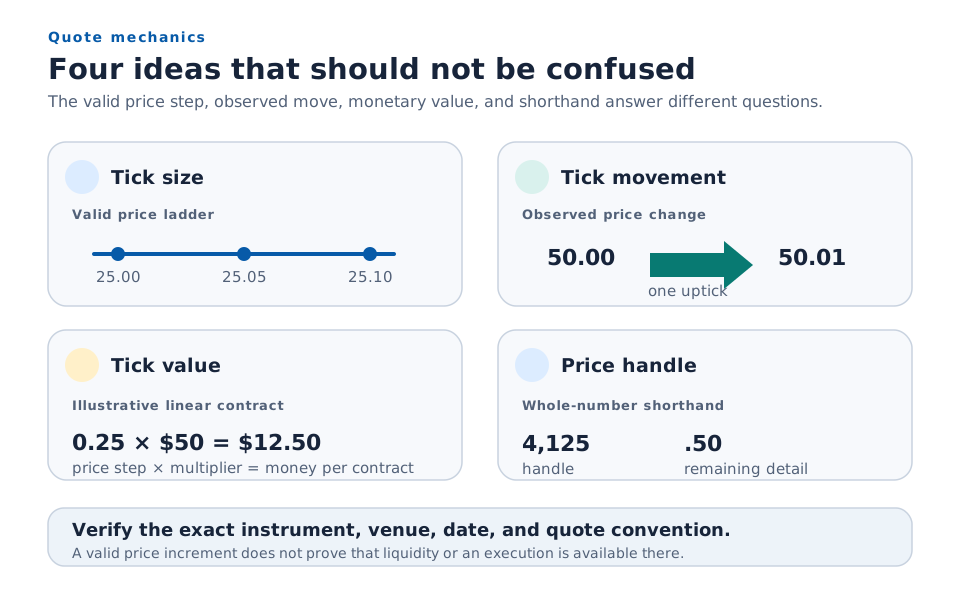
Tick size is the minimum permitted price increment; tick value converts that increment into money, while a handle identifies the whole-number part of a quote.
A price tick is a permitted price increment or one recorded move from one price to another. Tick size defines the minimum quoting or order-price step, tick value converts that step into money for a stated position, and a handle is the whole-number part of a quoted price. The instrument, venue, and current rule or contract specification determine which convention applies.
In plain language, tick size tells you which price steps are valid. Tick value tells you what one of those steps means financially.
Key Takeaways
- Tick size is a price increment; tick value is a monetary amount.
- An uptick or downtick describes direction relative to a prior relevant price, not necessarily a move of exactly one minimum increment.
- A handle is trader shorthand for the whole-number portion of a price and is incomplete without the remaining decimals or fraction.
- Tick rules differ across stocks, options, futures, bonds, and foreign exchange.
- A smaller tick can permit finer price competition, while a larger tick can constrain the quoted spread and affect queue behavior.
- Current venue rules and contract specifications control. Historical conventions or an old broker screen are not reliable substitutes.
Tick Terms at a Glance
| Term | Plain-English meaning | Example | Main check |
|---|---|---|---|
| Tick size | Smallest permitted price increment | Prices move in 0.01 steps | Current venue rule or contract specification |
| Tick movement | Change between relevant prices | 50.00 to 50.01 is an uptick | Whether the comparison uses trades or quotes |
| Tick value | Money gained or lost for one tick on a stated position | 0.25 × $50 = $12.50 per contract | Multiplier, contract, currency, and position size |
| Handle | Whole-number portion used as shorthand | The handle of 4,125.50 is 4,125 | Full decimal or fractional quote |
Tick Size vs. Tick Movement
Tick size is a rule or product attribute. If an instrument has a tick size of 0.05, valid order prices might include 25.00, 25.05, and 25.10, but not 25.03.
Tick movement describes a change in a price observation:
| Price path | Interpretation |
|---|---|
25.00 to 25.05 | One minimum-increment uptick when tick size is 0.05 |
25.05 to 25.15 | A 0.10 increase, equal to two minimum increments |
25.15 to 25.10 | One minimum-increment downtick |
25.10 to 25.10 | No price change |
The word tick is sometimes used loosely for any change between consecutive trades or quotes. That change can span several minimum increments. A data analysis should state whether it counts price changes, minimum increments, trades, quotes, or another event type.
How to Calculate Tick Value
For a linear contract, a useful general relationship is:
Tick value per contract = tick size × contract multiplier
Suppose a hypothetical futures contract has:
| Contract term | Amount |
|---|---|
| Tick size | 0.25 index points |
| Contract multiplier | $50 per index point |
| Tick value | 0.25 × $50 = $12.50 |
A one-tick move changes one contract’s value by $12.50 before commissions, fees, taxes, slippage, and currency effects. A position of four contracts changes by $50.00 per tick:
$12.50 × 4 contracts = $50.00
Do not apply this shortcut blindly. Some contracts use fractions, percentages of par, basis points, currency conversion, variable tick schedules, or product-specific formulas. The exchange’s current contract specifications control.
Cash-Security Example
Assume a stock rises from 50.00 to 50.01 and the applicable minimum increment is 0.01.
| Position | Price change | Gross position change |
|---|---|---|
1 share | 0.01 | 0.01 |
100 shares | 0.01 | 1.00 |
1,000 shares | 0.01 | 10.00 |
This is arithmetic, not a prediction of profit. The actual result also depends on entry and exit prices, spread, order size, partial fills, fees, taxes, and whether the quoted price was available.
Why Tick Size Matters
Tick size affects several parts of market structure:
| Market issue | How tick size can matter |
|---|---|
| Bid-ask spread | A minimum increment can limit how narrowly displayed quotes compete |
| Limit-order placement | Order prices generally must conform to permitted increments |
| Queue priority | A trader may need to join an existing price queue when a smaller improvement is not allowed |
| Displayed depth | Orders can cluster at fewer price levels when increments are larger |
| Execution cost | Finer increments can permit price improvement, but displayed size and market impact still matter |
| Systems and controls | Brokers and venues validate prices against instrument-specific rules |
A smaller tick is not universally better. It can allow finer price competition, but it can also redistribute displayed size across more price points or change incentives to display liquidity. A larger tick can support depth at each price while making it more expensive to improve a quote. The outcome depends on the instrument and market design.
Tick Size and the Bid-Ask Spread
Suppose the best bid is 20.00 and the best ask is 20.05.
| Permitted increment | Possible inside price? | Important limitation |
|---|---|---|
0.05 | No valid price exists between 20.00 and 20.05 | The displayed spread is one tick |
0.01 | Prices such as 20.01 through 20.04 are valid | An inside order still needs a participant willing to quote it |
Tick size sets possible price steps; it does not by itself determine the spread. Volatility, competition, information risk, inventory costs, trading activity, and order-book depth also matter. Review Market Quotes and Executable Prices for bid, ask, spread, size, and execution evidence.
What Is a Price Handle?
A handle is the whole-number portion of a quoted price, often used as shorthand:
| Full quote | Handle | Detail omitted by the shorthand |
|---|---|---|
48.25 | 48 | .25 |
102.75 | 102 | .75 |
4,125.50 | 4,125 | .50 |
99-16 in a fractional convention | 99 | The product-specific fractional part |
The handle is not a separate order type, tick, or executable price. Saying that an instrument “traded in the 102 handle” may describe a broad range, while an order requires the complete valid price. In bonds, futures, rates, and foreign exchange, context is especially important because quote formats can use fractions, points, pips, basis points, or implied rates.
U.S. Equity Tick-Size Status
Minimum increments for U.S. national market system stocks are governed by Regulation NMS and related market rules. In 2024, the SEC adopted amendments that would add a 0.005 minimum increment for certain stocks priced at or above $1.00, based on their time-weighted average quoted spread.
Implementation should not be inferred from the 2024 announcement alone. In October 2025, the SEC granted temporary relief from the relevant compliance dates until the first business day of November 2026. In June 2026, the SEC Chair stated that staff had been directed to review the minimum-increment and access-fee provisions by year-end. As of July 29, 2026, readers should verify the current SEC orders, listing-exchange assignments, and broker or venue rules before applying the amended framework.
This status is U.S.-specific and can change. It does not define valid increments for options, futures, bonds, foreign exchange, digital assets, or securities in other jurisdictions.
Tick Conventions Across Products
| Product | Where to verify the increment | Common interpretation risk |
|---|---|---|
| Exchange-listed stock or ETF | Securities rules, listing exchange, venue, and broker validation | Assuming every security uses the same permanent increment |
| Listed option | Options exchange rules and series specifications | Confusing premium increment with contract value |
| Futures contract | Exchange contract specifications | Ignoring multiplier, fraction, or variable tick schedule |
| Bond | Dealer platform, venue, security terms, and quote convention | Confusing price points, fractions, yield, and spread |
| Foreign exchange | Trading venue or dealer convention | Treating a pip, pipette, and tick as universal equivalents |
| Digital asset | Specific exchange’s market rules | Assuming increments and units match across venues |
The same label can represent different economics. A one-tick move in two contracts is not comparable until the tick size, multiplier, currency, and position size are matched.
How to Evaluate Tick Information
Use this sequence:
- Identify the exact instrument: symbol, contract month, option series, security identifier, currency, and venue.
- Find the governing source: current exchange rule, contract specification, broker validation rule, or regulatory requirement.
- Separate the terms: tick size, observed price change, tick value, handle, pip, point, and basis point.
- Confirm the quote format: decimals, fractions, percentage of par, yield, implied rate, or another convention.
- Calculate the exposure: price increment, multiplier, quantity, and currency conversion.
- Check the order: side, limit price, time in force, rejection or repricing notice, and execution report.
- Date the evidence: rules and contract terms can change, so retain the effective date and source.
Common Mistakes and Limitations
- Treating tick size and tick value as synonyms: one is a price step; the other is a monetary result.
- Assuming a tick is always one cent: increments are instrument- and rule-specific.
- Using a generic contract multiplier: futures and options specifications differ by product.
- Counting every uptick as exactly one minimum increment: a recorded move can cross several increments.
- Ignoring position size: monetary exposure scales with shares, contracts, face amount, and multiplier.
- Reading a handle as the full price: omitted decimals or fractions remain economically important.
- Using an outdated rule summary: implementation dates, assignments, and permitted increments can change.
- Treating a valid price as an available price: a permitted order level does not prove displayed liquidity or execution.
Sources and Further Reading
- SEC: Regulation NMS minimum pricing increments final-rule page provides the adopting release and later Commission actions.
- SEC: Statement Regarding Minimum Pricing Increments and Access Fee Caps describes the temporary relief through the first business day of November 2026 and the June 2026 review direction.
- CME Group: A Trader’s Guide to Futures explains contract size, tick size, and tick value in the futures context.
Regulatory and exchange sources can be amended. Check the source’s date, later orders, and the current product specification before relying on a particular increment.
FAQs
Is a tick always the minimum price increment?
Is tick value the same for every futures contract?
Can a stock order use a half-cent price?
Is a handle the same as a round-number trading signal?
Related Terms
- Market Quotes and Executable Prices: Bid, ask, spread, size, timing, depth, and quote firmness.
- Limit Order: Order with a stated maximum purchase price or minimum sale price.
- Market Depth: Displayed quantity across multiple price levels.
- Order Queue: Priority of orders waiting at a price level.
- Pip: Foreign-exchange price increment that should not be assumed to equal a tick.
- Basis Point: One-hundredth of a percentage point, used for rates and yields.
Educational Use
This article is for financial education only. It does not provide personalized trading, investment, legal, tax, or regulatory advice; specify a valid order price for a particular instrument; or replace current exchange rules, contract specifications, or professional guidance.