Market Quotes and Executable Prices
Market quotes show bid, ask, spread, size, timing, and depth; those fields determine whether a displayed price is useful or executable.
A market quote communicates buying or selling interest for a financial instrument. A basic stock quote can show bid, ask, size, last sale, and timing; a Level 2 display can add price levels; a dealer axe or workout market can indicate negotiated interest; and a firm quote can carry a defined obligation for covered size. None of these records proves what a particular order received. Only an execution record establishes a completed fill.
The practical question is not simply, “What price appeared?” It is, “What did that price represent, when was it valid, for what quantity, from which source, and under what conditions?”
Key Takeaways
- Bid and ask show displayed buying and selling interest; last sale records a completed transaction.
- The bid-ask spread is the ask minus the bid, but realized trading cost can also include market impact, slippage, fees, and taxes.
- Real-time, delayed, snapshot, and historical quotes describe different market states.
- A midpoint is calculated from bid and ask and may not be available for execution.
- Level 2 shows additional displayed price levels, but not every source of liquidity.
- A dealer axe and workout market communicate interest or an estimated range, not a guaranteed trade.
- Whether a quote is firm depends on the product, participant, venue, size, conditions, and governing rules.
- Displayed prices can change before an order arrives, and a large order can trade across several levels.
- Order acknowledgments, execution reports, and confirmations provide stronger transaction evidence than screenshots.
Quote Evidence at a Glance
| Record or field | What it communicates | Main limitation |
|---|---|---|
| Bid | Displayed buyer-side interest at a stated price and size | Can change, be withdrawn, or cover limited quantity |
| Ask or offer | Displayed seller-side interest at a stated price and size | Can change, be withdrawn, or cover limited quantity |
| Last sale | Most recent eligible reported transaction | Historical immediately after execution |
| Mid-market price | Arithmetic midpoint of best bid and best ask | Usually a reference, not a standing order |
| Level 2 or depth | Additional displayed price levels and quantities | Feed-specific and incomplete |
| Dealer axe | Strong dealer interest to buy or sell | May omit price, size, or commitment |
| Workout market | Estimated range for a negotiated trade | Subject to confirmation and order details |
| Subject or indicative quote | Price requiring confirmation | Not firm until confirmed under applicable terms |
| Firm quote | Actionable price and covered size under stated conditions | Obligation is limited by governing rules and facts |
| Execution report | Actual fill price, quantity, time, and status | Applies to the completed order, not future liquidity |
This hierarchy prevents a common error: treating every number on a screen, message, or dealer run as equivalent evidence.
What Is a Stock Quote?
A stock quote is a market-data display that combines current or recent information about a stock. Common fields include:
| Field | Typical meaning | Interpretation check |
|---|---|---|
| Symbol | Short identifier used by the data service | Confirm exchange and share class |
| Bid price | Highest displayed buying price within the feed | Check size, source, timestamp, and venue coverage |
| Bid size | Quantity displayed at the bid | Confirm units and whether size is aggregated |
| Ask price | Lowest displayed selling price within the feed | Check size, source, timestamp, and venue coverage |
| Ask size | Quantity displayed at the ask | Hidden and off-venue interest may be absent |
| Last sale | Most recent transaction eligible for the displayed field | It may be stale or carry a special condition |
| Change | Difference from a selected reference | Identify prior close, settlement, or other reference |
| Volume | Completed activity during a period | Does not guarantee current depth |
| Open, high, and low | Selected session-price observations | Historical fields, not standing quotes |
| Timestamp | Time attached to the record or display | Feed, report, and screen times can differ |
| Status | Real-time, delayed, halted, closed, or another label | Read the provider’s field definitions |
A compact public quote, broker order ticket, consolidated feed, direct exchange feed, and depth product can show different information. The display is useful only when its coverage and timing match the reader’s purpose.
Bid, Ask, Spread, and Quote Size
The bid price is the highest displayed price at which a buyer is willing to buy within the quote’s coverage. The ask price, also called the offer, is the lowest displayed price at which a seller is willing to sell. A market sell generally interacts with available bids, while a market buy generally interacts with available asks.
The bid-ask spread is:
Quoted spread = best ask - best bid
Suppose a stock quote shows:
| Quote side | Price | Displayed size |
|---|---|---|
| Best bid | 49.98 | 500 shares |
| Best ask | 50.02 | 300 shares |
The quoted spread is 0.04 per share and the midpoint is 50.00. If a market buy for 100 shares reaches the market while the quote remains available, it may execute near the 50.02 ask. A market sell may execute near the 49.98 bid.
That simple example has important limits:
- The quoted sizes cover only displayed quantity within the feed.
- A buy larger than
300shares may consume the best ask and continue at higher prices. - A sell larger than
500shares may consume the best bid and continue at lower prices. - Quotes can update or disappear while an order is traveling to the venue.
- Hidden orders, reserve quantity, other venues, and internalized liquidity may not appear.
The spread is therefore an observable cost of immediacy, not the complete cost of a trade. Commissions, regulatory or exchange fees, taxes, market impact, and slippage can also affect the result. A narrow displayed spread can still provide poor execution if size is small or the market moves quickly.
Quoted, Effective, and Realized Spreads
Different spread measures answer different questions:
| Measure | What it compares | What it helps evaluate |
|---|---|---|
| Quoted spread | Best ask minus best bid | Cost visible before an order |
| Half-spread | Half of the quoted spread | Distance from midpoint to one quote side |
| Effective spread | Execution price versus the contemporaneous midpoint, commonly doubled | Actual price paid for immediacy relative to the displayed market |
| Realized spread | Execution price versus a later midpoint under a stated method | Outcome after allowing time for prices to move |
These measures require synchronized timestamps, consistent sign conventions, and a stated methodology. They should not be reconstructed from an undated screenshot or a last-sale price.
Real-Time, Delayed, Snapshot, and Historical Quotes
| Data state | Plain meaning | Suitable use | Main limitation |
|---|---|---|---|
| Streaming real-time | Updates delivered continuously without a standard intentional public delay | Time-sensitive monitoring and order context | Network, processing, display, and human latency remain |
| Snapshot real-time | Current data returned when requested or refreshed | Occasional checks before a decision | Becomes stale if it does not refresh |
| Delayed | Earlier data shown after a stated interval | Education, broad monitoring, and non-urgent research | Old bid, ask, and size may no longer exist |
| End-of-day | Session summary published after the period | Screening and historical review | Not intraday execution evidence |
| Historical | Stored observations from prior periods | Research, charting, and backtesting | Adjustments and methodology matter |
The timing label can differ by field. A service might provide a current last sale but delayed depth, or regular-session data beside a separate extended-hours quote.
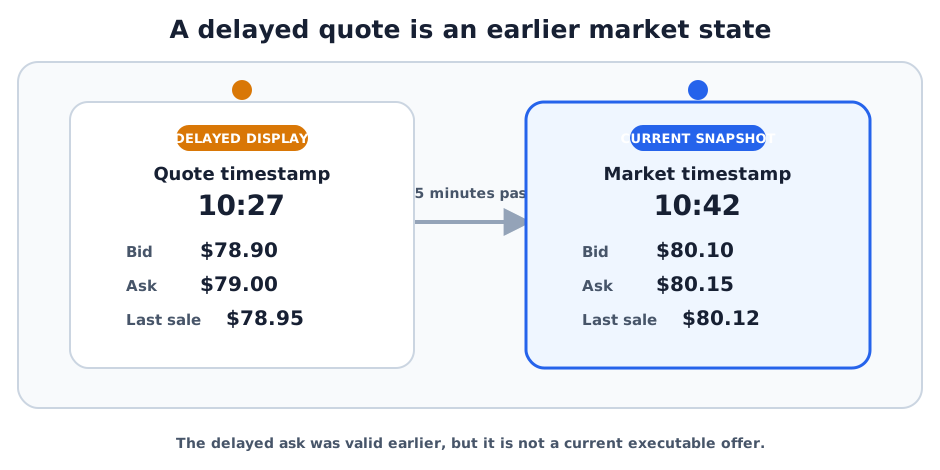
Delayed Quote Example
Assume a website clearly states that its quote is delayed:
| Display field | Delayed screen at 10:42 | Current market at 10:42 |
|---|---|---|
| Data timestamp | 10:27 | 10:42 |
| Bid | 78.90 | 80.10 |
| Ask | 79.00 | 80.15 |
| Last sale | 78.95 | 80.12 |
The delayed screen can accurately describe the earlier market state while being unsuitable for a current order. A market buy submitted at 10:42 interacts with current selling interest, not the old 79.00 ask. A limit order at 79.00 controls the maximum purchase price but may not execute.
No universal delay interval should be assumed. The provider’s notice, timestamp, and data agreement control.
Why Real-Time Does Not Mean Zero Latency
Market information moves through a chain:
- a venue changes a quote or reports a trade;
- a direct feed, consolidated processor, or reporting system receives the event;
- a broker or vendor normalizes and distributes it;
- a network delivers the update;
- a device renders the value; and
- an order travels back through broker and market systems.
Each stage takes time. Updates can also be cached, throttled, or refreshed at intervals. A real-time label is a distribution status, not a promise that the displayed price will remain available.
Top of Book, Level 1, and Level 2
Top-of-book or Level 1 data typically shows the best displayed bid and ask within the product’s coverage, plus basic size and last-sale information.
Level 2 market data adds visible bid and ask depth beyond those best prices. Depending on the feed, it can show several price levels, displayed quantities, venues, or participant identifiers.
| Data view | Typical content | Main limitation |
|---|---|---|
| Level 1 | Best bid, best ask, size, and last sale | Only the top displayed market |
| Level 2 | Multiple bid and ask levels with visible size | Does not necessarily show every venue or hidden order |
| Full depth feed | More or all displayed orders for a specific venue | Still limited to that feed and venue |
Level 2 Example
Suppose the visible ask side is:
| Ask price | Displayed size |
|---|---|
20.05 | 300 shares |
20.10 | 500 shares |
20.15 | 700 shares |
A market buy for 200 shares may execute near 20.05 if that quote remains available. An order for 1,000 shares can consume more than one level and receive a higher average price.
This example does not predict the fill. Displayed orders can cancel, new orders can arrive, hidden or reserve quantities can interact, and routing can reach other venues.
What Level 2 Can and Cannot Show
Level 2 can help a reader:
- compare order size with visible depth;
- see nearby displayed price levels;
- understand why a market order might walk through the book;
- review contemporaneous visible conditions around a fill; and
- identify whether a depth snapshot is stale or venue-limited.
It does not reveal all liquidity. Hidden orders, dark venues, internalized flow, bilateral interest, and uncovered venues may be absent. Large displayed size is not guaranteed support or resistance and can disappear before execution.
What Is the Mid-Market Price?
The mid-market price, or midpoint, is the arithmetic midpoint between the best bid and best ask:
Mid-market price = (best bid + best ask) / 2
| Best bid | Best ask | Midpoint |
|---|---|---|
100.00 | 100.10 | 100.05 |
24.80 | 25.20 | 25.00 |
9.95 | 10.05 | 10.00 |
If the bid is 20.00 and the ask is 20.20, the midpoint is 20.10. A market buyer may pay closer to the ask, while a market seller may receive closer to the bid. A limit order at 20.10 might execute inside the spread, but it might also remain unfilled.
Why the Midpoint Matters
The midpoint can provide:
- a neutral reference between buyer and seller quotes;
- a benchmark for comparing an execution with the contemporaneous spread;
- an input to transaction-cost or price-improvement analysis;
- a starting point for an OTC negotiation; and
- a provisional mark when bid and ask differ.
Midpoint is not automatically fair value. A wide spread, stale side, one-sided market, small quote size, or stressed market can make it weak evidence. The midpoint from one venue also need not represent the broader market.
Firm, Indicative, and Dealer Quotes
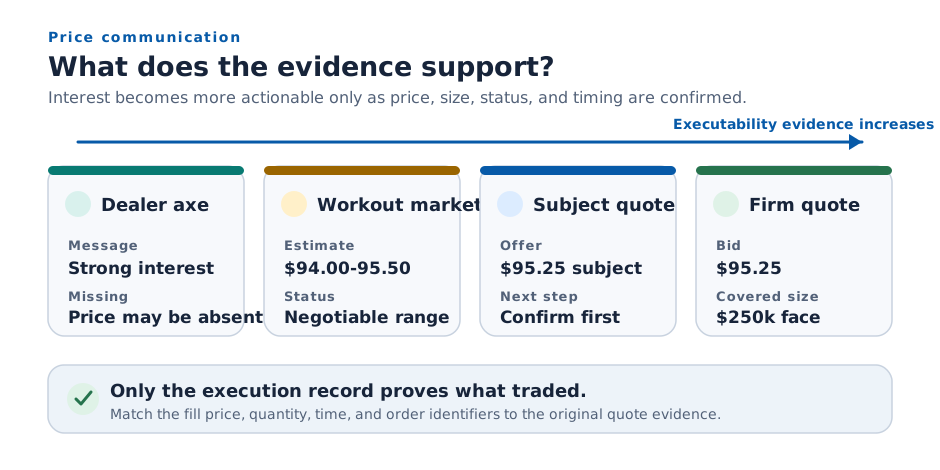
Quote communications lie on a spectrum from general interest to completed execution.
What Is a Firm Quote?
A firm quote communicates a bid or offer that a covered participant is expected to honor for stated size under applicable conditions and market rules. Firmness is not a universal label that creates the same obligation everywhere.
A usable firm quote identifies:
- the instrument and side;
- quoted price or yield basis;
- covered quantity;
- market, venue, or bilateral channel;
- time and status;
- settlement assumptions; and
- any conditions allowed by the governing framework.
Even a firm quote does not guarantee that an unlimited order will fill. The obligation can be limited to covered size, the quote can update before an order arrives, and eligibility or market-state conditions can matter.
Firm Quote Example
Assume a dealer communicates an offer of 99.25 for 500,000 face amount and confirms that the price is firm for that stated quantity under the current settlement terms.
That communication is stronger evidence than a general indication. It does not establish:
- the same price for
2,000,000face amount; - availability after the quote is updated or withdrawn as permitted;
- the all-in economics under different accrued-interest or settlement assumptions; or
- a completed trade before the dealer accepts the order and reports the execution.
Whether a specific obligation applies is a rule-and-fact question. The relevant venue rules, participant status, product, jurisdiction, and contemporaneous records control.
Dealer Axes, Workout Markets, and Subject Quotes
Dealer Axe
A dealer axe communicates strong interest to buy or sell a named instrument. It can reflect inventory, client flow, hedging needs, or a trading objective.
An axe may identify only the side and instrument. It does not necessarily include a price, available quantity, or commitment to transact. It is market-interest evidence, not personalized advice.
Workout Market
A workout market is an estimated range where a negotiated trade might occur after considering size, liquidity, credit, settlement, and current interest.
For example, a dealer might describe a thinly traded bond as 98.75–99.25 workout for a stated quantity. The range helps frame negotiation but is not two firm orders at its endpoints.
Subject or Indicative Quote
A subject quote or indicative quote requires confirmation. It can be useful for valuation context, price discovery, or deciding whether to request a firm market, but it should not be represented as currently executable.
| Communication | Price included? | Size included? | Commitment to trade? |
|---|---|---|---|
| Dealer axe | Sometimes | Sometimes | Not by the label alone |
| Workout market | Usually a range | Should be stated | No |
| Indicative or subject quote | Usually | Often | Requires confirmation |
| Firm quote | Yes | Yes | Defined by applicable rules and conditions |
| Execution | Yes | Yes | Completed transaction |
Consolidated and Venue-Specific Quotes
U.S. exchange-listed stocks can trade across several market centers. A consolidated product combines specified information across covered venues, while a proprietary exchange feed describes that venue and can include additional depth or fields.
Two screens can therefore disagree without either being inherently defective:
- one venue’s best bid may differ from the best bid across covered markets;
- one exchange’s last trade can differ from a consolidated last sale;
- a direct feed can include depth absent from a basic consolidated product;
- participant and order-level details can vary by product; and
- processing paths and timestamps can differ.
The data legend should identify whether a screen is consolidated, venue-specific, dealer-supplied, indicative, or otherwise limited.
What Price Can Actually Execute?
Executability depends on more than the displayed number:
| Decision question | Evidence to review |
|---|---|
| Can a small market buy execute near the ask? | Current ask, size, depth, routing, and order arrival time |
| Can a larger order fill at one price? | Depth across levels and venues, hidden-liquidity uncertainty, and market impact |
| Can a limit order execute at the midpoint? | Limit, queue position, later contra-side interest, and time-in-force |
| Is a dealer level actionable? | Firm or indicative status, side, size, settlement, counterparty, and time |
| Was a completed fill consistent with the market? | Order instructions, timestamped quotes and trades, route, execution report, and confirmation |
A market order prioritizes execution rather than a particular price. A limit order controls the worst acceptable price but does not guarantee execution. The public screen can change while the order is in transit.
Session and Market-State Checks
During extended hours, participation and venue coverage can differ, spreads may widen, and displayed size may shrink. During a halt, a stale last sale can remain visible even though continuous trading is unavailable. Auction indications and reopening quotes should not be confused with completed trades.
When a market is closed, a displayed bid or ask can be stale, indicative, or queued for another session. The quote status, session, and timestamp should be visible before the price is used.
How to Evaluate Quote Evidence
Use this sequence:
- Identify the instrument: full identifier, share class or contract, currency, and market.
- Classify the record: bid, ask, last sale, midpoint, depth, dealer indication, firm quote, or execution.
- Check timing: timestamp, delay label, refresh behavior, time zone, and report age.
- Check coverage: consolidated, venue-specific, top-of-book, depth, dealer, or bilateral.
- Confirm size: units, displayed quantity, intended order, and whether the quote aggregates venues.
- Confirm status: regular or extended session, open, halted, closed, indicative, subject, or firm.
- Review conditions: participant, product, settlement, credit, quote rules, and permitted exceptions.
- Compare contemporaneous evidence: quote, depth, trades, order instructions, and routing record.
- Use the execution record: fill price, quantity, timestamp, and status establish what happened.
Common Mistakes and Risks
- Using delayed data for active execution: earlier bid, ask, and size may no longer exist.
- Treating real time as instantaneous: every market-data and order path has latency.
- Confusing last sale with a live offer: a completed trade is not standing liquidity.
- Treating midpoint as guaranteed: no order may exist at the calculated price.
- Assuming Level 2 shows the whole market: depth is product- and venue-specific.
- Reading visible size as permanent: orders can update, cancel, or be consumed.
- Calling every displayed price firm: screens can contain delayed, indicative, subject, or reference values.
- Treating a dealer axe as advice: dealer interest can reflect inventory or flow.
- Treating a workout range as a promise: it is an estimate requiring negotiation.
- Ignoring size and settlement: a quote for one quantity or convention does not establish another.
- Applying one market’s rules globally: quote obligations differ across products, venues, participants, and jurisdictions.
- Substituting a screenshot for execution evidence: only the order and fill records establish the transaction.
Quote and dealer communications can be stale, selective, incomplete, or misunderstood. Anyone evaluating a specific dispute, compliance question, valuation, or execution should use the governing rules, contemporaneous records, and qualified professional advice.
Sources and Further Reading
- Investor.gov: Stock Quotes describes bids, offers, and historical quote fields.
- Investor.gov: Executing an Order explains that an order’s path and execution can involve several market participants.
- FINRA: Market Data Frequently Asked Questions identifies delayed equity data and displayed delay notices in its market-data context.
- FINRA: Vendor Display Rule discusses consolidated quotation and last-sale display requirements within its scope.
- Nasdaq TotalView describes a proprietary depth-of-book market-data product.
- CTA: Delayed Market Data Policy documents delayed quotation and last-sale information for covered data.
- FINRA Rule 6272: Character of Quotations addresses firm and subject quotations within its stated scope.
- FINRA: OTC Quotations in Fixed Income Securities discusses quotation media and dealer-interest considerations in covered fixed-income activity.
- SEC Rule 605 guidance describes quoted, effective, and realized spread measures in its order-execution disclosure context.
These regulatory examples are U.S.-specific and do not define quote obligations for every product or jurisdiction.
FAQs
Are stock quotes always real time?
Is a real-time quote guaranteed to be executable?
Does Level 2 show all buy and sell interest?
Can an order execute at the midpoint?
Is a dealer axe a firm quote?
Does a firm quote guarantee the entire order will fill?
Related Terms
- Price Ticks and Quote Increments: Minimum price steps, tick value, and handle terminology.
- Market Depth: Visible buying and selling interest across price levels.
- Order Book: Queue of orders that can create displayed depth.
- Stock Quote Price Fields: Open, high, low, last-sale, unchanged, and trailing-range fields.
- Market Data: Quote, trade, reference, and derived data distributed to users.
- Execution: Completed fill that records the transaction outcome.
Educational Use
This article is for financial education only. It does not provide personalized investment, trading, valuation, legal, tax, or regulatory advice; recommend a data service or trading action; or determine whether a quote obligation applies to a specific dispute.