Market Impact
Market impact is the price change attributable to executing an order. Learn how size, liquidity, timing, and benchmarks affect its measurement.
Market impact is the change in available market prices attributable to executing an order. A buy order can consume offers and push subsequent fills higher; a sell order can consume bids and push fills lower. The effect is most important when an order is large relative to available liquidity.
Market impact is an implicit Transaction Cost. It is not every price change observed while an order is active: news, market-wide movement, spread cost, and execution delay can also change the final result.
Key Takeaways
- Market impact depends on order size relative to depth and trading activity, not on share count alone.
- Immediate impact can fade after an order ends, while a persistent component may remain.
- A benchmark comparison can estimate execution shortfall, but it does not automatically isolate market impact.
- Attempts to reduce impact create trade-offs with delay, information leakage, and the risk of not completing the order.
How an Order Creates Market Impact
An immediately executable order interacts with available quotes. If its size exceeds the quantity at the best price, it may consume additional price levels, often called walking the book.
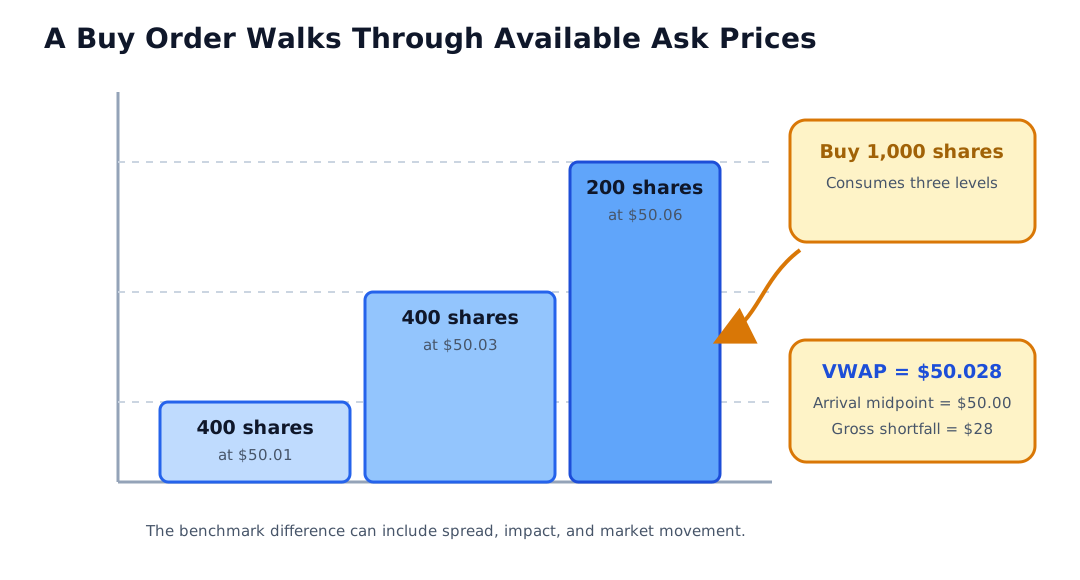
The mechanism has three steps:
- The order takes liquidity at the best available price.
- Remaining quantity reaches higher offers for a buy or lower bids for a sale.
- Other market participants may cancel, reprice, or add orders as they observe trading pressure.
Only the first two steps are visible in a static order-book snapshot. A full estimate also considers how quotes and trades changed during and after execution.
Temporary vs. Persistent Impact
| Component | What it describes | Interpretation challenge |
|---|---|---|
| Temporary impact | Price pressure that reverses after the order is completed | The recovery window must be defined |
| Persistent impact | Price movement that remains after the order | It may reflect information or broader market movement rather than the order alone |
The label permanent impact is also used in market-microstructure models, but persistent does not mean literally permanent. Attribution depends on the benchmark, comparison horizon, market model, and information arriving during the measurement window.
Worked Example: Buying Through the Ask
Suppose the quote midpoint is $50.00 when a 1,000-share buy order reaches the market. The available asks are:
| Ask price | Shares filled | Execution value |
|---|---|---|
| $50.01 | 400 | $20,004 |
| $50.03 | 400 | $20,012 |
| $50.06 | 200 | $10,012 |
| Total | 1,000 | $50,028 |
The order’s volume-weighted average execution price is:
Relative to the $50.00 arrival midpoint, the gross benchmark shortfall is $28, before commissions or other fees. That $28 is not automatically a pure market-impact estimate. It can include the cost of crossing the spread, book walking, quote changes, and market movement while the order executes.
What Determines Market Impact?
| Factor | Why it matters |
|---|---|
| Order size | More quantity may consume more price levels |
| Available depth | A deeper book can absorb more size near the current price |
| Participation rate | Trading aggressively relative to market activity can reveal demand or supply pressure |
| Urgency and order type | Seeking immediate completion usually gives up more price control |
| Volatility and news | Quotes may move for reasons unrelated to the order |
| Venue and trading session | Displayed, hidden, auction, and off-exchange liquidity behave differently |
| Execution schedule | Splitting an order may reduce immediate pressure but extend exposure to market movement |
Ratios such as order size divided by average daily volume can provide scale, but they are not complete models. Average volume may be stale, intraday volume is uneven, and two stocks with the same ratio can have different spreads and depth.
Market Impact vs. Related Costs
| Measure | Reference point | What it can capture |
|---|---|---|
| Quoted spread | Best bid versus best ask | Cost implied by displayed top-of-book prices |
| Effective spread | Fill versus quote midpoint at order receipt | Execution cost around the contemporaneous midpoint |
| Slippage | Actual fill versus an expected or stated price | Broad difference that may include several causes |
| Market impact | Price path attributable to the order | Order-induced movement, estimated using a model and time window |
| Delay or opportunity cost | Decision benchmark versus later execution or nonexecution | Cost of waiting or failing to complete |
Analysts should document the sign convention. For a buyer, paying above the benchmark is adverse; for a seller, receiving below it is adverse. Quoting all costs as positive adverse amounts can make comparisons easier.
How to Evaluate Market Impact
- Record the parent order, side, size, limit, start time, end time, and completion rate.
- Choose and preserve the benchmark, such as decision price, arrival midpoint, or interval benchmark.
- Reconstruct child orders and fills by timestamp and venue.
- Compare order size with contemporaneous spread, depth, volume, and volatility.
- Separate broad market or sector movement where the analysis method supports it.
- Test multiple post-trade horizons before describing impact as temporary or persistent.
- State what the data cannot identify, including hidden liquidity and unobserved counterfactual prices.
Risks and Limitations
- Attribution is imperfect: the market price that would have existed without the order cannot be directly observed.
- Benchmarks change the answer: arrival price, decision price, and closing price measure different questions.
- Order splitting is not free: slower trading can increase nonexecution and market-movement risk.
- Displayed depth can vanish: static depth may overstate what is actually executable.
- Historical impact may not transfer: liquidity regimes, volatility, and venue behavior change.
- Algorithms do not guarantee lower cost: execution instructions can reduce one cost while increasing another.
This page is educational only. It does not recommend an execution algorithm, venue, order type, or trading strategy and should not be treated as personalized investment or trading advice.
Sources and Further Reading
- Investor.gov: Executing an Order
- SEC: Rule 605 of Regulation NMS FAQs
- SEC: Disclosure of Order Execution Information
- SEC: Order Book Reporting Methods and Their Impact on Market Activity Measures
FAQs
Is market impact always a loss?
Do only large institutional orders create market impact?
Does splitting an order eliminate market impact?
Related Terms
- Stock Liquidity: Ability to trade shares in meaningful size without excessive cost or price disruption.
- Market Depth: Displayed quantity available across price levels.
- Transaction Cost: Explicit and implicit costs of entering or exiting a position.
- Order Book: Resting bids and offers organized by price and priority.
- Price Discovery: Process through which orders, trades, and information establish market prices.
- Market Microstructure: Study of how trading rules, venues, and orders shape prices and liquidity.