Limit Order Book
A limit order book organizes resting buy and sell interest by price and priority. Learn how orders enter, execute, cancel, and remain partly hidden.
A limit order book, or LOB, is a venue-specific record that organizes resting buy and sell orders by price and execution priority. The buy side contains bids, the sell side contains asks or offers, and the best displayed prices form the top of that venue’s book.
The visible book is not a complete list of everyone willing to trade. It can omit hidden or reserve quantity, orders held by brokers, interest on other venues, and future orders. It is a rapidly changing market record, not a valuation or prediction.
Key Takeaways
- The highest bid and lowest ask are the best displayed prices on the selected book.
- Price normally ranks orders before time or another venue-specific allocation rule.
- A marketable limit order can execute immediately; only its unfilled quantity may rest.
- Market-by-price data aggregate quantity at each level, while market-by-order data can identify individual displayed order events.
- Displayed size can be canceled, modified, executed, or supplemented by hidden interest.
- An order’s limit controls its worst permitted price, not whether or when it will fill.
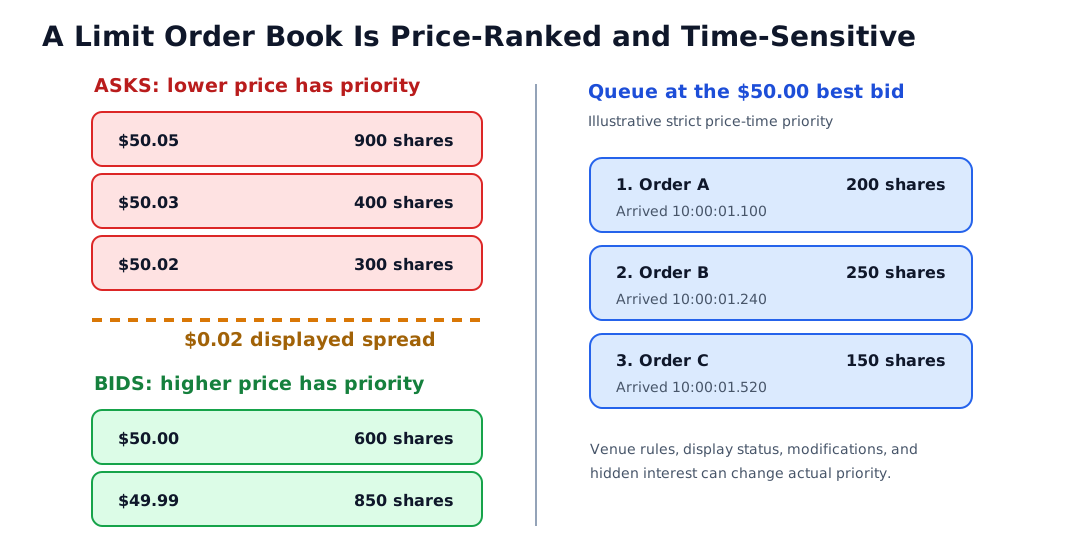
Anatomy of a Limit Order Book
The book has two sides:
| Side | Resting instruction | Better price for that side | Top-of-book level |
|---|---|---|---|
| Bid | Buy at the limit price or lower | Higher bid | Highest bid |
| Ask or offer | Sell at the limit price or higher | Lower ask | Lowest ask |
If the best bid is $50.00 and the best ask is $50.02, the displayed bid-ask spread is:
$50.02 - $50.00 = $0.02 per share
Orders farther from the top form additional levels of Order Book Depth. An order at a better price generally has priority over one at a worse price. Orders at the same price are allocated under the venue’s rules, which may use time, displayed status, participant class, size, pro rata allocation, or a hybrid method.
Worked Example: A Marketable Buy Limit
Assume this simplified displayed sell side exists on one venue immediately before an order arrives:
| Ask price | Displayed quantity | Cumulative quantity |
|---|---|---|
| $50.02 | 300 shares | 300 shares |
| $50.03 | 400 shares | 700 shares |
| $50.05 | 900 shares | 1,600 shares |
A trader submits a buy limit order for 600 shares at $50.03. The limit permits execution at $50.03 or lower, so the order is marketable against the first two ask levels.
If the displayed book remains unchanged and no hidden or higher-priority interest intervenes:
- 300 shares execute at $50.02.
- 300 shares execute at $50.03.
- The order is fully filled.
- 100 displayed shares remain at the $50.03 ask.
The volume-weighted average execution price is:
[(300 x $50.02) + (300 x $50.03)] / 600 = $50.025 per share
The average can contain a fraction of one cent even when each component execution occurs at a permitted tick. The confirmation and account record determine the actual transaction amounts and rounding.
If the same 600-share order had a $50.02 limit, no more than the 300 shares available at $50.02 could execute under this snapshot. The remaining 300 shares could rest as a bid at $50.02, subject to venue, routing, order instructions, and later market events. Reaching a limit price does not guarantee the entire order will fill.
When an Order Rests or Executes
A new order is compared with eligible interest on the opposite side:
- A buy limit priced below the best ask normally cannot execute immediately and may rest as a bid.
- A buy limit priced at or above an available ask is marketable and can remove sell-side liquidity up to its limit.
- A sell limit priced above the best bid may rest as an ask.
- A sell limit priced at or below an available bid can remove buy-side liquidity down to its limit.
A marketable order can trade at multiple prices. If quantity remains after all eligible opposite-side interest within the limit is exhausted, the remainder may rest, route, cancel, or receive other handling according to the order type and instructions.
Price Priority and Queue Priority
Price is usually the first priority dimension. A bid at $50.01 is more aggressive than a bid at $50.00, while an ask at $50.02 is more aggressive than an ask at $50.03.
At one price, the Order Queue determines which eligible interest trades first. Under strict price-time priority, an earlier displayed order generally ranks ahead of a later displayed order at the same price. That rule should not be assumed for every venue or product.
Order modification can also matter. Changing price or increasing quantity may lose time priority under applicable rules. Reserve refreshes, pegged-order repricing, auction transitions, and trading halts can change rank. A depth screen showing total size at a level does not necessarily reveal how much quantity is ahead of one particular order.
Market-by-Price vs. Market-by-Order Data
| Feed view | What it reports | What it helps answer | Main limitation |
|---|---|---|---|
| Market by price, or level book | Aggregate displayed quantity at each price | How much visible depth is posted at a level? | Does not identify each order or exact queue rank |
| Market by order | Individual displayed order additions, changes, executions, and cancellations | How did specific displayed orders change? | Still omits interest outside the feed and some non-displayed liquidity |
| Top of book | Best displayed bid and ask, often with size | What are the current inside prices? | Omits deeper levels |
| Trade feed | Completed transactions | What actually traded? | Does not show unexecuted interest |
The SEC has noted that exchange feeds use different order-based and level-book reporting methods. Metrics derived from one feed format should not be compared mechanically with metrics from another without normalizing their message structures.
Displayed, Hidden, and Reserve Interest
Not every eligible order is fully displayed:
- Displayed order: Visible in the applicable quote or depth feed under the venue’s rules.
- Non-displayed order: Eligible to execute but not shown as ordinary displayed depth.
- Reserve order: Shows a selected portion while retaining additional non-displayed quantity.
- Broker-held order: May remain outside the venue until the broker routes or releases it.
- Off-exchange interest: May execute through a dealer, alternative trading system, or another mechanism not represented in one exchange book.
Visible depth therefore understates some available liquidity. It can also overstate likely liquidity if displayed orders cancel before an incoming order reaches them. The book should be described as conditional, timestamped evidence.
Limit Order Book vs. Related Records
| Record | Core question | Important caveat |
|---|---|---|
| Limit order book | What limit-priced interest is resting and eligible on this venue? | Display and coverage are incomplete |
| Order Book | What buy and sell interest does the market view contain? | May include or describe more than ordinary displayed limit orders |
| Quote | What are the best displayed bid and ask within its coverage? | Shows little or no depth beyond the top |
| Trade tape | What transactions completed? | Historical immediately after each execution |
| Execution report | What happened to one submitted order? | Does not describe every market participant |
How the Book Changes
The limit order book changes whenever an eligible event occurs, including:
- a new order adds quantity;
- an existing order changes price or size;
- an order is canceled or expires;
- an incoming order executes against resting interest;
- a reserve quantity refreshes;
- an order is repriced by a peg or protection rule;
- trading enters an auction or halt state; or
- a correction or system event changes the published record.
A screenshot freezes one state but loses the sequence. For serious analysis, retain timestamps, message order, venue identifiers, and feed documentation.
How to Evaluate Limit-Order-Book Evidence
- Confirm the instrument, venue, session, currency, and timestamp.
- Identify whether the feed is top-of-book, market-by-price, or market-by-order.
- Check whether data are direct, consolidated, real-time, delayed, or sampled.
- Distinguish displayed quantity from hidden, reserve, broker-held, and off-venue interest.
- Review the venue’s priority and order-type rules.
- Compare the proposed order size with cumulative opposite-side depth through its limit.
- Account for additions, cancellations, and latency between observation and arrival.
- Use acknowledgments and execution reports to determine actual fills.
- Separate execution evidence from any claim about value or future direction.
Risks and Common Mistakes
- Whole-market error: Treating one venue’s book as all available demand and supply.
- Displayed-liquidity error: Assuming every eligible order is visible.
- Stability error: Assuming displayed orders will remain until execution.
- Queue error: Treating aggregate size as an exact measure of quantity ahead.
- Intent error: Inferring participant identity or motive from anonymous messages.
- Direction error: Assuming a large bid or ask predicts the next price move.
- Fill error: Assuming a touched limit guarantees a complete execution.
- Valuation error: Treating book shape as evidence of fundamental worth.
- Manipulation claim: Calling ordinary cancellation activity deceptive without evidence of intent and the applicable legal standard.
Public Source Checks
- SEC: Order Book Reporting Methods distinguishes order-based feeds from aggregated level-book reporting and explains why the format affects activity measures.
- SEC: Hidden Volume Ratios explains that continuous markets can include displayed and hidden limit orders and that off-exchange activity is not represented in an exchange book.
- NYSE: Integrated Feed describes an order-by-order venue feed containing depth, trades, imbalances, and status messages.
- Investor.gov: Types of Orders explains price control and execution uncertainty for market, limit, and stop orders.
Related Terms
- Limit Order: Instruction to buy or sell at a specified price or better.
- Order Book Depth: Displayed quantity across multiple price levels.
- Order Queue: Priority among eligible orders at a price.
- Order Imbalance: Excess eligible interest on one side under a defined measurement.
- Market Order: Order that prioritizes execution rather than a fixed limit price.
- Bid-Ask Spread: Difference between the best displayed bid and ask.
FAQs
Does a limit order book show every buy and sell order?
Does every limit order enter the book?
What is the top of the limit order book?
Can a large displayed order disappear?
Educational Use
This article provides general market-structure education. It does not provide personalized investment or trading advice and does not recommend an order, venue, security, or execution strategy.