Transaction Cost
Total explicit and implicit cost of buying, selling, or transferring an asset, including fees, spreads, slippage, and market impact.
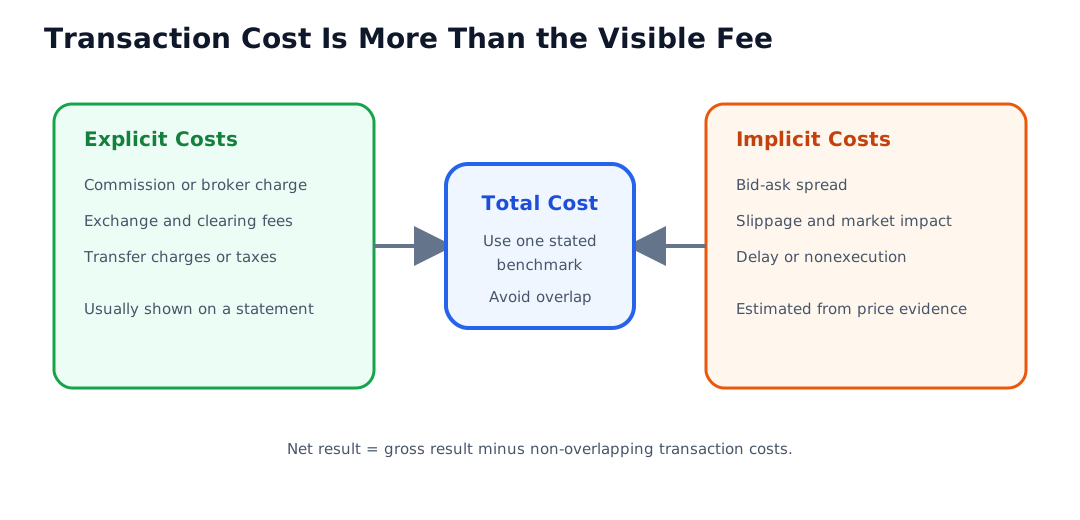
Transaction cost is the total cost of buying, selling, or transferring an asset. In securities markets, it includes explicit costs such as commissions and fees, plus implicit costs such as the Bid-Ask Spread, slippage, and Market Impact.
Transaction costs matter because the return a reader actually earns is the return after trading costs, fund expenses, taxes, and other frictions that apply to the transaction.
Key Takeaways
- Transaction costs can be explicit, like commissions and exchange fees, or implicit, like spread cost and market impact.
- A low commission does not mean a trade is free if the spread, slippage, or tax effect is material.
- Transaction costs are more important for frequent trading, large orders, illiquid assets, and strategies with small expected edges.
Main Types of Transaction Costs
| Cost type | Example | Why it matters |
|---|---|---|
| Commission or brokerage fee | Per-trade fee or platform charge | Directly reduces proceeds or increases purchase cost |
| Bid-ask spread | Buying at the ask and selling at the bid | Hidden in the execution price rather than shown as a line item |
| Exchange or regulatory fee | Venue, clearing, or transaction fee | May vary by market and broker |
| Slippage | Expected price differs from actual fill price | Common in fast or thin markets |
| Market impact | A large order moves the price | Important for institutional or illiquid trades |
| Transaction taxes and transfer charges | Securities transaction tax, stamp duty, transfer tax, recording fee | Depends on asset type and jurisdiction |
Explicit vs. Implicit Costs
| Category | Easy to see? | Examples |
|---|---|---|
| Explicit cost | Usually yes | Commission, account fee, exchange fee, transfer fee, tax charged on the transaction |
| Implicit cost | Often no | Spread, slippage, market impact, delay cost, price concession |
Implicit costs are often the harder part of transaction-cost analysis because they depend on market conditions, order size, Liquidity, and execution quality.
Worked Example: Avoiding Double Counting
Suppose a stock is quoted at $49.98 bid and $50.02 ask, so the midpoint is $50.00. A 500-share buy order fills at an average price of $50.03 and carries a $2 explicit fee.
| Component | Calculation | Estimated cost |
|---|---|---|
| Fill cost versus arrival midpoint | ($50.03 - $50.00) x 500 | $15 |
| Explicit fee | Stated charge | $2 |
| Total measured cost | $15 + $2 | $17 |
The $15 midpoint comparison already captures the execution-price difference around the quote, including the half-spread and any additional slippage embodied in the fill. Adding a separate $10 half-spread estimate would double count part of the same cost. A different benchmark, such as the portfolio manager’s earlier decision price, would answer a broader implementation-cost question and could produce a different result.
Where Transaction Costs Show Up
Transaction costs appear in:
- stock and ETF trades
- bond trades and dealer markups or markdowns
- option and futures trades
- foreign exchange conversions
- mutual fund loads or redemption fees
- real estate sales, mortgage closing costs, and transfer charges
- private-market or alternative investment transactions
The exact cost categories differ by asset, account type, broker, venue, and jurisdiction.
Income and capital-gains taxes can affect an investor’s net result, but they are generally analyzed separately from market-microstructure transaction costs. A transaction tax or stamp duty charged because the trade occurred is more directly part of the transaction-cost calculation. The applicable classification depends on the analytical purpose and jurisdiction.
Common Mistakes
- Counting only commissions: spread, slippage, market impact, and taxes can matter more than the visible fee.
- Ignoring trade size: a small order and a block trade can have very different execution costs.
- Confusing transaction cost with ongoing cost: management fees, custody fees, and fund expense ratios are ongoing costs, not one-time transaction costs.
- Assuming liquidity is stable: a cost estimate from calm markets may fail during stress.
- Using gross return instead of net return: net performance should reflect trading costs that actually apply.
How To Evaluate Transaction Cost
For a securities trade, review:
- commission, broker fee, and exchange or regulatory fees
- bid, ask, and spread at the time of execution
- order type and order size
- Market Depth and recent Trading Volume
- execution price compared with midpoint or benchmark price
- tax or transfer costs that apply to the transaction
This page is educational only. It explains finance concepts and should not be treated as personalized trading, investment, tax, legal, accounting, or regulatory advice.
Sources and Further Reading
- Investor.gov: Understanding Fees
- Investor.gov: How Fees and Expenses Affect Your Investment Portfolio
- Investor.gov: Bid Price/Ask Price
- SEC: Rule 605 of Regulation NMS FAQs
FAQs
Is a zero-commission trade free?
Why do transaction costs matter more for frequent traders?
Are taxes part of transaction cost?
Related Terms
- Bid-Ask Spread: A key implicit trading cost.
- Market Impact: The price movement caused by executing an order.
- Liquidity: The ability to trade or raise cash without large cost or delay.
- Stock Liquidity: Stock-specific evidence from spreads, depth, activity, impact, and resilience.
- Market Efficiency: A broader concept affected by trading frictions.
- Opportunity Cost: The value of the next-best alternative given up.