Working Capital Financing
Working capital financing funds the timing gap between operating cash payments and customer collections through supplier credit, borrowing, or longer-term capital.
Working capital financing is the funding a business uses to cover the timing gap between cash paid for operations and cash collected from customers. It may come from supplier credit, short-term borrowing, receivables or inventory financing, or longer-term capital. It is not limited to short-term debt: a business may use long-term funds for the permanent portion of its operating investment and short-term facilities for seasonal peaks.
Key Takeaways
- Working capital financing addresses a cash-timing need, not necessarily a loss or lack of profitability.
- Trade credit and accrued expenses finance part of the operating cycle before a company borrows from a lender.
- A committed revolving facility can cover variable needs, but availability may depend on covenants, collateral, or a borrowing base.
- Matching longer-term funds with permanent needs and shorter-term funds with temporary peaks can reduce refinancing pressure.
- The cheapest stated rate is not always the lowest-risk source after fees, dilution, recourse, collateral controls, and loss of flexibility are considered.
What Creates a Financing Need?
A business may pay suppliers and employees before customers pay it. Inventory can also remain in production or storage before it is sold. Accounts payable and accrued operating expenses offset part of that need because they defer some cash payments.
An operating view of the amount tied up in the cycle is:
A common analytical version includes trade receivables, inventory, and other operating current assets, less accounts payable, accrued operating expenses, and other operating current liabilities. Cash, short-term investments, bank debt, and current maturities are usually excluded when the purpose is to isolate the operating investment. This differs from broad Working Capital, which uses all current assets minus all current liabilities.
External financing need is not automatically equal to operating working capital. Cash generated by the business, minimum cash reserves, taxes, capital spending, distributions, and existing debt service also affect the amount and timing of funding required.
Permanent and Seasonal Needs
Many businesses have a baseline amount invested in receivables and inventory throughout the year. That is the permanent or core working-capital need. A retailer building stock before a holiday season or a manufacturer buying raw materials before a production run may also have a seasonal or temporary peak.
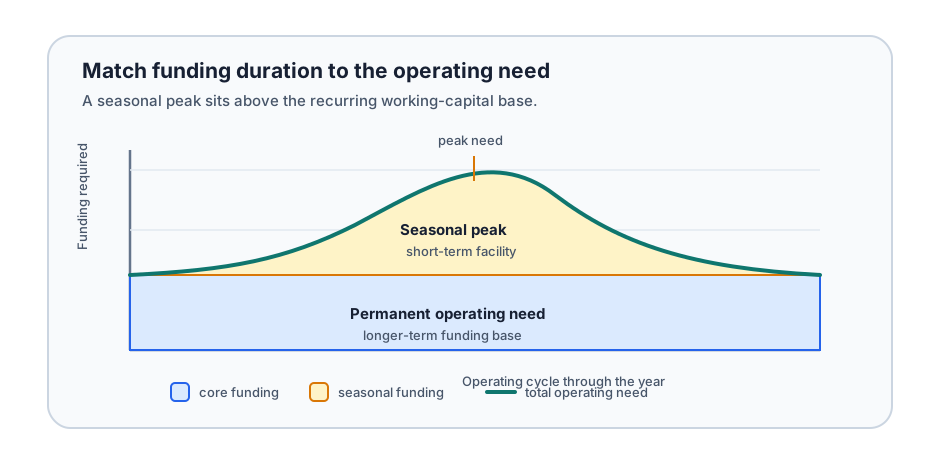
The diagram illustrates maturity matching, not a required financing formula. Actual needs can be volatile, facilities can be withdrawn or constrained, and long-term funding can cost more than short-term borrowing.
Common Sources of Working Capital Financing
| Source | How it supports operations | Important constraints |
|---|---|---|
| Trade Credit | Supplier permits payment after delivery | Discount loss, shorter terms, supplier concentration, relationship risk |
| Revolving credit | Borrower draws and repays within a facility limit | Commitment fee, floating rate, covenants, renewal and draw conditions |
| Overdraft or short-term loan | Covers brief cash deficits or a defined need | Limit can be small; repayment date may not match collections |
| Commercial Paper | Larger issuers obtain short-term market funding | Market access, rollover, rating, and backup-liquidity risk |
| Factoring | Receivables are sold for earlier cash | Fees, dilution, recourse, customer notice, and concentration rules |
| Receivables or inventory lending | Assets support a borrowing base | Eligibility tests, reserves, appraisals, reporting, and collateral controls |
| Long-term debt or equity | Funds the permanent operating investment | Higher duration cost, fixed obligations, or ownership dilution |
Supplier credit is still financing even when no bank loan appears. Extending payment days may preserve cash, but overdue balances should not be presented as an efficiency gain.
Financing Strategies
| Strategy | Typical structure | Main tradeoff |
|---|---|---|
| Matching | Longer-term capital funds the core need; short-term credit funds peaks | Attempts to align funding maturity with the need |
| Conservative | Longer-term capital also funds part of the temporary peak | More liquidity cushion, but potentially higher carrying cost |
| Aggressive | Short-term credit funds some of the permanent need | Potentially lower initial cost, but greater rollover and rate risk |
These labels describe financing posture, not universally suitable choices. Stability of cash flow, lender access, collateral quality, currency, seasonality, and downside scenarios matter more than the label.
Worked Example
Assume a distributor has the following operating balances during a normal month:
- trade receivables: $750,000
- inventory: $600,000
- other operating current assets: $100,000
- accounts payable: $400,000
- accrued operating expenses: $150,000
Operating working capital is:
Before its peak season, receivables and inventory together rise by $500,000, while supplier credit rises by $150,000. The incremental operating need is therefore $350,000, and peak operating working capital becomes $1.25 million.
Suppose retained capital and term funding cover $800,000 of the baseline need. The business could require up to $450,000 from a revolving facility at the seasonal peak, before considering its cash reserve and other cash flows. A facility limit of exactly $450,000 would leave no margin for slower collections, ineligible collateral, inventory write-downs, or an unexpected cost increase.
The example demonstrates a funding gap; it does not determine an appropriate facility size or capital structure.
How to Evaluate the Financing
- Forecast weekly or monthly cash needs through at least one complete seasonal cycle.
- Separate the recurring core need from temporary peaks and one-time uses of cash.
- Reconcile the forecast with receivable aging, inventory reports, payable terms, payroll, taxes, and debt service.
- Test whether facility availability still covers needs after borrowing-base exclusions and lender reserves.
- Model slower collections, weaker sales, margin compression, inventory impairment, and higher interest rates.
- Review covenants, collateral, guarantees, recourse, termination rights, and renewal dates.
- Compare total cost, including commitment fees, unused-line fees, discount loss, legal costs, and operational controls.
- Identify backup liquidity before assuming a short-term instrument can always be rolled over.
Statement and Disclosure Checks
The balance sheet shows the current assets, current liabilities, cash, and debt outstanding at a reporting date. The cash flow statement shows period changes, including operating working-capital movements and financing cash flows. Neither statement alone is a complete liquidity forecast.
For a public company, also review:
- management’s discussion of liquidity and capital resources;
- debt and credit-facility notes, including maturity, rate, collateral, and covenant terms;
- receivables, inventory, supplier-finance, and factoring disclosures;
- unused facility capacity and the conditions required to draw it; and
- subsequent events that could change funding access after period-end.
Risks and Common Mistakes
- Funding permanent needs with overnight or very short maturities: repeated refinancing can fail during market or company stress.
- Confusing a facility limit with available liquidity: borrowing-base rules, covenants, letters of credit, and existing draws can reduce availability.
- Treating delayed payment as free financing: lost discounts, late fees, supply disruption, or reputational damage may exceed the cash benefit.
- Ignoring recourse and dilution in receivables financing: returns, credits, disputes, and concentrated customers can reduce proceeds or create repayment exposure.
- Using a year-end balance as a peak forecast: seasonal businesses can need substantially more cash between reporting dates.
- Financing an operating loss as if it were a timing gap: borrowing can bridge collections, but it does not repair negative unit economics.
- Assuming renewal: a revolving facility with a future maturity date is not permanent capital.
Authoritative Sources
- SEC: Beginners’ Guide to Financial Statements
- SEC: MD&A guidance on liquidity and capital resources
- OCC: Accounts Receivable and Inventory Financing
Related Terms
- Working Capital: The broad current-assets-minus-current-liabilities balance.
- Working Capital Management: Operating discipline that can change the amount and timing of funding required.
- Cash Conversion Cycle: A timing measure for inventory, receivables, and payables.
- Revolving Credit: A reusable borrowing structure often used for variable operating needs.
- Short-Term Debt: Obligations due within a short contractual horizon.
FAQs
Is working capital financing always short term?
Does positive working capital eliminate financing risk?
Is unused revolving credit the same as cash?
This page is educational and does not provide accounting, treasury, lending, legal, or investment advice.