Cash-Flow Statement
The cash-flow statement reconciles beginning and ending cash by classifying period cash movements as operating, investing, or financing activities.
The cash-flow statement, also called the statement of cash flows, explains how an entity’s defined cash total changed during a reporting period. It classifies cash receipts and payments as operating, investing, or financing activities and reconciles the beginning balance with the ending balance.
It complements the Income Statement, which measures accrual-based performance, and the Balance Sheet, which shows financial position at a point in time.
Key Takeaways
- The statement separates cash from operations, long-term investment, and financing with capital providers.
- Profit and operating cash flow differ because accruals, noncash items, and working-capital timing affect them differently.
- Direct versus indirect presentation changes the operating section, not the underlying operating cash total.
- A positive net cash change is not automatically good, and a negative change is not automatically bad.
- Classification policies, restricted cash, noncash transactions, and gross flows must be reviewed with the notes.
The Cash Reconciliation
A simplified statement relationship is:
The defined cash total must follow the applicable reporting framework and the issuer’s disclosed cash perimeter. It may require reconciliation among cash, cash equivalents, and amounts described as Restricted Cash.
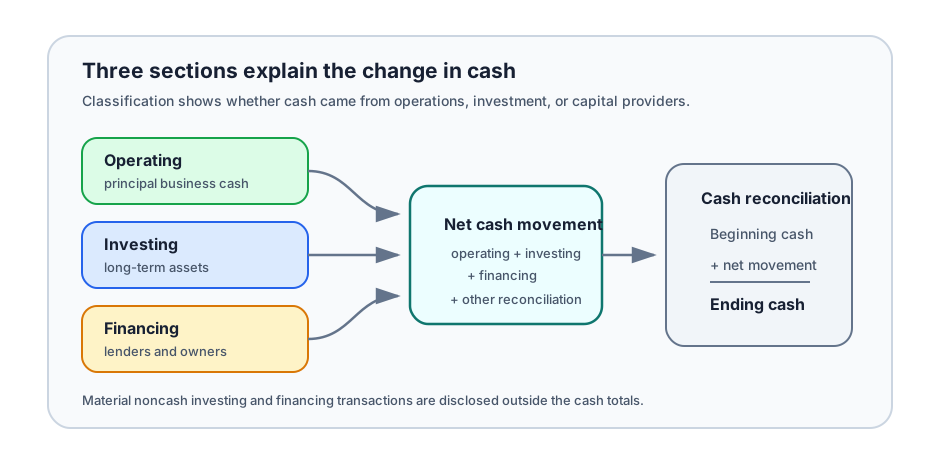
Noncash investing and financing transactions do not enter current cash-flow totals, but material transactions may require separate disclosure.
The Three Cash-Flow Sections
| Section | Main focus | Common examples | Main analytical question |
|---|---|---|---|
| Operating Cash Flow | Principal revenue-producing activities | Customer collections, suppliers, employees, taxes, and operating working capital | Does the business generate cash through its operations? |
| Investing Cash Flow | Long-term assets, investments, and businesses | Capital expenditure, acquisitions, asset sales, and non-cash-equivalent investments | How is cash being invested or recovered from long-term resources? |
| Financing Cash Flow | Contributed equity and borrowings | Debt issuance, principal repayment, share issuance, repurchases, and owner distributions | How did lenders and owners provide or receive cash? |
Classification can depend on the reporting framework, transaction facts, and business model. Interest, dividends, taxes, derivatives, financial-institution activities, and complex transactions require policy-specific review.
Direct vs. Indirect Operating Presentation
| Method | What the operating section presents | What does not change |
|---|---|---|
| Direct | Major classes of gross operating cash receipts and payments | Net operating cash flow for the same facts and policies |
| Indirect | A reconciliation from an accrual-based profit subtotal to operating cash flow | Investing and financing presentation |
The cash-flow statement is not a cash-basis income statement. Both methods operate within accrual-basis financial reporting. The indirect method explains the profit-to-cash bridge, while the direct method shows gross operating receipts and payments more visibly.
Worked Example
Assume a company reports the following cash flows for the year:
| Cash-flow section | Net amount |
|---|---|
| Operating activities | +$420,000 |
| Investing activities | -$310,000 |
| Financing activities | -$85,000 |
| Exchange-rate effect | -$5,000 |
| Net increase in the defined cash total | +$20,000 |
If beginning cash and cash equivalents were $210,000, ending cash is:
The company generated operating cash, invested most of it in long-term assets, and returned more financing cash than it raised. The $20,000 increase alone does not reveal whether the investment was productive, the distributions were sustainable, or ending liquidity was adequate.
Suppose the company also obtained equipment through a new $75,000 lease without paying cash at commencement. The asset and lease liability affect the balance sheet but do not enter the current cash-flow totals. The noncash transaction may be separately disclosed.
Why Profit and Cash Differ
Accrual accounting recognizes revenue and expenses under recognition rules rather than only when cash changes hands. Differences commonly arise from:
- credit sales and customer collections;
- inventory purchases and cost recognition;
- supplier and employee payment timing;
- customer prepayments and deferred revenue;
- depreciation, amortization, impairment, and provisions;
- gains or losses whose cash effects belong outside operations; and
- noncash equity compensation or deferred taxes.
A gap between net income and operating cash flow is not automatically evidence of poor earnings quality. Its cause, persistence, reversibility, and consistency with disclosures determine its significance.
How to Read the Statement
- Reconcile beginning and ending cash to the balance sheet and cash note.
- Confirm what the statement includes as cash, cash equivalents, and restricted cash.
- Compare operating cash flow with net income over several periods.
- Identify the largest noncash and working-capital adjustments.
- Separate capital expenditure, acquisitions, investment purchases, and asset-sale proceeds.
- Review gross debt issuance and repayment rather than only net financing cash flow.
- Identify dividends, repurchases, and equity issuance and determine how they were funded.
- Read noncash, acquisition, debt, lease, supplier-finance, and restricted-cash disclosures.
- Compare reported cash generation with maturities, commitments, and management’s liquidity discussion.
Interpreting Common Cash-Flow Patterns
| Pattern | Possible constructive explanation | Possible warning |
|---|---|---|
| Positive operating, negative investing | Reinvestment in productive assets | Overexpansion or weak capital discipline |
| Negative operating, positive financing | Planned early-stage funding | Dependence on external capital to sustain operations |
| Positive investing | Strategic asset or business disposal | Selling productive assets to meet obligations |
| Negative financing | Debt reduction or supported distributions | Lost refinancing access or excessive cash returns |
| Rising cash despite losses | Capital raise or asset sale | Operating weakness masked by nonoperating inflows |
These are hypotheses, not conclusions. Amounts, purpose, business stage, terms, and repeatability matter.
Cash Flow Statement vs. Free Cash Flow
The statement of cash flows is a required financial statement under applicable reporting rules. Free Cash Flow is usually an analytical or non-GAAP measure derived from selected reported amounts.
A common version subtracts capital expenditure from operating cash flow, but definitions vary. Some measures adjust for acquisitions, leases, asset sales, restructuring, or other items. Reconcile any free-cash-flow measure to the filed statement before comparing companies.
Common Mistakes and Limitations
- Treating the net cash increase as profit: borrowing and asset sales can raise cash without creating operating earnings.
- Calling positive operating cash proof of quality: customer advances or delayed suppliers can temporarily support cash.
- Calling all investing outflows capital expenditure: acquisitions, loans, and investment purchases may also appear.
- Reading only net section totals: offsetting gross inflows and outflows can conceal refinancing or portfolio turnover.
- Ignoring noncash transactions: leases, debt conversions, and shares issued in acquisitions can materially change capital.
- Assuming classification is universal: policies and frameworks can classify selected items differently.
- Treating depreciation as a cash source: an indirect-method add-back reverses a noncash expense; it is not a receipt.
- Using one quarter without seasonality: collections, purchases, taxes, and financing dates can distort short periods.
Authoritative Sources
- SEC: Beginners’ Guide to Financial Statements
- SEC Chief Accountant: Improving the Quality of Cash Flow Information
- IFRS Foundation: IAS 7 Statement of Cash Flows
Related Terms
- Statement of Cash Flows vs. Income Statement: Comparison of cash movements with accrual-based performance.
- Cash and Cash Equivalents: The defined monetary resources reconciled by the statement.
- Working Capital: A major source of differences between profit and operating cash.
- Net Cash Flow: The combined period movement from the cash-flow sections.
- Free Cash Flow: A defined analytical measure commonly derived from operating cash and capital spending.
FAQs
Can a profitable company have negative cash flow?
Does negative investing cash flow indicate distress?
Why does ending cash sometimes differ from the three-section total?
This page is educational and does not provide accounting, audit, tax, legal, lending, or investment advice.