Financial Statement Fraud
Financial statement fraud is an intentional material misstatement or omission designed to deceive users; learn common schemes, warning signs, and evidence.
Financial statement fraud, or fraudulent financial reporting, is an intentional material misstatement or omission in financial statements designed to deceive users. It can involve fabricated transactions, improper recognition, omitted liabilities, biased estimates, misleading disclosures, or management override of otherwise effective controls.
The term must be used carefully. Fraud is a legal concept, and the governing elements depend on jurisdiction and proceeding. Auditing standards focus on intentional acts that cause material misstatement, but auditors do not make the final legal determination that fraud occurred.
Key Takeaways
- Intent distinguishes fraud from an unintentional accounting error.
- A scheme can affect amounts, classifications, estimates, presentation, or disclosures.
- Fraudulent financial reporting and asset misappropriation are distinct fraud categories, but either can produce a material financial-statement misstatement.
- Pressure, opportunity, and rationalization can inform risk assessment; they do not prove a person committed fraud.
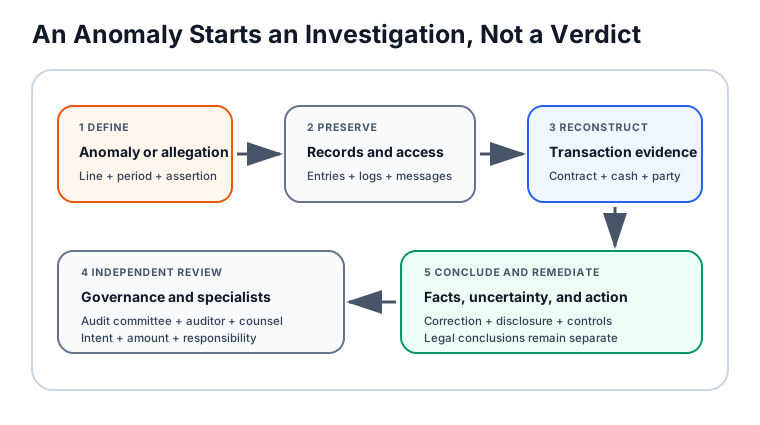
- Ratio changes, statistical anomalies, and whistleblower allegations are leads to investigate, not final evidence.
- An audit provides reasonable, not absolute, assurance that statements are free of material misstatement due to error or fraud.
- Investors should distinguish an allegation, an audit adjustment, a restatement, a regulatory charge, and a final adjudicated finding.
Fraud vs. Error, Bias, and Earnings Management
| Issue | Defining feature | Possible response |
|---|---|---|
| Error | Unintentional mistake or omission | Correct entry, control remediation, possible restatement |
| Estimation uncertainty | Reasonable outcomes differ because evidence is incomplete | Update estimate and disclose material uncertainty |
| Management bias | Estimates or presentation consistently favor a desired result | Expand testing, challenge assumptions, assess aggregate effect |
| Earnings management | Accounting or operating choices influence reported results | Determine whether choices are supportable and disclosure is complete |
| Fraudulent financial reporting | Intentional material misstatement or omission designed to deceive | Investigate, preserve evidence, involve governance and legal specialists |
| Asset misappropriation | Theft or misuse of assets | Quantify loss and determine whether records or statements are misstated |
These categories can overlap. A deliberately unreasonable allowance estimate can cross from bias into fraudulent reporting. Theft concealed through fictitious expenses can become both asset misappropriation and a financial-statement misstatement.
Common Financial Statement Fraud Schemes
Revenue and receivables
Schemes can include fictitious customers, premature recognition, undisclosed side agreements, Channel Stuffing, concealed returns, or recording financing proceeds as sales.
Expenses and liabilities
Management might omit vendor invoices, fail to accrue obligations, capitalize current costs, release reserves without support, or keep liabilities outside the reporting entity.
Assets and valuation
Inventory counts, receivable allowances, impairments, fair values, useful lives, mineral reserves, and acquisition assumptions can be fabricated or intentionally biased.
Disclosures and consolidation
Misstatements can arise from omitted related parties, guarantees, contingencies, subsequent events, concentrations, covenant breaches, or entities that should be consolidated.
Cash flow and non-GAAP presentation
Improper classification can make operating cash flow appear stronger without changing total cash. Misleading non-GAAP measures can obscure recurring costs or change recognition principles, though a problematic non-GAAP presentation is not automatically financial statement fraud.
Worked Example: Fictitious Service Revenue
Assume a company has genuine annual revenue of USD 50 million and pretax income of USD 5 million. Near year-end, an executive directs staff to create USD 4 million of invoices for services that were never ordered or delivered. No related cost is recorded.
| Measure | Actual | Reported after fictitious invoices | Overstatement |
|---|---|---|---|
| Revenue | USD 50 million | USD 54 million | 8% |
| Accounts receivable | Existing balance | Existing balance + USD 4 million | USD 4 million |
| Pretax income | USD 5 million | USD 9 million | 80% |
The same false entry changes revenue, receivables, margin, profit growth, and potentially bonus or covenant outcomes. The profit effect is much larger than the revenue percentage because the fictitious sale has no associated cost.
An investigator would not stop at the arithmetic. Relevant evidence could include customer identity, approved contract, service-delivery records, invoice creation logs, journal-entry access, emails, customer confirmation, later credit notes, cash collection, compensation targets, and who approved the entry. Materiality and legal responsibility require the full context.
Why Fraud Can Be Difficult to Detect
Management override
Senior personnel can authorize journal entries, alter estimates, pressure staff, or bypass controls designed for ordinary transactions.
Collusion
Employees, customers, vendors, or third parties can coordinate documents and explanations, reducing the reliability of evidence that appears independent.
Estimates and judgment
Allowances, valuations, impairment tests, and provisions often have a range of supportable outcomes. Intentional bias may be hidden inside a technically complex model.
Concealment across systems
The accounting entry may appear normal while the contradictory evidence sits in email, a side agreement, shipping data, customer support records, or a different legal entity.
Timing
Temporary entries can be reversed after period end. Future write-offs or cash shortages may emerge only after financial statements are issued.
Warning Signs Are Not Proof
Potential indicators include:
- revenue, receivables, or margins diverging from cash collections and industry demand;
- repeated results just above bonus, covenant, or analyst thresholds;
- large manual entries late in the reporting process;
- reserve releases or estimate changes without operational evidence;
- unusual related-party transactions or counterparties with limited substance;
- turnover in finance leadership, auditors, or control personnel;
- delayed reconciliations, unsupported schedules, or inaccessible records;
- management restricting access to customers, staff, systems, or governance bodies;
- restatements, regulator inquiries, whistleblower complaints, or control deficiencies; and
- transactions with no clear business purpose or inconsistent documentation.
Each indicator has possible legitimate explanations. For example, a new product can increase receivables, a restructuring can create late journal entries, and an acquisition can change margins. Evidence must test competing explanations.
Evidence and Investigation Workflow
- Define the allegation or hypothesis. Identify the statement line, assertion, period, entities, and people potentially involved.
- Preserve information. Protect accounting records, communications, logs, devices, approvals, and document versions under qualified direction.
- Reconstruct the transaction. Link source documents, subledgers, general-ledger entries, bank records, contracts, delivery, and third-party evidence.
- Test intent and knowledge. Review who knew what, when, and what actions or representations followed.
- Quantify possible misstatement. Consider amount, classification, disclosure, periods, tax, covenant, compensation, and market effects.
- Escalate through governance. Independent directors, the audit committee, counsel, auditors, insurers, or regulators may need to act.
- Document conclusions and uncertainty. Distinguish established facts, disputed evidence, assumptions, and applicable standards.
- Correct and remediate. Entries, disclosures, filings, controls, personnel, and prior statements may require action.
Investigations should be independent of implicated personnel and designed with legal, privacy, employment, privilege, and regulatory obligations in mind.
The Auditor’s Role and Limitations
For U.S. public-company audits, PCAOB standards require auditors to plan and perform the audit to obtain reasonable assurance about whether the financial statements are free of material misstatement due to error or fraud. Auditors assess fraud risks, apply professional skepticism, test journal entries and adjustments, review estimates for bias, and consider unusual transactions.
Reasonable assurance is a high level of assurance, not a guarantee. Fraud involving collusion, falsified documents, override, or carefully concealed side agreements can be harder to detect. Management remains responsible for the financial statements and internal control; the audit does not transfer that responsibility.
Statistical Tests and Benford’s Law
Benford’s Law describes an expected first-digit distribution in certain naturally occurring datasets. It can help identify records for review when the dataset is suitable, but it is not a universal fraud detector.
The method may be inappropriate for assigned numbers, prices constrained to a narrow range, small datasets, minimum or maximum values, or data shaped by policy. A deviation does not establish intent, and a fabricated dataset can conform to the expected distribution. Use statistical tests with transaction evidence, not as a verdict.
How Investors Should Read Fraud-Related Events
Check the procedural status and primary documents:
- an allegation has not necessarily been substantiated;
- an audit adjustment may correct an error before issuance;
- a restatement identifies unreliable prior reporting but does not by itself prove fraud;
- a material weakness concerns internal control and does not necessarily mean a material misstatement occurred;
- a regulatory complaint or charge states allegations to be tested through the relevant process; and
- a settlement or order must be read for admissions, findings, parties, periods, and scope.
Then assess which historical numbers can still be used, whether management and controls changed, how cash and debt are affected, and what uncertainty remains. A stock-price decline or recovery does not establish accounting accuracy.
Prevention and Detection Controls
- independent audit-committee oversight and direct access to internal and external auditors;
- clear revenue, estimate, journal-entry, consolidation, and disclosure controls;
- segregation of duties and access monitoring;
- reconciliations between operational, subledger, general-ledger, tax, and bank data;
- protected reporting channels and anti-retaliation procedures;
- conflict, related-party, vendor, and customer due diligence;
- review of compensation pressure and override risk;
- data analytics followed by documented investigation; and
- timely remediation, accountability, and retesting.
Controls reduce risk but cannot eliminate every intentional scheme.
Common Mistakes
Calling every accounting error fraud. Intent must be evaluated separately from whether a number is wrong.
Assuming an unqualified audit opinion guarantees no fraud. Audits provide reasonable assurance within a materiality framework.
Treating ratios or Benford results as proof. Analytics identify unusual items; documents, people, transactions, and governing standards establish facts.
Repeating scandal summaries without primary records. Amounts, parties, allegations, and outcomes should come from filed complaints, orders, judgments, or corrected statements.
Ignoring disclosure fraud. A materially misleading omission can matter even when arithmetic totals are unchanged.
Assuming a restatement proves intent. Restatements can result from errors, changing interpretations, or control failures without established fraud.
Official Sources
- PCAOB: AS 2401, Consideration of Fraud in a Financial Statement Audit defines fraud for audit purposes and addresses risk assessment, management override, evidence, communication, and documentation.
- PCAOB: AS 2201, An Audit of Internal Control Over Financial Reporting explains internal-control objectives, material weaknesses, and integrated-audit responsibilities.
- SEC: Beginners’ Guide to Financial Statements explains the core statements, notes, and auditor’s report.
- SEC: Financial Reporting and Accounting Fraud describes common enforcement concerns including revenue recognition and auditor independence.
Related Terms
- Channel Stuffing: Excess distributor shipments that require contract, recognition, return, and demand analysis.
- Earnings Management: Accounting or operating choices intended to influence reported performance.
- Revenue Recognition: The framework for recognizing customer-contract revenue.
- Material Misstatement: An error or omission important enough to affect user decisions under the applicable materiality framework.
- Internal Control: Processes designed to support reporting, operational, and compliance objectives.
- Restatement: Revision of previously issued financial statements when specified corrections are required.
- Quality of Earnings: Analysis of earnings persistence, cash conversion, estimates, and transparency.
FAQs
What is the difference between fraud and an accounting error?
Does a restatement mean management committed fraud?
Can an audit guarantee that financial statements contain no fraud?
Can Benford's Law prove financial statement fraud?
This article provides general financial-reporting, audit, and fraud-risk education, not accounting, audit, forensic, legal, enforcement, or investment advice. Specific conclusions require complete evidence and the governing professional and legal standards.