Interest Rate Futures
Interest rate futures are standardized contracts tied to rates or rate-sensitive debt instruments, used to hedge funding, duration, and yield-curve exposure.
Interest rate futures are standardized, exchange-traded contracts whose value is tied to an interest rate, a rate index, or a rate-sensitive debt instrument. They let market participants hedge or take exposure to future rate changes without making the underlying loan, deposit, or bond transaction at the time the futures position is opened.
The category includes cash-settled short-term rate futures and deliverable government bond futures. Those products can move in different quote formats, so “rates rose” is not enough to determine a gain or loss without identifying the exact contract.
Key Takeaways
- Many short-term rate futures use an inverse quote such as
100 - annualized rate, so a higher expected rate means a lower futures price. - Bond futures are price-quoted and generally fall when the relevant bond yields rise.
- Futures margin is a performance bond; it is not the notional principal of a loan or the maximum possible loss.
- A futures hedge offsets the contract’s specified rate exposure, not every component of a borrower’s funding cost or a portfolio’s return.
- Futures-implied rates reflect current pricing and contract conventions, not certain forecasts of future central-bank decisions or realized rates.
- Daily variation settlement can create a cash need before an offsetting loan, deposit, or bond benefit is realized.
- Current exchange rules control the benchmark, observation period, multiplier, tick, margin, expiration, and final-settlement method.
Main Types
| Contract type | Underlying or settlement reference | Typical quote relationship | Primary hedge use |
|---|---|---|---|
| Overnight-rate future | Average or compounded overnight benchmark for a stated period | Often 100 - rate | Future floating-rate or policy-sensitive exposure |
| Short-term term-rate future | Specified money-market rate for a future period | Often 100 - rate | Borrowing, lending, or reset exposure |
| Government bond future | Deliverable basket of eligible notes or bonds | Bond-price style quote | Duration and yield exposure |
| Other rate-index future | Contract-specific rate, spread, or index | Defined by exchange | Targeted benchmark or curve exposure |
Currency futures are not normally classified as interest rate futures even though interest-rate differentials influence FX pricing.
Futures Rate and 100 - Rate Quoting
A futures rate is the rate implied by an interest-rate futures quote after applying the contract’s quotation and settlement convention. It is not a separate guaranteed rate or a promise that the benchmark will equal that level later.
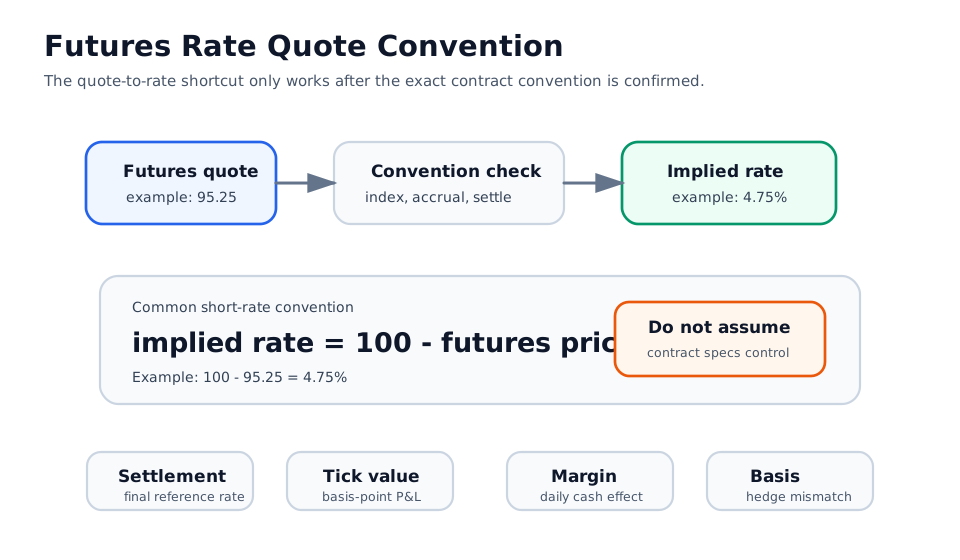
For a contract using an IMM-style inverse quote:
If the quoted futures price is 95.00, the corresponding rate is 5.00%. If the expected or realized contract rate rises to 5.20%, the price falls to 94.80.
| Rate movement | Futures-price movement | Position that gains |
|---|---|---|
| Rate rises | Price falls | Short futures |
| Rate falls | Price rises | Long futures |
This inverse relationship applies only to contracts using that quote convention. Read the product specification before applying it.
The quoted rate should also be distinguished from the contract’s final settlement rate. Depending on the product, settlement may use an average or compounded benchmark over a defined observation period rather than one rate observed on one day.
Worked Short-Term Rate Example
Assume a hypothetical 100 - rate futures contract is priced at 95.00, implying 5.00%. New information moves the implied rate to 5.20%, so the futures price falls to 94.80.
The move is 20 basis points. If the contract’s value is $25 per full basis-point move, one short contract gains:
One long contract loses $500, before fees. The $25 value is an assumption for this example; actual contract multipliers and tick values come from the exchange specification.
Basis-Point Value and Contract Sensitivity
The basis-point value of a contract is the approximate money gain or loss from a one-basis-point change in the rate represented by the futures price. One basis point is 0.01%, or 0.0001 in decimal form.
For an inverse-quoted short-term rate future, a rate increase generally lowers the futures price. If the contract is worth $25 per basis point:
| Rate change | Long contract | Short contract |
|---|---|---|
| Rate rises 1 bp | Loses about $25 | Gains about $25 |
| Rate falls 1 bp | Gains about $25 | Loses about $25 |
| Rate rises 20 bp | Loses about $500 | Gains about $500 |
The actual relationship is defined by the contract’s multiplier, tick, rate period, and settlement formula. A trader should calculate the cash value from the current exchange specification rather than assume every rate future uses the same basis-point value.
For a simple-interest cash exposure, a first-pass basis-point value is:
This approximation must use the exposure’s actual day-count convention and accrual period. Compounded overnight rates, amortizing balances, caps, floors, and irregular dates require more detailed modeling.
Borrower and Lender Hedge Direction
Future borrower concerned about rising rates
A borrower expecting a benchmark-linked loan in the future may sell an inverse-quoted rate future. If the benchmark rises, the futures price falls and the short position gains, offsetting part of the higher borrowing cost.
The hedge can miss if the loan amount, start date, accrual period, benchmark, credit spread, or day-count convention differs from the futures contract.
Worked Example: Future Borrowing Cost
Assume a company expects to borrow $20 million for 90 days in six months. Its interest cost will be based on a market benchmark plus the company’s credit spread. The company wants to reduce its exposure to a benchmark-rate increase, and the selected inverse-quoted futures contract is assumed to be worth $25 per basis point.
Using a 90/360 year fraction, the borrowing exposure’s approximate basis-point value is:
The first-pass hedge count is:
If the relevant benchmark rises by 40 basis points and the futures position responds exactly as assumed:
- the loan’s 90-day benchmark interest increases by approximately
40 x $500 = $20,000; and - the 20 short futures gain approximately
40 x $25 x 20 = $20,000.
The simplified benchmark-rate effects offset before fees and timing differences. The hedge does not fix the company’s credit spread, commitment fees, lender terms, or total borrowing cost.
If the company borrows only $15 million, delays the borrowing, uses a different benchmark, or keeps the loan longer than 90 days, the futures position can over-hedge or under-hedge the actual exposure. The hedge should be resized or closed when the forecast changes.
Lender or investor concerned about falling rates
A lender expecting to invest cash at a future floating rate may buy an inverse-quoted rate future. If rates fall, the futures price rises and the long position gains, offsetting part of the lower interest income.
The exact direction differs for price-quoted bond futures and for exposures with embedded options. Always map the contract price to the underlying rate before trading or documenting a hedge.
Margin and Cash-Flow Timing
Interest rate futures are marked to market through daily settlement. A favorable move credits the futures account, while an adverse move creates a debit and can require additional cash. The related loan, deposit, or bond position may not produce its offsetting economic benefit at the same time.
Worked Example: Economically Helpful, Cash-Flow Negative
Continue the borrowing example with 20 short contracts worth $25 per basis point. Instead of rising, the futures-implied rate falls by 30 basis points.
The approximate futures loss is:
The lower benchmark may reduce the company’s future 90-day interest expense by about $15,000, but that saving occurs after the loan begins and interest accrues. The futures loss is settled through the margin process earlier. The hedge may be working economically while creating a short-term liquidity need.
This timing difference should be included in treasury forecasts. Initial margin is not the contract’s purchase price, and losses can exceed the amount initially deposited.
Contract Period and Final Settlement
A short-term rate future normally refers to a defined rate and observation period. Depending on the contract, final settlement may use:
- a rate observed on a specified date;
- an arithmetic average over a period;
- a compounded overnight rate over a period; or
- another exchange-defined calculation.
For a contract based on an average or compounded overnight rate, part of the final result becomes known as daily benchmark observations occur. The remaining portion continues to reflect rates for days not yet observed. A displayed implied rate during this period is therefore a blend of known and market-implied inputs under the contract formula.
Calendar dates matter. Weekends, holidays, publication conventions, day counts, lookbacks, and the weighting of individual observations can affect settlement. The official contract rule, not a shorthand market label, determines the cash amount.
Futures-Implied Rate Is Not a Forecast
Before the settlement period begins, a short-term rate futures price reflects market trading around the rate expected under the contract’s methodology. The price can also reflect risk premiums, liquidity, convexity, technical positioning, and transaction constraints.
Once an averaging or compounding period has started, the final contract rate may combine:
- benchmark observations already known for elapsed days; and
- market-implied rates for the remaining days.
For those reasons, a futures-implied rate is a pricing input, not a guaranteed future benchmark or a probability-free prediction.
Single Contracts, Strips, and Curve Spreads
A single contract isolates one listed settlement period. An exposure extending across several periods may require a strip of futures, with contract weights based on the principal, accrual period, and sensitivity in each interval.
| Position structure | General purpose | Main control issue |
|---|---|---|
| Single contract | Target one future rate period | Date and benchmark mismatch |
| Futures strip | Cover a sequence of future periods | Weighting, gaps, rolls, and changing principal |
| Calendar spread | Trade or hedge the relationship between two periods | Both legs can move and the spread can widen unexpectedly |
| Curve package | Adjust exposure across several maturities | Key-rate sensitivity and correlation assumptions |
A view that the yield curve will steepen or flatten does not by itself specify which contracts to buy or sell. Because many short-term rate futures use inverse prices, the direction must be translated from rate changes into price changes for every leg. Contract basis-point values may also differ, so equal contract counts do not necessarily create a sensitivity-neutral spread.
Hedging a Series of Rate Resets
Suppose a borrower has a one-year floating-rate loan that resets every three months. One futures contract tied to a single future quarter does not cover all four reset periods. A more complete hedge could require separate positions aligned with the relevant periods.
The hedge record should map:
| Exposure detail | Futures detail to compare |
|---|---|
| Principal expected in each period | Contract notional or basis-point value |
| Reset and accrual dates | Contract observation and settlement period |
| Loan benchmark | Futures reference benchmark |
| Day-count and compounding | Contract calculation method |
| Borrower credit spread | Usually remains outside the benchmark hedge |
| Payment timing | Daily futures cash flows versus loan interest dates |
If the loan amortizes, is prepaid, or changes benchmark, an unchanged futures strip can become an unintended rate position.
Interest Rate Futures vs. FRA vs. Swap
| Feature | Interest rate future | Forward-rate agreement | Interest rate swap |
|---|---|---|---|
| Venue | Exchange-traded | Usually OTC | OTC or cleared |
| Terms | Standardized | Customized single future period | Customized or standardized series of periods |
| Cash flows | Daily variation margin and final settlement | Usually one net settlement | Multiple fixed/floating settlements |
| Credit structure | Generally centrally cleared | Counterparty and collateral terms | Counterparty or clearing terms |
| Main mismatch | Contract dates, quote, and benchmark | Reference rate and borrowing terms | Curve, tenor, reset, and basis |
| Exit | Offset in listed contract | Negotiated closeout or offset | Termination or offsetting swap |
A Forward-Rate Agreement and a futures contract can hedge similar rate periods, but daily margin cash flows and standardized dates can produce different economic results.
The instruments also differ in valuation and credit structure. A futures price reflects daily settlement and standardized contract terms. An FRA or swap can be customized, but its collateral, counterparty, documentation, and closeout terms require separate review. Similar stated rate exposure does not guarantee identical value changes.
Bond Futures Within the Category
Bond Futures are interest rate futures whose price is linked to eligible debt securities. For a long-duration bond exposure:
- yields rise -> bond and bond-futures prices generally fall;
- yields fall -> bond and bond-futures prices generally rise; and
- a short bond-futures position can reduce exposure to rising yields.
Deliverable baskets, conversion factors, cheapest-to-deliver securities, repo financing, and curve basis make bond futures more complex than a simple 100 - rate quote.
Risks and Limitations
- Quote-direction risk: A rate view can be implemented backward if the contract’s price convention is misunderstood.
- Basis risk: The futures benchmark, dates, or tenor may not match the actual loan, deposit, swap, or bond.
- Spread risk: A borrower’s credit or liquidity spread can change independently of the reference rate.
- Margin liquidity: A valid long-term hedge can require cash after adverse daily price moves.
- Curve risk: Different maturities can move by different amounts or in opposite directions.
- Convexity and model risk: Futures and OTC rates can differ because their cash-flow timing and valuation are not identical.
- Roll risk: Maintaining exposure requires moving into a later contract at the prevailing spread.
- Benchmark risk: Methodology, publication, fallback, or market structure can change.
- Operational risk: Contract month, multiplier, tick, sign, or settlement-period errors can invalidate the hedge.
Common Mistakes
- Buying an inverse-quoted contract to hedge a future borrower against rising rates when the required direction is short.
- Treating
100 - futures priceas a guaranteed forecast rather than a contract-implied rate. - Matching notional principal while ignoring accrual period and basis-point value.
- Hedging a benchmark rate but claiming the borrower’s credit spread is fixed too.
- Using one contract month for a loan or investment with several reset periods.
- Ignoring daily margin cash flows because the hedge is expected to offset at maturity.
- Applying a short-term
100 - raterule to a price-quoted bond future without checking the specification. - Relying on an old multiplier, tick value, observation period, or broker margin requirement.
Evaluation Checklist
- Identify the exact exchange, product, contract month, benchmark, and final-settlement period.
- Confirm whether the quote is price-based,
100 - rate, or another convention. - Calculate tick value and basis-point value from the current contract specification.
- Map the underlying principal, dates, accrual, benchmark, and sensitivity to the futures position.
- Separate benchmark-rate risk from credit spread, liquidity, option, and other risks.
- Stress rate moves, curve changes, basis changes, and daily margin requirements.
- Rebalance for changes in forecast borrowing, deposits, bond holdings, or reset schedules.
- Reconcile futures gains and losses with the underlying exposure and all transaction costs.
Authoritative Sources
- The CFTC Futures Glossary defines interest rate futures as contracts on fixed-income securities or specified interest-rate levels.
- The CFTC explanation of futures-market purpose explains standardization, clearing, margin, daily marking to market, and hedging.
- CME Group’s Understanding SOFR Futures illustrates the
100 - rateconvention and explains how a contract transitions from expected to realized benchmark observations. - The Federal Reserve Bank of New York’s reference-rate information provides methodology and publication information for SOFR and related rates.
Contract specifications and margin requirements can change. Use the current exchange rulebook, broker agreement, and benchmark administrator’s methodology for an actual position.
This page is for financial education only. It does not forecast interest rates or recommend a futures, FRA, swap, bond, borrowing, or hedging strategy. Interest rate futures can create losses beyond initial margin and may not match the exposure being hedged.
Knowledge Check
FAQs
Why do many interest rate futures rise when rates fall?
100 - rate pricing, so a lower rate produces a higher futures quote. Bond futures also generally rise when yields fall because bond prices and yields move inversely.Does an interest rate futures position create a loan?
Can a futures price predict the next policy rate exactly?
How many interest rate futures are needed for a hedge?
Does a rate futures hedge fix a borrower's credit spread?
What is a futures strip?
Related Terms
- Futures Contract: The standardized exchange-traded contract structure.
- Forward Rate: A future-period rate implied by today’s yield curve.
- Interest Rate Swap: A multi-period fixed-versus-floating rate derivative.
- Basis Risk: The risk that the futures hedge and actual exposure do not move together.
- SOFR: A U.S. overnight reference rate used in rate markets.
- Basis Point: One-hundredth of one percentage point, used to express rate changes and contract sensitivity.
- Hedge Ratio: The quantity relationship used to size a derivative against an exposure.
- Margin: Collateral supporting futures obligations rather than the contract’s notional principal.