Excess Reserves
Excess reserves are qualifying bank reserves above the applicable required amount; they are not necessarily idle or economically surplus.
Excess reserves are a bank’s qualifying reserve holdings above the amount required by the applicable reserve rule. The term is arithmetic, not a judgment that the balances are idle, unnecessary, or available to be lent directly to customers.
Key Takeaways
- Excess reserves equal actual qualifying reserves minus required reserves, subject to the reporting definition.
- If the required reserve ratio is zero, all reserve balances can be classified as excess under the formula.
- Banks may still need those balances for settlement, liquidity, collateral, and internal risk management.
- “Excess reserves” and “excess liquidity” are not interchangeable across central-bank frameworks.
- Interest paid on reserve balances can affect banks’ demand for reserves and overnight market rates.
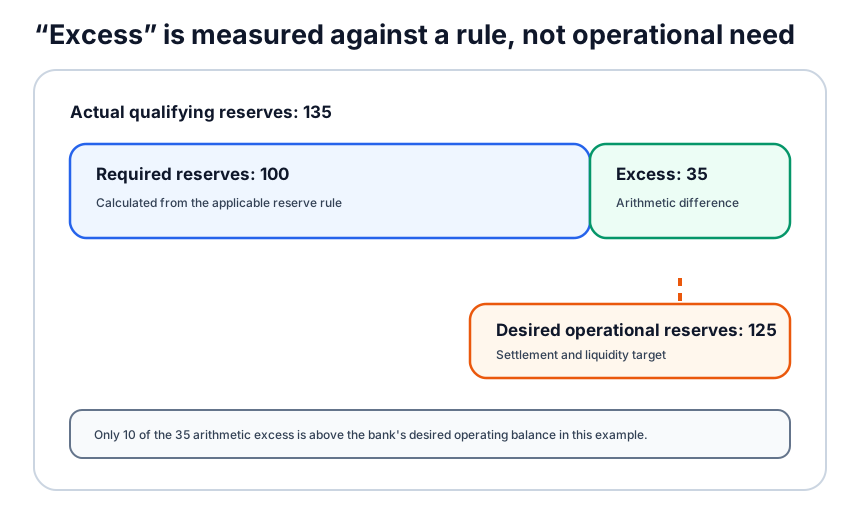
Worked Example: Required vs. Operational Reserves
If a bank maintains 135 million of qualifying reserves and its calculated Reserve Requirement is 100 million:
The bank has 35 million of excess reserves under that definition.
Now assume the required amount is zero. The arithmetic classifies all 135 million as excess, even if the bank considers 120 million necessary for payments and liquidity. This is why “excess” should not be read as “unneeded.”
Required, Excess, and Desired Reserves
| Measure | Meaning |
|---|---|
| Required reserves | Regulatory minimum calculated under the reserve rule |
| Actual reserves | Qualifying reserves the bank maintains |
| Excess reserves | Actual reserves above the required amount |
| Desired reserves | Balance the bank chooses for settlement, liquidity, and risk |
| Surplus to desired reserves | Actual reserves above the bank’s own operational target |
Only the first three are needed for the regulatory excess-reserve calculation. A bank can have excess reserves while holding less than its desired operational balance.
Why Banks Hold Reserves Above the Minimum
- settle customer and interbank payments
- cover uncertain payment outflows
- meet intraday liquidity needs
- satisfy internal liquidity limits
- reduce dependence on volatile market funding
- preserve flexibility around collateral and central-bank operations
- earn interest on eligible central-bank balances
- respond to stress or payment-system disruption
The motivation can change with market conditions. High balances during stress may reflect precaution rather than a lack of lending opportunities.
Zero-Requirement Systems
The Federal Reserve’s reserve-requirements page states that U.S. reserve requirement ratios have been zero since March 26, 2020. The Federal Reserve now pays one interest rate on eligible reserve balances, described on its Interest on Reserve Balances page.
In that framework:
- required reserves under the ordinary ratio are zero
- reserve balances still exist
- balances remain important for settlement and policy implementation
- older “required versus excess” series may not describe the current operating system well
Analysts often use reserve balances or discuss ample reserves rather than interpreting every balance as economically excess.
Positive-Requirement Systems
The ECB’s minimum-reserves framework publishes required reserves, current-account holdings, excess reserves, remuneration, and deficiencies for covered euro-area institutions.
That framework illustrates the direct arithmetic:
1current-account holdings
2- average reserve requirements
3= reported excess reserves
The exact calculation still depends on the maintenance period, averaging rules, eligible accounts, and published methodology.
Excess Reserves and Payment Settlement
Bank Reserves transfer between banks when payments settle.
If a customer at Bank A pays a customer at Bank B:
- Bank A’s reserve balance falls
- Bank B’s reserve balance rises
- aggregate reserves are unchanged
- each bank’s excess position can change
Bank A may move from excess to deficient while Bank B gains excess reserves. Distribution matters even when the system total is stable.
Excess Reserves and Bank Lending
Banks do not normally lend reserve balances directly to households or companies. A bank loan creates a customer deposit; reserve balances move when resulting payments settle with other banks.
Excess reserves can influence:
- the marginal value of liquidity
- interbank borrowing demand
- short-term funding rates
- the attractiveness of central-bank remuneration
- willingness to absorb payment outflows
They do not impose a fixed loan multiplier. Lending also depends on capital, risk, borrower demand, profitability, funding, and regulation.
Interest on Reserve Balances
When a central bank pays interest on reserves, the administered rate can establish a reference return for banks. A bank compares:
- the central-bank rate
- unsecured and secured overnight rates
- collateral and counterparty risk
- balance-sheet and regulatory costs
- expected payment needs
The Federal Reserve’s IORB FAQ explains reserve balances as bank assets and Federal Reserve liabilities and describes the policy role of the interest rate.
Interest can make banks willing to hold large reserve balances without treating them as a zero-return tax.
Excess Reserves vs. Excess Liquidity
The terms can refer to different measures:
| Term | Possible meaning |
|---|---|
| Excess reserves | Institution-level reserves above its requirement |
| Aggregate excess reserves | Sum of institution-level excess amounts |
| Excess liquidity | Central-bank-system measure based on autonomous factors, facilities, and reserve needs |
| Ample reserves | Operating regime in which reserve supply remains above the level needed for effective rate control |
| Surplus cash | Corporate or treasury cash above an internal target; not a central-bank reserve concept |
Always use the central bank’s methodology when interpreting a published excess-liquidity figure.
How to Analyze Excess Reserves
- Identify the reserve requirement and its effective date.
- Confirm what counts as actual qualifying reserves.
- Match computation and maintenance periods.
- Determine whether balances are daily or averaged.
- Check whether vault cash is included.
- Review interest paid on required and excess balances.
- Compare actual reserves with the bank’s desired operational balance.
- Examine distribution across institutions, not only the aggregate.
- Relate reserve levels to overnight rates and central-bank facilities.
Risks and Limitations
- Misleading label: “Excess” can imply economic redundancy that the formula does not establish.
- Zero-requirement distortion: All balances can appear excess when the required amount is zero.
- Aggregation risk: System-wide abundance can conceal shortages at individual banks.
- Timing risk: Maintenance-period averages can conceal daily or intraday stress.
- Definition changes: Data series can change when reserve frameworks are redesigned.
- Interest-rate sensitivity: Remuneration changes bank income and reserve demand.
- Lending inference: High excess reserves do not prove banks are unwilling or unable to lend.
- Cross-country comparability: Requirements, eligible accounts, and liquidity frameworks differ.
Common Mistakes
- Treating excess reserves as cash sitting unused in a vault.
- Assuming banks can hand central-bank reserve balances directly to customers.
- Interpreting all reserves above zero as surplus liquidity.
- Comparing current data with a discontinued or differently defined historical series.
- Ignoring reserve remuneration.
- Assuming high excess reserves guarantee bank solvency.
- Treating aggregate excess reserves as equally distributed.
- Applying a U.S. definition to another central-bank system.
Related Terms
- Bank Reserves: Central-bank balances used for settlement and liquidity.
- Reserve Requirement: The rule determining required reserves.
- Borrowed Reserves: Reserve balances supplied through central-bank credit.
- Federal Funds Rate: The U.S. overnight unsecured rate on reserve-balance transactions between eligible institutions.
- Liquidity: The ability to meet obligations or transact without excessive cost.
FAQs
Are excess reserves unused money?
If reserve requirements are zero, are all reserves excess?
Do excess reserves prevent a bank from lending?
This article is educational and does not provide banking, investment, legal, or regulatory advice. Reserve frameworks and terminology can change; verify current official sources.