Bank Reserves
Bank reserves are commercial banks' balances at the central bank, plus vault cash where the applicable definition includes it, used for settlement and liquidity.
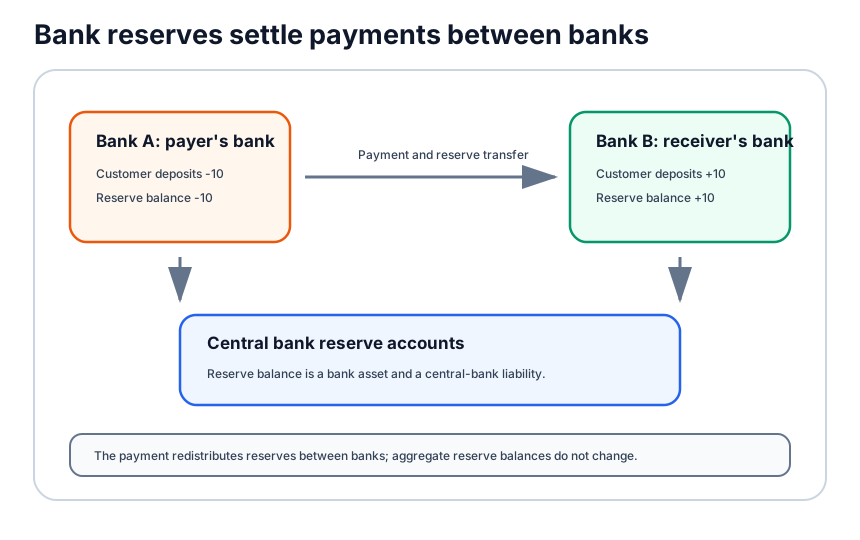
Bank reserves are balances that eligible banks hold at the central bank; some regulatory definitions also include qualifying vault cash. Reserve balances are assets of commercial banks and liabilities of the central bank, and they are used to settle interbank payments, manage liquidity, and implement monetary policy.
Key Takeaways
- Bank reserves are not the same as customer deposits, bank capital, or a country’s international reserves.
- A bank payment transfers reserve balances between banks; it does not normally change aggregate reserves by itself.
- Reserve requirements can influence how much a bank must hold, but banks can hold reserves even when the required ratio is zero.
- The central bank changes aggregate reserve supply through asset purchases and sales, lending, repos, and other balance-sheet operations.
- Reserve abundance affects money-market rates and payment settlement, but does not mechanically determine bank lending or broad money.
Reserve Balances on Two Balance Sheets
The same reserve balance appears differently to each party:
| Entity | Balance-sheet classification |
|---|---|
| Commercial bank | Asset: balance held at the central bank |
| Central bank | Liability: reserve balance owed to the commercial bank |
For the Federal Reserve, the Board’s Interest on Reserve Balances FAQ explicitly describes reserves as Federal Reserve liabilities and depository-institution assets.
Vault cash requires separate attention. Some reserve-requirement systems allow qualifying vault cash to satisfy a required amount, but operational discussions often use “reserves” to mean balances in central-bank accounts. Always check the definition behind the data.
How Reserves Settle a Payment
Assume a customer of Bank A sends 10 million to a customer of Bank B.
| Balance | Bank A | Bank B |
|---|---|---|
| Customer deposits | -10 million | +10 million |
| Reserve balances | -10 million | +10 million |
The payment reduces Bank A’s reserve balance and increases Bank B’s. Aggregate reserve balances across the two banks are unchanged.
Bank A must fund the outflow if its remaining reserves are below its operational target. It can:
- receive incoming payments
- borrow reserves in the interbank market
- sell or repo eligible securities
- attract other funding
- borrow from a central-bank facility
The reserve transfer settles the interbank obligation. It is not a movement of physical cash between the two customers.
Worked Example: Payment Outflow and Overnight Funding
Suppose Bank A begins the day with 18 million in reserve balances and an internal operating target of 12 million. A customer payment sends 10 million to Bank B, reducing Bank A’s reserve balance to 8 million.
Bank A is now 4 million below its target. It borrows 4 million overnight from Bank C in an unsecured federal funds transaction. After settlement:
| Bank | Reserve change from customer payment | Reserve change from overnight loan | Ending position explained |
|---|---|---|---|
| Bank A | -10 million | +4 million | 12 million, equal to its target |
| Bank B | +10 million | None | Received the customer’s payment |
| Bank C | None | -4 million | Exchanged reserves for a federal funds loan asset |
The payment and loan redistribute reserves; neither transaction changes the banking system’s aggregate reserve balance. If the hypothetical federal funds rate is 4.35% and the parties use a one-day Actual/360 calculation, Bank A’s overnight interest is approximately:
4,000,000 x 4.35% x 1 / 360 = 483.33
The quoted rate, day-count convention, settlement date, and reporting treatment must be verified for an actual transaction.
What Changes Aggregate Reserves?
Private payments redistribute reserves among banks. The central bank and government-related flows generally change the aggregate.
Operations That Can Add Reserves
- central-bank purchases of securities or foreign currency
- central-bank loans and repos
- payments from a government’s central-bank account into commercial banks
- redemption of central-bank bills or liquidity-absorbing deposits
Operations That Can Drain Reserves
- central-bank sales of securities
- repayment of central-bank loans or repos
- tax receipts transferred from banks to a government’s central-bank account
- issuance of central-bank bills or term deposits
- increased public demand for banknotes, depending on the balance-sheet flow
The New York Fed’s monetary-policy implementation overview explains how asset purchases and reserve-management operations affect reserve supply.
Required, Excess, and Desired Reserves
| Measure | Meaning |
|---|---|
| Required reserves | Amount required under the applicable reserve rule |
| Excess Reserves | Reserve amount above a measured requirement |
| Desired reserves | Amount a bank chooses to hold for settlement, liquidity, and risk management |
| Aggregate reserves | Total reserve balances across eligible institutions, subject to the source’s scope |
Excess and desired reserves are not necessarily the same. If the required ratio is zero, all reserve balances can be “excess” under the arithmetic definition even though banks need them for daily payments and liquidity risk.
See Reserve Requirement for the rule and calculation.
Reserve Requirements Are Jurisdiction-Specific
Some central banks impose positive minimum reserve ratios. Others use zero ratios or different liquidity frameworks.
For example:
- The Federal Reserve’s reserve-requirements page states that U.S. reserve requirement ratios have been zero since March 26, 2020.
- The ECB’s minimum-reserves framework requires covered euro-area credit institutions to hold deposits with their national central bank.
These systems can change. A country name is not enough; verify the current rule, eligible liabilities, averaging period, permitted assets, and remuneration.
Interest on Reserve Balances
A central bank may pay interest on eligible reserve balances. The administered rate can help anchor overnight money-market rates because a bank compares private lending opportunities with the return available at the central bank.
The effect depends on the operating framework:
- Scarce-reserves system: Reserve demand intersects with a limited supply, and small quantity changes can move overnight rates.
- Corridor system: Lending and deposit facilities help bound market rates.
- Ample- or abundant-reserves system: Interest on reserve balances or a deposit facility helps establish a floor while reserves remain plentiful.
The label does not by itself reveal whether reserves are scarce or abundant. Analysts should compare reserve supply with banks’ demand and observe short-term funding rates.
Federal Reserve Accounts and Master Accounts
In the United States, eligible institutions hold reserve balances through accounts at Federal Reserve Banks. These accounts are often called master accounts because an account can serve as the financial relationship through which an institution settles transactions and uses approved Reserve Bank services.
Account access is not automatic merely because an organization calls itself a bank, payment company, or financial-technology firm. Eligibility begins with federal law, and a Reserve Bank evaluates requests under the Board’s account access guidelines. The scope of approved services, risk controls, settlement arrangements, and account terms also matter.
Analysts should distinguish three questions:
| Question | Evidence to check |
|---|---|
| May the institution legally qualify for an account or service? | Charter, statute, regulator, and eligibility provisions |
| Has a Reserve Bank granted access? | The Board’s Master Account and Services Database and institution records |
| What can the institution do through the relationship? | Account agreement, operating circulars, service approvals, limits, and controls |
Not every deposit shown on the Federal Reserve balance sheet is a bank reserve. The U.S. Treasury General Account, foreign-official deposits, and other deposit accounts are separate Federal Reserve liabilities. They can affect aggregate reserve balances when funds move between those accounts and commercial banks, but they should not be relabeled as depository-institution reserves.
Bank Reserves and Lending
The statement “banks lend out reserves” is usually misleading.
When a bank makes a loan to a customer, it generally creates a deposit on its own balance sheet. The loan does not transfer reserve balances to the borrower. Reserves move later if the borrower sends funds to another bank or withdraws cash.
A bank’s lending decision depends on:
- borrower demand and credit risk
- capital and leverage constraints
- funding costs and liquidity needs
- expected return
- regulation and internal risk limits
- the availability and cost of settlement balances
More aggregate reserves can change funding conditions, but there is no fixed reserve multiplier that forces banks to expand loans by a predetermined amount.
Bank Reserves vs. Other Financial Buffers
| Concept | Main purpose |
|---|---|
| Bank reserves | Central-bank settlement and monetary-policy asset |
| Vault cash | Physical currency held by the bank |
| Liquid assets | Cash and marketable assets available for liquidity management |
| Bank capital | Loss-absorbing equity and qualifying capital instruments |
| Customer deposits | Liabilities the bank owes to depositors |
| International Reserves | External reserve assets controlled by monetary authorities |
A bank can have ample reserves but weak capital, or strong capital but inadequate reserve balances for near-term settlement. The measures answer different questions.
Why Bank Reserves Matter
Payment Settlement
Central-bank money is typically the final settlement asset for payments between banks. Reserve availability therefore supports payment-system functioning.
Liquidity Management
Banks manage reserve balances against expected payment flows, collateral, central-bank access, and internal liquidity limits.
Monetary Policy
The central bank uses reserve supply and remuneration to influence overnight rates and transmit its policy stance.
Financial Stability
Emergency central-bank lending can add reserves when private funding markets are impaired. That liquidity does not repair an insolvent bank; collateral, capital, and credit losses remain separate.
How to Analyze Reserve Data
- Identify whether the series covers reserve balances, vault cash, or both.
- Confirm which institutions are eligible and included.
- Check daily, weekly-average, or maintenance-period timing.
- Separate required, excess, and total balances where relevant.
- Review interest paid on reserves and facility rates.
- Reconcile central-bank assets and other liabilities that change reserve supply.
- Track government accounts, currency demand, and settlement flows.
- Compare reserve supply with overnight rates and signs of scarcity.
Cross-country comparisons require caution because central-bank account structures and statistical definitions differ.
Risks and Limitations
- Definition risk: “Reserves” can include reserve balances, vault cash, or both.
- Aggregation risk: A high system total can coexist with concentration or distribution problems at individual banks.
- Timing risk: Intraday settlement pressure may not appear in period-average data.
- Collateral risk: A bank may have central-bank access but insufficient eligible collateral.
- Rate risk: Changes in reserve remuneration affect bank income and market rates.
- Policy inference: Large reserves do not automatically mean monetary policy is loose.
- Solvency confusion: Reserves provide liquidity, not capital to absorb credit losses.
- Jurisdiction risk: Eligibility, requirements, and remuneration can change.
Common Mistakes
- Defining bank reserves only as a legally required minimum.
- Confusing reserve balances with customer deposits or cash available to households.
- Saying banks directly lend reserve balances to nonbank borrowers.
- Assuming an interbank payment changes aggregate reserves.
- Treating excess reserves as idle or unnecessary.
- Using reserve totals as a complete measure of bank liquidity or solvency.
- Confusing bank reserves with foreign exchange or international reserves.
- Calling every Federal Reserve deposit account a bank reserve or assuming every financial firm has master-account access.
Related Terms
- Reserve Requirement: A rule specifying required reserves against defined liabilities.
- Excess Reserves: Reserves above the applicable required amount.
- Borrowed Reserves: Reserve balances supplied through central-bank borrowing.
- Open Market Operations: Transactions used to adjust reserves and short-term rates.
- Monetary Base: Currency plus qualifying central-bank reserve liabilities.
FAQs
Are bank reserves the same as reserve requirements?
Can a bank lend its reserves to a customer?
Do more bank reserves always cause more lending or inflation?
This article is educational and does not provide banking, investment, legal, or regulatory advice. Verify current central-bank rules and account definitions for the relevant jurisdiction.